MRT breakdowns debated in Parliament

I was one of the 127,000 commuters affected by the MRT breakdown on the night of 15 December 2011. After waiting for more than seven minutes to take the northbound train home, I decided to go up to station control to find out what was going on.

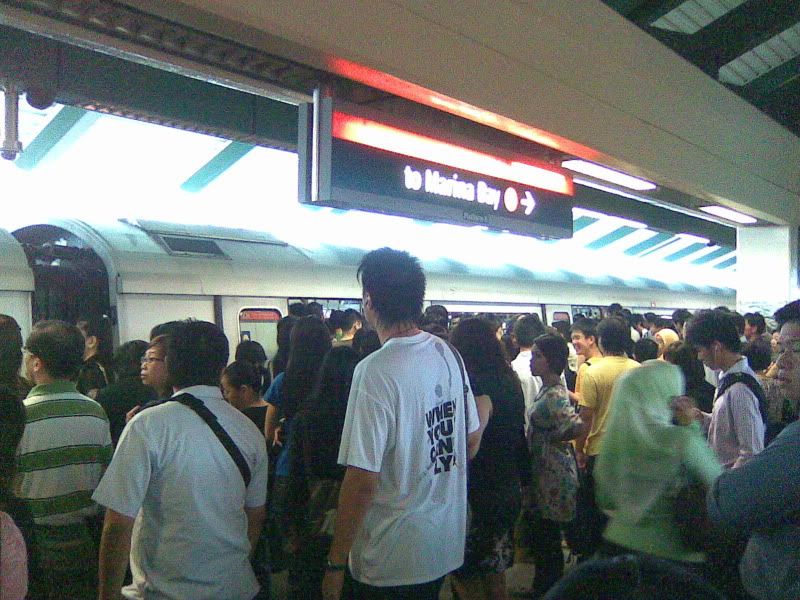
I was one of the 127,000 commuters affected by the MRT breakdown on Thursday night. I arrived at City Hall station at about 7pm, after knocking off from my work at Raffles City Tower, and found a huge crowd assembling on the station platform. After waiting for more than seven minutes to take the northbound train home, I realised that the LCD display on the platform was stuck at “Train arriving in 4 minutes”. I decided to go up to station control to find out what was going on.
A small crowd had gathered around the station master, who told us that train service from Marina Bay to Orchard (later Braddell) had stopped and it was going to be “a long, long time” before service would be restored.
I discovered later from the news that I had missed—by mere minutes—being on one of the four trains that got stuck on the northbound train. I ended up taking a big detour to Jurong East station and then north to my home in Sembawang. It took me three times longer than normal to reach home.
My experience was a mere inconvenience. But for the 4,000 passengers who were stuck for over an hour in the four packed trains with no lights, air conditioning or proper ventilation, it must have been a thoroughly traumatic experience. A photo circulating the Internet of a smashed train door window—an attempt by commuters to get some air to breathe—paints a vivid picture of how serious this train breakdown was. At least two commuters were hospitalised because of this incident.
While we only hear of train breakdowns in the news when there are massive disruptions like this, regular commuters will attest that there are many more “track faults” and slowdowns than are reported in the news.
In the 10 years that I have been taking trains daily along the North-South line to work, I have never experienced such poor quality of service as I do nowadays. Apart from massively overcrowded trains, every few days I would find myself in a stalled train in between stations, with a pre-recorded announcement repeating over and over again in the four official languages: “This train will be delayed because of a track fault. We are working on restoring the service soon. We apologise for the inconvenience caused.”
Oftentimes, the air conditioning is not working properly, and the vents are blowing out warm air onto a crowd of commuters packed like sardines. I have lost count of how many times I have written to SMRT to inform them of a broken down air conditioner.

I was one of the 127,000 commuters affected by the MRT breakdown on the night of 15 December 2011. I arrived at City Hall station at about 7pm, after knocking off from my work at Raffles City Tower, and found a huge crowd assembling on the station platform. After waiting for more than seven minutes to take the northbound train home, I decided to go up to station control to find out what was going on.

The station master told me that train service from Marina Bay to Braddell had stopped and it was going to be “a long, long time” before service would be restored. I discovered later from the news that I had missed—by mere minutes—getting on one of the four trains that got stuck on the northbound train. I ended up taking a big detour to Jurong East station and then north to my home in the north. It took me almost three times longer than normal to reach home.

My experience was a mere inconvenience. But for the 4,000 passengers who were stuck for over an hour in the four packed trains with no lights, air conditioning or proper ventilation, it must have been a thoroughly traumatic experience. At least two commuters were hospitalised because of this incident. One passenger had to break the train window just to get in some ventilation.

While we only hear of train breakdowns in the news when there are massive disruptions like this, regular commuters like myself will attest that there are many more “track faults” and slowdowns than are reported in the news.

Continue reading “MRT breakdowns debated in Parliament”

Parliamentary Questions on MRT CEO, Rochor & public sector doctors

These are the questions which I will be asking the Ministers during the Parliament sitting on 9 January 2012.

——————-

Mr Gerald Giam Yean Song: To ask the Minister for Transport (a) whether
LTA has to date  exercised its power to impose conditions relating to the
appointment, re-appointment or removal of MRT operators’ CEO, chairman
or any of its directors; and (b) what criteria does the LTA use to decide when
to impose such conditions.

1. To ask the Minister for Transport (a) whether LTA has to date exercised its power to impose conditions relating to the appointment, re-appointment or removal of MRT operators’ CEO, chairman or any of its directors; and (b) what criteria does the LTA use to decide when to impose such conditions.

2. To ask the Minister for Transport (a) whether other options were studied by the Ministry before it decided to build the North-South Expressway (NSE); (b) if so, what were the options and what were the reasons for building the NSE instead of pursuing these other options; and (c) whether the Government had considered the feasibility of adding a second level to the existing Central Expressway instead of building a new expressway.

3. To ask the Minister for National Development whether any consultation was done with residents and business owners before the decision was taken to acquire the HDB blocks, private properties and shops in the Rochor area (including Rochor Centre) to build the North-South Expressway.

4. To ask the Minister for National Development what is the compensation that the residents of the flats in the Rochor area affected by the upcoming land acquisition will receive if they choose not to relocate to the new flats in Kallang.

5. To ask the Minister for Health what is the average age of public sector doctors leaving for private practice and how this figure compares with that of ten years ago.

——————–

Source: Parliament Order Paper

WP’s statement on the Ministerial Salary Review Committee’s report

This was the statement which Workers’ Party issued regarding the the Report on Ministerial salaries.

————–

1.  The recommendations of the Committee to Review Ministerial Salaries (“the Committee”) are a step in the right direction towards grounding political leaders with a stronger sense of public service and mission. We hope that Ministers and Members of Parliament (MPs) will see political office primarily as a noble undertaking which allows them to improve the lives of fellow Singaporeans, rather than as a career option to be weighed against high-earning individuals in the private sector.

2.  The Workers’ Party (WP) is of the view that the Committee’s proposal to peg ministers’ salaries to the 1,000 top income earners has created a flawed formula. These individuals make up just 0.06%[1] of the workforce and are unrepresentative of the general population. The incomes of these “super-rich” Singaporeans generally rise much faster than the rest of the population, potentially escalating the salaries of ministers in subsequent years.

3.  The Committee’s proposed formula also assumes that political talent is found only among the top 1,000 income earners. This reflects an elitist mindset that earning power is the primary indicator of one’s ability.

4.  Rather than an approach that assumes top earners are also top talent, WP recommends a whole-of-government, people-up approach to determining ministerial salaries.

5.  WP has identified this approach in the way 12 developed economies determine their politicians’ salaries. The economies are Australia, Canada, Finland, Germany, Hong Kong, Japan, South Korea, New Zealand, Sweden, Taiwan, the United Kingdom and the United States. In most of these economies, a minister’s salary is set at multiples of that of an MP, which is in turn set at the salary of a senior management grade in the civil service. This is the approach that Singapore should take, as political office is in the genre of public service.

6.  WP proposes that MPs’ allowances should be pegged to the salaries of divisional directors in the Civil Service (excluding the Administrative Service)[2]. Civil service salaries are currently competitively benchmarked to general wage levels of Singaporeans. The salaries of ministers and the Prime Minister should be set at reasonable multiples of an MP’s allowance.

7.  WP is supportive of a variable component which takes into account both national objectives being achieved through a whole-of-government effort, as well as the individual performance of ministers. While the suggested National Bonus incorporates some indices, WP believes that the formula should reflect that some national goals are longer-term in nature, requiring an assessment over the term of a government, not annually; some bonus payments may need to be deferred. We also propose to do away with the Annual Variable Component as this is unnecessary, since there is already a National Bonus based on national economic outcomes. The sum of the total variable components should be capped at a reasonable number of months.

8.  WP further believes that the procedure for any review or change of the salary structure for political office should be transparent and subject to Parliamentary approval.

9.  WP’s MPs will elaborate and expand upon the above proposals during the 16 January 2012 debate on the motion in Parliament to adopt the Committee’s recommendations.

THE WORKERS’ PARTY
6 January 2012


[1] 1,000 divided by the total Singaporean labour force of 1,712,600 (Singaporeans in the Workforce, October 2011).

[2] This refers to the MX9 (Superscale) grade, which draws a salary of about $10,000 per month.

Lease Buyback Scheme

Recently, National Development minister Khaw Boon Wan announced that MND was reviewing the Lease Buyback Scheme to include 4-room and 5-room flats.

I’m glad to hear this. It was a proposal that the Workers’ Party had made in our 2011 Manifesto (Chapter 8: Public Housing):

“The HDB’s Lease Buyback Scheme has seen a very low take-up rate since its inception. The eligibility criteria for the Scheme should be reviewed to extend it to more households who may be in financial need. It should be extended to lessees of 4-room or larger flats so that more elderly will benefit from the scheme. In addition, HDB should provide better public education on this complex scheme so that there will be a higher take up rate among the elderly.”

Parliamentary Questions: Rental housing, MRT overcrowding and healthcare expenditure

During Question Time in Parliament on Monday (21 November 2011), I asked five questions on the issues of rental housing, MRT overcrowding, MediShield insurance premiums and claims, Medifund claims and healthcare costs vis-a-vis Singaporeans’ household expenditure. Here are the salient points from the ministers’ answers and debate.

During Question Time in Parliament on Monday (21 November 2011), I asked five questions on the issues of rental housing, MRT overcrowding, MediShield insurance premiums and claims, Medifund claims and healthcare costs vis-a-vis Singaporeans’ household expenditure. Here are the salient points from the ministers’ answers and debate.

Rental housing

I asked National Development Minister Khaw Boon Wan if his ministry would consider allowing those earning more than $1,500 a month to still rent flats from the HDB, but pay higher rental rates.

Currently HDB rules prohibit households earning more than $1,500 a month from renting from HDB, where they enjoy significant rental subsidies. The minister had said individual appeals from those earning slightly more than the threshold are allowed on a case-by-case basis. He said that the government preferred to encourage people to buy flats rather than rent. Citing statistics from recent sales of Built-to-Order (BTO), or new, HDB flats, he pointed out that new three-room flats were within the purchasing power of even households earning less than $1,500 per month, taking into account the housing grants available.

However, from my meetings with residents during meet-the-people sessions (MPS), I have encountered many who earn slightly more than $1,500 a month yet cannot afford to buy BTO flats. Some had just sold their flats, due to divorce or financial difficulty, and could not afford to pay the resale levy on the profits of their sale. Others needed housing urgently and could not wait for two to three years for the BTO flat to be built. In short, many of these residents are shut out of the BTO market and had no choice but to bunk in with friends or family in very crowded conditions. They would usually come to MPS when their friends or family members were threatening to evict them. Rental from the open market is not really an option, since they would need to pay over $800 just for a single room.

Hence my suggestion was to have a middle tier of public rental rates, somewhere in between the $200 or so that HDB currently charges and the $800 open market rental rate, for those who earn beyond the $1,500 income threshold but are not able to buy BTO flats.

The minister said his ministry will look into this suggestion and that he belongs to the “school of thought” which agrees that exceptions can be made for these families.

Continue reading “Parliamentary Questions: Rental housing, MRT overcrowding and healthcare expenditure”

MRT train crush and the solution right under our noses

Why did it take so long for SMRT to finally “look into” extending the peak period? Perhaps it’s because the “crush loads” don’t exactly hurt profits, but buying new trains and hiring more train drivers will. So it took a bit of political pressure to get things moving.

MRT crush load

At the risk of sounding like a broken old record, I’m going to point out once again that the PAP government failed in the last 10 years to adequately plan our infrastructure for the huge influx of immigrants and foreign workers that we saw between 2005 and 2010. One bugbear for many Singaporeans (mostly from the middle to lower classes, who take public transport), is the overcrowding on buses and MRT trains.

The government’s grand solution to all this was to build more MRT lines. Hence the huge investment of over $10 billion to build the Circle Line (up from a budgeted $6.7 billion) and another $1.4 billion to build the Downtown Line. While I don’t begrudge this necessary investment in a public good, the benefits from this investment are playing a game of catch up with our ever-growing population.

What we needed were interim solutions to solve the immediate problem of “crush loads” on our bus and train networks. This could not be achieved by building more lines, as they take years to complete. Hence, Singaporeans have been forced to squeeze on unbearably crowded trains with fellow commuters for the past few years while construction of the new lines was going on. We were repeatedly told by the government, “Don’t worry, relief is coming soon. We’re building more lines.”

One interim solution that could have been carried out much faster (and at much lower cost) than building new lines was to increase train frequency, within the limits of the ageing signalling system.

I had raised this proposal during my maiden speech in Parliament last month. I had said:

…if the Government is serious about encouraging our people to drive less and use more public transport, it must give priority to tackling the overcrowding problem on trains. The solution lies not only in building more lines, but making better use of the existing lines by increasing train frequency and maintaining that high frequency for longer periods, especially during peak hours.

Why can’t the MRT operators maintain a train interval of two minutes from 7am to 9am, and from 5pm to 8pm? Is it because of technical constraints, or because it will increase their costs and reduce their profits?

Continue reading “MRT train crush and the solution right under our noses”

Destruction of GE 2011 ballot papers

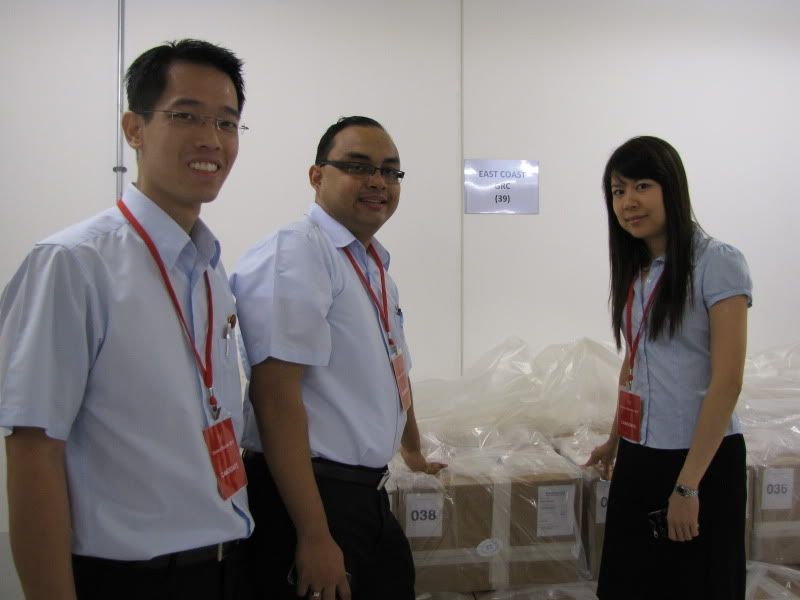
This morning, 17 Workers’ Party candidates in the General Election 2011, together with a few candidates from the PAP, NSP and SDP, witnessed the destruction of the ballot papers from the election.

This morning, 17 Workers’ Party candidates in the General Election 2011, together with a few candidates from the PAP, NSP and SDP, witnessed the destruction of the ballot papers from the election.

Under Singapore law, after an election, ballot papers must be sealed and stored in a secure vault in the Supreme Court for a period of six months, in case there are any disputes in the election results that require a recount. After the six months, they are to be destroyed so as to ensure that the votes cannot be traced back to individual voters.

Continue reading “Destruction of GE 2011 ballot papers”

Use of Medisave Funds to pay for Parents’ Healthcare Expenses

Mr Gerald Giam Yean Song asked the Minister for Health what percentage of Singaporeans currently draw from their adult children’s Medisave accounts to pay for their own healthcare expenses.

This Parliamentary Question that I asked the Health Minister on 21 October 2011 relates to a point that I brought up in my maiden speech on 18 October, concerning the healthcare burden that low income families have to bear. It is an issue of great concern to me, which I will continue to raise in future Parliament sittings.

———-

Mr Gerald Giam Yean Song asked the Minister for Health what percentage of Singaporeans currently draw from their adult children’s Medisave accounts to pay for their own healthcare expenses.
The Minister for Health (Mr Gan Kim Yong): Sir, in 2010, there were around two million working Singaporean CPF members, of which 80,000, or less than 5%, used their CPF to pay for their parents’ healthcare expenses. If we exclude older CPF members from the denominator, the proportion will be slightly higher, but it will still be around 5%. A total of $732 million was withdrawn from Medisave accounts in 2010 to pay for direct medical expenses. Of this amount withdrawn, 18% was withdrawn to pay for the parents’ treatment. Out of the total amount of Medisave withdrawn for the elderly’s healthcare expenses last year, about 45% was from their children’s Medisave accounts.
Sir, family support is an integral part of our healthcare financing framework. It is also an important second line of defence. But MOH is mindful of the burden and the responsibility borne by the younger generation in supporting the healthcare expenses of their elderly parents. The Government has from time to time provided top-ups to the Medisave accounts of the elderly. Between 2005 and 2011, nearly $1 billion was distributed to elderly Singaporeans this way. Workfare also helps older, low-income workers build up their Medisave by providing additional contributions over and above the normal CPF contribution rates. Nevertheless, I believe more can be done to help the elderly, especially those in the lower and middle-income families and we are exploring ways to help them.
Mr Gerald Giam Yean Song (Non-Constituency Member): Mr Speaker, just one supplementary question. Given that the Government has put forward this principle of self-reliance to Singaporeans, does the Minister feel that this situation, where a lot of elderly have to draw from their children’s Medisave accounts, is a departure from this principle of self-reliance, because the children will also have to build up their own Medisave accounts for the future?
Column: 20
Mr Gan Kim Yong: Mr Speaker, I thank Mr Giam for the question. In fact, self-reliance is a very important underlying principle of our healthcare financing framework. But to ensure good health for Singaporeans, everyone has a role to play. Firstly, at the individual level, each one of us must take personal responsibility for our health. If we do not adopt healthy lifestyle, if we are not careful in our diet and eat laksa everyday and so on, I think no one can help us keep ourselves healthy. So, we have to take responsibility for our own state of health, and we also have to make it our personal responsibility to save up for rainy days, in case we fall ill one day.
But beyond the individual, family also plays an important role. Mutual support in the family will provide a second line of defence and this is part and parcel of our family values. This is what our society is about and it is important for us to continue to encourage mutual support within the family. We must not weaken that value.
And beyond the family, I think society, as a whole, also plays an important role. Just about three to four days ago, on Tuesday, I attended a concert called “Rays of Hope”. The concert was organised by the National Cancer Centre of Singapore (NCCS). The concert was to raise funds for the young cancer patients. I think the society also plays a role. The doctors come together, raise funds for their patients. This is another very precious value of our society that we should try to preserve and, of course, the Government itself will also play our role. In fact, we spent about $2.2 billion a year providing subsidies for our patients.
So, I think this is part and parcel of our broader sense of self-reliance. At the individual level, we try to achieve sufficient savings for ourselves. Beyond the individual level, the family achieves self-reliance through mutual support. And beyond the family, society as a whole achieves self-reliance by helping one another. The Government, at a national level, we achieve self-reliance by providing support for those who need it most.
Mr Gerald Giam Yean Song: Mr Speaker, I still remain concerned about the financial health of these children who have to fork out money for their parents’ medical treatment. I understand this principle in our values that we have to support our parents, but for those children who are from lower income backgrounds – is there additional help that the Ministry intends to provide to them, to assist them as they assist their parents, so that they do not have to draw down on their meagre Medisave accounts to be able to help their parents.
Mr Gan Kim Yong: Mr Speaker, for the lower income, whether they are older or whether they are from the younger generation which Mr Giam was concerned about, the Ministry does help them for their medical needs. First and foremost, we want to encourage as many of them as possible to stay on MediShield, which should provide a basic insurance to cover most of the medical expenses in hospitals. We have provided up to 80% subsidy for our B2, C class wards in hospitals which generally have larger medical bills compared to outpatient.
With the Government subsidy for the B2, C class wards, generally, the patients would be able to afford the B2, C class bills without out-of-pocket expenses, only drawing from the Medisave, MediShield and so on. Up to about 70% of them would have no out-of- pocket expenses. That means that they are fully covered, in one way or the other. Secondly, among those who have out-of-pocket expenses, the remaining 30%, about one-third of them, receives help from Medifund. So, we want to make sure that all Singaporeans whether you are in the high-income or low-income groups, whether you are old or young, will be able to receive medical treatment that is appropriate for them. We also provide financial counselling at the beginning to make sure that they opt for the right class of ward so that they can afford it. But at the end of the day, I think it is important for us to emphasise individual responsibility so that we encourage them to save sufficiently for their old age for their medical needs and if they do get into trouble, we have many ways to help them.
Column: 22
Recently, I think the Prime Minister announced a series of initiatives to enhance our financial support for medical care, one of which is Primary Care Partnership Scheme (PCPS) which caters to the older and the lower-income Singaporeans to allow them to have subsidised care at the private General Practitioners (GPs). We have also enhanced the drugs subsidies at the hospitals and our polyclinics to ensure that the drugs will remain affordable to our lower income families.

Mr Gerald Giam Yean Song asked the Minister for Health what percentage of Singaporeans currently draw from their adult children’s Medisave accounts to pay for their own healthcare expenses. Continue reading “Use of Medisave Funds to pay for Parents’ Healthcare Expenses”

Building of Subsidised Rental Flats

This was another Parliamentary Question I posed to the National Development Minister on 20 October 2011 regarding the building of subsidised rental flats.

This was another Parliamentary Question I posed to the National Development Minister on 20 October 2011 regarding the building of subsidised rental flats.

—————

Mr Gerald Giam Yean Song asked the Minister or National Development (a) how many subsidised rental flats would need to be built to meet the current high demand; and (b) when does HDB plan to build these flats.
The Minister for National Development (Mr Khaw Boon Wan): Mr Speaker, Sir, as I said yesterday, currently, there are 44,000 households living in HDB rental flats. Another 1,600 applicants are on the waiting list and the average waiting time for a flat allocation is now six months.
We are building more rental flats, with a view to shortening the waiting time further through speeding up the allocation of flats to these low-income families. Our supply of rental flats will soon reach 47,000, to which we will add another 3,000 units next year. So, this should clear the outstanding demand while meeting demand from new applicants.
We plan to build another 7,000 units. This will further increase the total stock to 57,000 by 2015, amounting to 5% of all HDB households. As we build more rental flats, we must ensure that they are safeguarded for poor and needy households who cannot afford to own a home, have no family support, and do not have other housing options. It is important that HDB maintains strict rules and criteria to do so. Nonetheless, HDB will exercise flexibility to help those who do not meet the rules but worthy of consideration.
Column: 40
We must also recognise that needy and vulnerable families often face social problems that extend beyond the need for rental housing. We will also work closely with MCYS and other social agencies to help these families more holistically.
Mr Gerald Giam Yean Song (Non-Constituency Member): Mr Speaker, I would like to thank the Minister for his reply. I would just like to ask one supplementary question. Has this number that he has come up with factored in the likely higher demand due to the looming economic downturn, and in light of the Minister’s remarks yesterday that he intends to make housing for low-income families his second top priority?
Mr Khaw Boon Wan: Obviously, figures are dynamic and we have to be mindful of changing circumstances. Fortunately, for rental blocks, the construction time is relatively shorter, so we do have some lead time. I am ramping it up anyway, hence the numbers — 7,000 new units, 3,000 new units. They are higher than the normal projection of the annual demand. But I keep a very open mind because we do not quite know how the situation will shape up. Yesterday, I shared with the Member from Aljunied, Mr Low Thia Khiang, in the Members’ Room, that whatever we do, we must not unwittingly incentivise the growth of these rental blocks. We need some, but I think if you make it too easy for rental units to be accessed, you can unwittingly create other kinds of problems.
As a stretch target, if you ask me, I would prefer “zero rental units”, meaning everybody becomes a home-owner. We know that that is not possible but I think we should always bear it in mind that the correct thing to do is to prevent problems so that families do not get into a dire situation when they become homeless and need to be temporarily placed somewhere. The best is if they can organise themselves, and working with us, work towards home-ownership. That I think should always be our target.
Mr Yaw Shin Leong: Mr Speaker, I thank the Minister for the clarification. Just a supplementary question: it was reported that HDB will review its public housing model. So will HDB be considering abolishing its commercial partnership with Keppel Land to commercially rent out public flats managed by EM Services?
Mr Khaw Boon Wan: Sir, I think the Member was referring to another scheme which is a pilot scheme called Interim Rental Housing (IRH). Let us back-track a little. 92% of Singaporeans own their own homes. This leads us to ask, “What has happens to the other 8%?”
Sir, 8% of Singaporeans are living in a rented place. The bulk of them in subsidised HDB rental flats, which is the 44,000 that I spoke about – which will become 57,000. The rest are in various kinds of arrangements, most of them private market arrangements. They rent a room, or they rent a place from landlords. They are not subsidised. Then, there is a small category which makes up a very tiny percentage of the total rental market. MND started this scheme two to three years ago as an interim programme. They were not sure how the project will shape up, so they asked EM Services — which happened to be the joint-venture which the Member spoke about — to test it out. They worked on a cross-subsidy model. Some of the units are rented out at market rates, some are at subsidised rates. The profit made from the market rates are used to subsidise the other portions.
Column: 42
I am reviewing the policy but because those are contractual arrangements that have been made to the company, I will see through the contractual arrangements. My own thinking is eventually we will take over all the rental units and leave the rest to the market.

Mr Gerald Giam Yean Song asked the Minister or National Development (a) how many subsidised rental flats would need to be built to meet the current high demand; and (b) when does HDB plan to build these flats.

The Minister for National Development (Mr Khaw Boon Wan): Mr Speaker, Sir, as I said yesterday, currently, there are 44,000 households living in HDB rental flats. Another 1,600 applicants are on the waiting list and the average waiting time for a flat allocation is now six months.

Continue reading “Building of Subsidised Rental Flats”

Application rates for Build-To-Order and Sale of Balance flats

This was a Parliamentary Question (PQ) I asked the National Development Minister in Parliament on 20 October 2011, regarding the lower application rates for smaller HDB flats, and the supplementary question I posed following the Minister’s answer.

This was a Parliamentary Question (PQ) I asked the National Development Minister in Parliament on 20 October 2011, and my supplementary question following the Minister’s answer.

——————–

10 Mr Gerald Giam Yean Song asked the Minister for National Development what are the reasons for the lower application rates for smaller (2-room and 3-room) Built-to-Order (BTO) flats and Sale of Balance Flats (SBF) as compared to larger (4-room and 5-room) flats in recent HDB flat sales exercises.
Mr Khaw Boon Wan: Sir, in last month’s launch of Build-to-Order (BTO) flats, the application rates for 3-room, 4-room and 5-room flats were 1.8, 1.6 and 2.4 times respectively. No 2-room BTO flats were offered. For the Sale of Balance (SBF) flats, the application rates for 2-room, 3-room, 4-room and 5-room flats were 0.9, 8.2, 11.9 and 11.1 times respectively. As the Member has correctly observed, the larger flat types tend to attract higher application rates.
Column: 46
HDB provides a range of flats to cater to Singaporeans with different budgets and life-cycle needs. In planning the supply of the various flat types, HDB takes into account changing demographic profiles, as well as housing needs and propensities. The bulk of the new flats supplied are larger flats to meet first-timer households’ needs for space, to cater to their growing family size. At the same time, we also need to provide a good number of smaller flats to help lower-income households become homeowners and second-timers right-size. The smaller flats will also be needed for our ageing population, allowing more seniors the option to move into smaller flats. Although the application rates differ at the time of launch, all the flats eventually get taken up, as they are completed.
Mr Gerald Giam Yean Song: Mr Speaker, I have three supplementary questions. First, there has to be a reason why there is a lower application rate at that time that flats were launched. Is it because firstly, the poor are not able to navigate the application process, which involves a lot of online submissions and receiving alerts when the launches are eminent? Or secondly, is it because the price of these smaller flats is still out of the income range of these applicants? And thirdly, if the answer to the second question is “yes”, would the Minister consider lowering the price of 3-room and smaller flats in order to make them more affordable to the lower income?
Mr Speaker: Minister, you have one minute and thirty seconds for your reply.
Mr Khaw Boon Wan: Let me try, starting from the last. Making 3-room flats more affordable compared to larger flats – the answer is “yes”. In fact that is so. Yesterday, I gave Members some illustrations about the affordability of 3-room, 4-room and 5-room flats. Generally, the BTO prices less the housing grants equal to about five years of annual salary. But for 2-roomers, it is less than three years of annual income, after all the grants. Members can see there is a clear difference between the pricing of smaller flats compared to bigger flats. As to the Member’s first question about the lower application rates and what could be the reasons: well, the application rate is a function of several factors such as how many units are put onto the market, how many people apply. And you cannot get it precisely matched. It is very hard to do it, such that you get an exactly identical application rate for all the different room types. I think that would be quite impossible. Even if you are able to project to such precision, that also cannot be the way we do things because when we design the housing estate – let us say in existing Tampines — we have to know what is the current housing distribution in Tampines and take that into account. But as I said, regardless of the different application rates, at the end of the day, no units get wasted. They will all be taken up finally. As to whether a lack of IT skills was a deterrent for the lower income applicants, it should not be. At HDB Hub in Toa Payoh, we have staff there to assist, if needed.
3.00 pm
Mr Speaker: Order. End of Question Time.
Mr Gerald Giam Yean Song asked the Minister for National Development what are the reasons for the lower application rates for smaller (2-room and 3-room) Built-to-Order (BTO) flats and Sale of Balance Flats (SBF) as compared to larger (4-room and 5-room) flats in recent HDB flat sales exercises.

Mr Khaw Boon Wan: Sir, in last month’s launch of Build-to-Order (BTO) flats, the application rates for 3-room, 4-room and 5-room flats were 1.8, 1.6 and 2.4 times respectively. No 2-room BTO flats were offered. For the Sale of Balance (SBF) flats, the application rates for 2-room, 3-room, 4-room and 5-room flats were 0.9, 8.2, 11.9 and 11.1 times respectively. As the Member has correctly observed, the larger flat types tend to attract higher application rates.

HDB provides a range of flats to cater to Singaporeans with different budgets and life-cycle needs. In planning the supply of the various flat types, HDB takes into account changing demographic profiles, as well as housing needs and propensities. The bulk of the new flats supplied are larger flats to meet first-timer households’ needs for space, to cater to their growing family size. At the same time, we also need to provide a good number of smaller flats to help lower-income households become homeowners and second-timers right-size. The smaller flats will also be needed for our ageing population, allowing more seniors the option to move into smaller flats. Although the application rates differ at the time of launch, all the flats eventually get taken up, as they are completed.

Mr Gerald Giam Yean Song: Mr Speaker, I have three supplementary questions. First, there has to be a reason why there is a lower application rate at that time that flats were launched. Is it because firstly, the poor are not able to navigate the application process, which involves a lot of online submissions and receiving alerts when the launches are eminent? Or secondly, is it because the price of these smaller flats is still out of the income range of these applicants? And thirdly, if the answer to the second question is “yes”, would the Minister consider lowering the price of 3-room and smaller flats in order to make them more affordable to the lower income?

Mr Speaker: Minister, you have one minute and thirty seconds for your reply.

Mr Khaw Boon Wan: Let me try, starting from the last. Making 3-room flats more affordable compared to larger flats – the answer is “yes”. In fact that is so. Yesterday, I gave Members some illustrations about the affordability of 3-room, 4-room and 5-room flats. Generally, the BTO prices less the housing grants equal to about five years of annual salary. But for 2-roomers, it is less than three years of annual income, after all the grants. Members can see there is a clear difference between the pricing of smaller flats compared to bigger flats. As to the Member’s first question about the lower application rates and what could be the reasons: well, the application rate is a function of several factors such as how many units are put onto the market, how many people apply. And you cannot get it precisely matched. It is very hard to do it, such that you get an exactly identical application rate for all the different room types. I think that would be quite impossible. Even if you are able to project to such precision, that also cannot be the way we do things because when we design the housing estate – let us say in existing Tampines — we have to know what is the current housing distribution in Tampines and take that into account. But as I said, regardless of the different application rates, at the end of the day, no units get wasted. They will all be taken up finally. As to whether a lack of IT skills was a deterrent for the lower income applicants, it should not be. At HDB Hub in Toa Payoh, we have staff there to assist, if needed.

Mr Speaker: Order. End of Question Time.