The following is the text of my maiden speech in Parliament today.
——
Mr Speaker, thank you for giving me the opportunity to make this, my maiden speech to this House.
In his address to Parliament, the President gave a broad outline of this Government’s goals for the next five years. The Government says it wants “every Singaporean worker to hold a skilled, well-paid job; every family to live in an affordable, comfortable home; every young person to develop himself fully and pursue his dreams; every senior citizen to stay active and to live with dignity”.
These are bold goals which my colleagues and I in the Workers’ Party will hold the Government accountable for over the next five years.
Sir, today I would like to focus on three areas that many senior citizens, families and workers have pressing concerns about. They are healthcare, public housing and public transport.
Healthcare financing
Mr Speaker, the axiom, “it’s better to die than fall ill in Singapore” has been heard time and again—twice during this debate alone.
Many Singaporeans, especially the elderly poor, worry greatly about falling ill. They are concerned not just about the painful treatment they will have to go through, but more often about the high costs involved, and the financial burden they may place on their struggling children.
In Singapore, government subsidies make up only a quarter of total health expenditure . Out-of-pocket expenses, employer benefits and private insurance make up most the remainder.
The much vaunted “3Ms” of Medisave, MediShield and Medifund pay for less than 10% of total healthcare expenses , the lion’s share of which comes from Medisave, which is really patients’ own savings. MediShield is a self-funding insurance scheme, which members pay premiums to join. These premiums rise as they grow older. They also have to fork out large deductibles and co-insurance before receiving pay-outs, and coverage ends at age 85.
The Government will say that we have Medifund. But Medifund is subject to extremely stringent means testing and the disbursements are not exactly generous. In 2009, an average of $1,029 was given to less than 24,000 in-patient Medifund applicants . This represented just 5% of the total hospital admissions that year.
For seniors with no income and little savings, the burden of healthcare is shifted to their children. In 2005, 60% of the elderly had their medical bills paid from their adult children’s Medisave accounts . This is a very high percentage, and is in fact a departure from the principle of “self-reliance”. If these patients’ children are also low-income earners—as is often the case—the Government is merely shifting the burden of poverty within the pool of the poor . Basically we are asking one disadvantaged group to pay for another.
The Government seems very reluctant it to take on a larger financial responsibility for caring for our senior citizens. Instead, it hides behind the mantras of self-reliance and filial piety to justify its relatively low expenditure on healthcare for the elderly.
Self-reliance is good in principle, but when a patient has exhausted his own savings and has to rely on his own struggling family members, then we as a society are not being fair to both the patient and his family.
The Ministry of Health claims to provide universal health coverage to citizens , but I believe we are still some way from that. The World Health Organization defines universal health coverage as having a healthcare financing system that provides all people with access to adequate healthcare services without suffering financial hardship paying for them.
If we are to achieve this goal, we need to expand the coverage of MediShield and reduce the over-reliance on direct payments by patients at the time they need the care . To fund this, we need to strengthen the current forms of prepayment and risk-pooling, and provide assistance to those who cannot afford the premiums, like housewives and the elderly. All this points to a need to perform some major surgery on MediShield.
Hospital capacity
Mr Speaker, for some time now, our public hospitals have been running at near full capacity, with bed occupancy rates often exceeding 90% for Tan Tock Seng Hospital and over 85% for National University Hospital. Khoo Teck Puat Hospital, which opened just last year, was supposed to ease the crunch. But it too has been running at almost 85% capacity for the past month. The Royal College of Surgeons in the U.K. has advised that bed occupancy rates above 82% put patients at an increased risk of infection .
It was reported in the Straits Times on 30th August this year that hospitals in Singapore are facing such a severe crunch in beds that some are “borrowing” space from other nearby organisations to house their patients.
How did we get into such a situation?
Between the year 2000 and 2010, our population has seen an increase of 26%, mostly through immigration. The number of hospital admissions has seen an increase of 15% in this same period. However, not only have the number of hospital beds not kept pace with population growth, but they have actually decreased during this period. In the past decade, there has been a 7% drop in the number public sector hospital beds, according to the Department of Statistics
Two years ago, the then-Health Minister admitted, that on hindsight, his ministry made a mistake by not building a new hospital two years earlier. Recently, the Health Minister floated the idea of bringing forward the opening of Sengkang Hospital, currently scheduled for 2020. I support this move, but this is still a long time to wait, and by that time, our population would have increased even more.
What is left unanswered is why this self-proclaimed “far-sighted” Government failed in the past 10 years to build our healthcare infrastructure to keep pace with population growth and an ageing population. Was the Government instead overly fixated on the near-sighted goals of boosting economic growth by increasing our population?
Housing shortage and prices
Mr Speaker, I would now like to address many Singaporeans’ concerns about the public housing situation in Singapore.
In the past 10 years, the HDB has grossly undersupplied new housing units to the market. According to figures from the HDB, between 2001 and 2009, an average of just 7,700 new flats were built each year . This was far short of the average annual resident household growth figure of 24,280 since 2005.
Even when the population surged from 2007 onwards because of the liberalisation of our immigration policies, the Government failed to react by building more flats for our people. Instead, they permitted more cash rich foreigners to purchase almost any types of private property, which increased their prices, and pulled up HDB flat prices, since the two are linked.
This combination of low supply and high demand resulted in a severe housing shortage, causing a sharp and sustained rise in property prices. HDB resale flat prices are now 92% higher than they were 10 years ago .
This has not only caused much distress for many Singaporean families, but has also created a potential asset bubble which could severely damage Singapore’s economy in a downturn.
The Government finally awoke from its slumber this year and ramped up the supply of Built-to-Order (BTO) flats to an expected 25,000 this year and another 25,000 next year. This is a move in the right direction. However, BTO flats do not solve the immediate housing problem, because it takes two or three years before the new flat owners get their keys. In the meantime, many are still without a home of their own.
Despite the bumper launches of BTO and Sale of Balance Flats (SBF) this year, we still saw the third-quarter HDB Resale Price Index shoot up 3.8% over the previous quarter. The cooling measures that the Ministry of National Development put in place earlier this year do not seem to be having their intended effects on the resale flat market.
The Government has gone some way in reducing the housing problems for first-timer couples, but not for singles, divorcees and those who need to downgrade to smaller flats because of financial difficulty. We need to find a way to help these people who are caught in between the policies. In particular, more measures need to be put in place to cool down the resale HDB flat market.
The HDB market, whether direct or resale, cannot simply be left to market forces. As a provider of this public good, the Government must step in to ensure that the welfare of its citizens comes first.
Public transport
Mr Speaker, please allow me to share some longstanding concerns about public transport in Singapore.
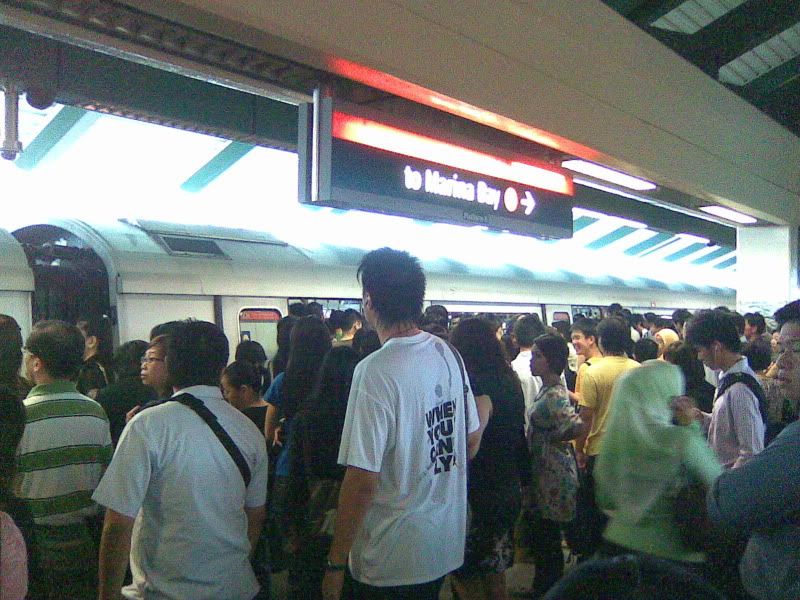
In March this year, just before the General Election was announced, SMRT and SBS Transit said they would add 590 additional MRT train trips. This was expected to ease the squeeze on trains. However, many regular commuters will testify that trains now seem even more crowded than ever. The recently opened Circle Line may improve the situation nearer the city, but for those commuting from the suburbs like Sembawang or Simei, finding room to board the trains will still be a challenge.
One key factor that affects the train loads is the waiting time. I understand that the current signalling systems on the ageing North-South and East-West lines allow for maximum train arrival intervals of about two minutes without compromising commuter safety.
If trains really arrived once every two minutes, the overcrowding problem would not be so severe. Unfortunately, this is seldom the case. Outside of the narrow window of about half an hour on weekday mornings and evenings, the frequency drops to three to five minutes, or more. This results in trains arriving packed with passengers, making it impossible for many of those on the platform to board. As a daily commuter myself, I often have to wait for two—sometimes three—trains to pass by before I can board, during morning and evening rush hours.
Sir, if the Government is serious about encouraging our people to drive less and use more public transport, it must give priority to tackling the overcrowding problem on trains. The solution lies not only in building more lines, but making better use of the existing lines by increasing train frequency and maintaining that high frequency for longer periods, especially during peak hours.
Why can’t the MRT operators maintain a train interval of two minutes from 7am to 9am, and from 5pm to 8pm? Is it because of technical constraints, or because it will increase their costs and reduce their profits?
Under the current profit-maximising model, operators are incentivised to cut costs and service levels, just to maintain their high margins. Their duopoly position in the local market reinforces this behaviour.
It is time for the Government to demand that these operators provide a higher level of service to commuters, even if it reduces their profit margins.
Summary
Mr Speaker, whether in healthcare, public housing or public transport, the Government has gone too far down the road of pursuing free market efficiency, often to the detriment of the elderly and low wage workers.
At a time when our citizens are exposed to heightened risks in the form of global competition, increased economic volatility, rising inequality and wage stagnation, the Government is exposing them to even more competition from foreigners. Our workers are told to be “cheaper, better, faster”, more self-reliant and less selective about their jobs.
This regressive transfer of risks from government to citizens must count as one of the PAP Government’s biggest policy failures in the last decade.
The demographic, social and economic changes of the 21st century demand a rethink of how much a government should provide for its people, and how much we can reasonably ask our citizens to provide for themselves.
Mr Speaker, we are at the dawn of a new era in the history of our nation. The phrase “new normal” has often been used to describe this new political reality. Now with more Workers’ Party members in the House, some pundits wonder if we will be a constructive, or destructive party in Parliament; will we help build our country, or be obsessed with tearing down our political opponents? This is related to some of Mr Lee Yi Shyan’s concerns earlier. I believe our party’s track record in Parliament answers these questions.
Having more Workers’ Party MPs does not change our rational and responsible approach to politics. We want to be a force for good in our country—to help to uncover solutions, not add to the problems.
However, it takes two hands to clap. The responsibility for ensuring fair and constructive debates, in and out this House, rests not only on the Opposition, but also on the Government. I hope that debates in this House will not just be about winning the argument or scoring political points, but leveraging on the arguments, and counter-arguments, to elicit better policy outcomes.
This will ultimately benefit Singaporeans, who put us here to serve them.
Thank you, Mr Speaker.
 Mr Speaker, thank you for giving me the opportunity to make this, my maiden speech to this House.
In his address to Parliament, the President gave a broad outline of this Government’s goals for the next five years. The Government says it wants “every Singaporean worker to hold a skilled, well-paid job; every family to live in an affordable, comfortable home; every young person to develop himself fully and pursue his dreams; every senior citizen to stay active and to live with dignity”.
These are bold goals which my colleagues and I in the Workers’ Party will hold the Government accountable for over the next five years.
Sir, today I would like to focus on three areas that many senior citizens, families and workers have pressing concerns about. They are healthcare, public housing and public transport.
Continue reading “Maiden speech in Parliament”
 After I delivered my