Singapore’s Covid-19 Response

COVID-19 was the crisis of a generation. Our front liners, including nurses, doctors, cleaners and drivers, responded heroically in the face of an enemy that we knew little about before 2020. Words cannot repay the debt of gratitude we owe each one of them.

COVID-19 also took the lives of over 1,700 people in Singapore. I extend my deepest condolences to their families for their immeasurable loss.

While I acknowledge that the Government has performed well in many aspects of its response to this pandemic, it is important that we do not get carried away patting ourselves on the back to the exclusion of implementing the important lessons learned during this crisis. We need to better prepare ourselves for future pandemics, which are likely to be more frequent and severe, not least because of increasing globalisation and urbanisation.

Healthcare capacity

Healthcare capacity was stretched even before COVID-19 hit. The pandemic exacerbated this capacity crunch. Many healthcare workers reported working long hours overtime, being recalled for duty on their days off and even having no time for toilet breaks. The White Paper highlighted challenges in staffing hospitals with healthcare workers, resulting in existing workers feeling fatigued and burnt-out from the prolonged crisis. 

We are now no longer fighting COVID-19 like before, yet the shortage of healthcare facilities and manpower still persists. For example, median waiting times for emergency cases that require hospital admission from January to September last year was about seven hours. This can spike to 50 hours during infection waves.

In October 2016, then-Minister for Health Gan Kim Yong launched the Healthcare Manpower Plan 2020, which highlighted the need for 30,000 more healthcare workers from 2015 to 2020 to look after Singapore’s fast-ageing population. It is now 2023. How many of these 30,000 additional healthcare positions have been filled? During the debate on the Healther SG motion last October, Minister Ong Ye Kung said that another 24,000 nurses, allied health professionals and support care staff are needed to operate hospitals, clinics and eldercare centres by 2030.

Recruitment alone is not sufficient. There needs to be a corresponding transformation in the remuneration of healthcare workers. The group that bore the heaviest burden of caring for COVID-19 patients were nurses. Their long working hours and lower starting pay compared to territories like Australia, Hong Kong and Canada, could have contributed to their high attrition in recent years. In 2021, the proportion of nurses resigning hit a five-year high, with 7.4% of local nurses and 14.8% of foreign nurses leaving their jobs.

Why are so many nurses leaving the healthcare sector? A study on healthcare workers conducted by researchers Celene Ting and others from the Saw Swee Hock School for Public Health, Tan Tock Seng Hospital and the NCID highlighted that healthcare workers reported burn-out from being overworked, emotional exhaustion and at times feeling a lack of appreciation or support at work. 

This was exacerbated by having to care for difficult and sometimes abusive patients. Nearly a third of healthcare workers witness or experience abuse each week, according to a tripartite workgroup’s findings, which SPS (Health) Rahayu Mazam shared earlier this month during the Committee of Supply debate.

Additionally, some healthcare workers are also drawn to work opportunities overseas, where they can receive higher remuneration and more societal recognition. For example, a nurse that CNA interviewed mentioned that after moving from Singapore to the United States, he felt more highly esteemed by the public, citing an example of how his car loan was approved immediately after he said he was a nurse, despite having no credit history.

Urgent changes are needed if we are to reverse the departure of nurses and boost their numbers in Singapore. 

Nurses’ basic pay should be benchmarked to that of their contemporaries in other essential public services, a point made by Associate Professor Jeremy Lim from the Saw Swee Hock School of Public Health during a recent CNA interview. Such services could include the police, army and the education service. The salaries of nurses in other jurisdictions like Australia, Hong Kong and Canada should also be considered in the benchmarking.

It should take into account the longer hours that nurses have to work compared to many other professions. This is to ensure that the opportunity cost of taking up nursing instead of another profession would be minimised. We also need to make the nursing profession more highly esteemed by the general public.

Another way to attract more Singaporeans to take up nursing and increase retention would be to enhance their professional development opportunities. Nurses in Singapore are often still seen as the assistants to doctors instead of being professionals in their own right. They should instead be granted more autonomy and entrusted with higher level responsibilities. In the United Kingdom, nurses run clinics, diagnose patients, take on high-level management roles and help to lead medical research. We should accelerate efforts to achieve the target of 700 Advance Practice Nurses by 2030.

Beyond pay, management culture, work recognition and working hours are also areas that need to be examined for a holistic improvement of the profession.

Including PwDs in pandemic response measures

During the pandemic, many people with disabilities (PwDs) experienced difficulties coping with measures such as the blocking off of regular entrances and exits, shifting access points for PwDs, and having to locate and scan SafeEntry codes. Many wheelchair users and people with developmental disabilities, visual impairments and autism spectrum disorder had difficulties with SafeEntry scanning. Measures such as COVID-19 swabbing and mask-wearing were difficult for some people with mental disabilities. I recall a resident of mine who was very worried that her son, who had a mental disability, would struggle and hurt himself when made to undergo mandatory swabbing at his block when an outbreak occurred there.

While support for PwDs was eventually introduced, much of this was reactive. This could be due to an absence of meaningful participation by PwDs when safe management measures were implemented. 

Moving forward, it would be advisable to have at least one member of the disability community on emergency task forces so that the community’s views can be adequately represented. More importantly, all policies rolled out need to take into account the unique needs of PwDs, to ensure that they are not excluded.

Honest communication with Singaporeans

The next section of my speech deals with the public communication on pandemic mitigation measures.

In January 2020, the Government issued an infographic titled “Advisory on wearing masks” which highlighted that “masks are generally not needed for people who are well.” 

The infographic, which was also posted on social media, added that “there are sufficient masks in the warehouses and government stockpiles.”

The then-chairman of the PAP’s Government Parliamentary Committee for Health, Dr Chia Shi-Lu, echoed the Government’s line later that month when he told the New Paper that “surgical masks can prevent the passing of virus from a wearer, but when it comes to protecting (a healthy wearer), the masks won’t protect from viruses.”

The Prime Minister, in January 2020, said Singaporeans should follow doctors’ advice on how best to protect themselves from the virus, which includes not wearing a mask unless they are unwell. 

The PM rightly pointed out though, that the “Wuhan virus” — as it was then called — was “probably more infectious than SARS, and possibly infectious even before people have symptoms.” This was on 31 January 2020.

The fact that the Government knew in those early days that asymptomatic transmission of the virus could occur should have prompted them to advise everyone to wear masks when in contact with other people. 

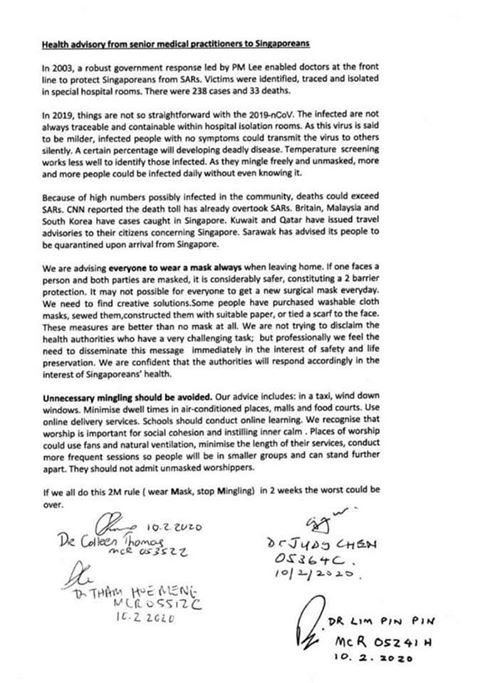
On 10 February 2020, four local doctors did just that by issuing a statement urging Singaporeans to wear masks always when leaving home, even if they were well. Dr Colleen Thomas, Dr Judy Chen, Dr Tham Hoe Meng and Dr Lim Pin Pin acknowledged the difficulties in obtaining new surgical masks every day, and urged the use of creative solutions like washable cloth masks or scarves. They pointed out that these measures were better than no mask at all. 

In response to the four doctors a few days later, the Director of Medical Services at MOH said that “it is not wearing masks that’s most important, it’s hand washing” — even though the two actions were not a binary choice. The Straits Times ran an article to “educate” the public on questions like, “Is it really true that you do not need to wear a mask if you are not sick? Is hand washing better protection against viruses than a mask?”

These statements were incongruous and did not seem to be consistent with common sense. People intuitively knew that any layer preventing the spread of droplets would be better than not having one.

It took a leaked recording of a Minister at a closed-door meeting in February 2020 to reveal that Singapore was rationing masks to save them for healthcare workers.

The White Paper stated that “in hindsight…the government could have encouraged Singaporeans to devise their own face masks while we set up manufacturing lines to ramp up production of surgical masks.” This was not hindsight — it was what the four doctors advised in the first place, which the Government did not heed. 

It took another three months for the Government to stop discouraging people from wearing masks by “updating the guidance” on 3 April 2020. The result of the about turn, as acknowledged in the White Paper, was that public trust in the Government was eroded. Singaporeans saw through the Government’s initial statements about the real reason why they were discouraging those who were well from wearing masks — it was because there were insufficient supplies of surgical masks, not because mask wearing was less effective than hand-washing. 

While concerns over panic buying and hoarding by the public were not unfounded, the Government had stockpiles of surgical masks for healthcare workers and should have had the power to requisition more masks from the commercial market.

Domestic manufacturing capacity during crises

This brings me to my next point: Why did Singapore not have sufficient domestic capacity to manufacture items as basic as face masks? Was the Government not able to marshal local companies to accept and prioritise contracts for the manufacture of materials deemed essential for our defence against COVID-19, including face masks and ventilators? 

The White Paper mentioned that the COVID-19 (Temporary Measures) Act gave the government the option of mobilising civilian resources using the Requisition of Resources Act (RORA), but chose not to use those powers. Instead, the government said it will leverage alternative structures — for example, through strategic partnerships or cooperation agreements — to effectively harness civilian resources for crises. I agree that it would not have been appropriate to use RORA for the COVID-19 pandemic, given that the Act is a rather blunt tool which is meant more for wartime scenarios than a public health crisis.

In any case, RORA does not appear to give the government the authority to ask the private sector to prioritise orders from the government, short of requisitioning the entire line of services. For example, it is not clear if the government can ask a company to prioritise orders from the government for the manufacturing of masks, without requisitioning and running the entire mask production facility on its own.

Will the Government consider legislation akin to the US Defense Production Act, which empowers the executive to direct private companies to prioritise orders from the federal government and take actions to restrict the hoarding of needed supplies? 

The role of Temasek

I now turn to the role during the pandemic played by one major local company — Temasek Holdings. 

Temasek-linked companies played an outsize role during the pandemic. Almost all the private sector partners named in the White Paper are Temasek-linked companies. The White Paper stated that private sector partners like Temasek were “indispensable” sources of support during COVID-19. This may point to an over-dependence on the Temasek ecosystem. Would it be better to diversify the base of private sector partners that can support the national effort in times of crisis?

During Question Time on March 3rd, I asked SMS (Finance) Chee Hong Tat if the Government’s total COVID-19 spending of $72.3 billion included the amount spent by Temasek Holdings, Temasek Foundation and other Temasek-linked companies for their COVID-19 activities. The SMS gave a rather convoluted answer but I believe the answer was “No”. 

This being the case, can I ask: How much did Temasek and its related organisations spend out of their own budgets on COVID-19 initiatives like face masks, hand sanitiser and oxygen concentrators which were made available locally and overseas?

The White Paper stated that “While Temasek’s main goal remains to deliver long-term returns on its assets, it plays a unique role in supporting a robust portfolio of local companies that can anchor important capabilities for Singapore in a crisis.”

Does Temasek have goals other than to deliver long-term returns on its assets? Is this “unique role” part of the Government’s mandate for this Fifth Schedule company? 

I appreciate the work that Temasek companies and their employees did to keep Singaporeans safe during the pandemic, and the resources they spent doing so. But I think it is important for the House to know if Temasek’s expenditure on COVID-19 constitutes a draw on our reserves and, if so, whether the approval of the President was sought and obtained?

Conclusion

Sir, it is a truism that those who do not learn history are doomed to repeat it. Notwithstanding the absence of a Committee of Inquiry, which the Workers’ Party had called for, we still have many lessons to learn from in the White Paper and this debate.

For the sake of our future generations who may have to go through catastrophic pandemics like these, we have to both learn and implement these lessons. 

In this spirit, Sir, I support the motion.

____________

Speech in Parliament during the debate on Singapore’s COVID-19 Response on 20 March 2023.

Parliamentary Elections (Amendment) Bill

Accommodations for PwDs

The Parliamentary Elections (Amendment) Bill takes steps to make elections more accessible for people with disabilities (PwDs) through the introduction of polling stations and mobile polling teams in nursing homes. In my speech today, I would like to make a proposal that could help PwDs more fully participate in the election process.

Article 29(a)(iii) of the United Nations’ Convention on the Rights of Persons with Disabilities (UNCRPD), which Singapore has ratified, calls for political participation by disabled people by “Guaranteeing the free expression of the will of persons with disabilities as electors and to this end, where necessary, at their request, allowing assistance in voting by a person of their own choice.”

However, the Government has placed a reservation on Article 29(a)(iii), stating that to keep voting secret and to safeguard the integrity of voting, PwDs can only be assisted by an election official. According to the Government, the election official is obliged to mark the ballot paper in the manner directed by the voter and is under oath to keep the vote secret. 

Has the Government considered the possibility that some PwDs would prefer to have someone they know and trust to help them to vote? This is a concern also expressed by the Disabled People’s Association (DPA). Other countries such as Canada and Germany allow friends and family to assist a PwD with voting. In Canada, the provision is made under Section 243.01 of the Canada Elections Act, which allows for either a friend or a relative to accompany a voter who “requires assistance to vote.” 

In Germany, this is provided under Section 14 of the Federal Elections Act, which states that: “Persons eligible to vote who are illiterate or prevented by a disability from casting their vote may avail themselves of another person’s assistance for that purpose.”

If the concern is that the person assisting the PwD will not keep the vote secret, they can be required to take an oath of secrecy, just like all the candidates’ polling agents and counting agents currently do.

Incorporating this measure will better ensure that PwDs can exercise their right to vote in a smooth and comfortable manner, while upholding the secrecy of their vote and election integrity.

Electronic voting and counting of votes

The Bill allows for votes to be counted by electronic means. This adds to previous amendments to the Act where electronic voting was permitted.

When votes are counted by manual or mechanical means, counting agents appointed by the candidates and the candidates themselves are able to personally witness the counting of all the votes. They can physically ensure there is no mis-count of votes for each candidate.

The existing Act sets out the details on the inspection and testing of electronic voting machines in the presence of the candidates, their election agents or polling agents before and during elections. However, the Bill before us today does not appear to mention the inspection and testing of the electronic counting machines or system.

Can the Minister clarify how the candidates and their counting agents will be able to audit the votes counted by electronic means?

Allowable activities after Parliament is dissolved

Finally, I would like to seek more clarity from the Minister about what kind of election activities are allowed in the period from the day the Writ of Election is issued to Nomination Day. The rest of the questions in this speech relate to this period.

Parliament is dissolved when the Writ of Election is issued. When this happens, every Member of Parliament ceases to be an MP according to Article 46(1) of the Constitution of the Republic of Singapore and their allowances cease to be paid.

After Parliament is dissolved, are the former MPs allowed to hold Meet-the-People sessions (MPS) in their constituencies, interact with residents and provide assistance to them? Can they write appeal letters to government agencies or other organisations on behalf of their constituents, and if they do, are agencies obliged to respond to them?

It should be noted that many residents will not be aware that MPs stand down after Parliament is dissolved and will continue contacting their MPs for assistance, sometimes on urgent personal matters or municipal matters that have safety implications.

Next, do grassroot adviser (GRA) appointments cease when the Writ is issued? If not, can GRAs continue operating as per normal after the Writ is issued, including writing appeal letters to government agencies on behalf of residents? 

Given that the People’s Association almost always appoints individuals who are PAP members as GRAs, would allowing GRAs to operate as per normal during this period circumvent the restrictions that are otherwise placed on election candidates, and create an unlevel playing field for the opposition?

Is “campaigning” allowed from the day the Writ is issued to Nomination Day? Are potential candidates allowed to conduct house-to-house visits or visit markets and coffee shops, to either check on residents’ well-being or explicitly canvass for votes, while wearing their party uniforms and badges?

Just before previous elections, some incumbent MPs and potential candidates conducted some of these activities. For example, a Yahoo News article entitled “GE2020: Josephine Teo to leave Bishan-Toa Payoh GRC to contest in Jalan Besar” reported that Mrs Teo was “seen during a People’s Action Party (PAP) walkabout at Beo Crescent on Monday morning (29 June), together with Jalan Besar incumbent Members of Parliament (MPs) Denise Phua and Heng Chee How, as well as new candidate Wan Rizal Wan Zakariah. They were introduced to the residents as candidates contesting the GRC.”

That year, Parliament was dissolved on 23 June and Nomination Day was 30 June. This constituency walkabout took place within this period.

In another article in the Straits Times, it was reported that then-National Development Minister Lawrence Wong announced the PAP’s slate in Marsiling-Yew Tee GRC at a walkabout in the Marsiling ward of the GRC on 28 June — again within this period. There was even a video of the team, consisting of Mr Wong, Mr Zaqy Mohamad, Mr Alex Yam and Ms Hany Soh, together with Mr Ong Teng Koon, the former MP of the ward, at a coffee shop wearing their PAP all-white uniforms. At least two members of the group were wearing a PAP badge.

In the Candidate Handbook for General Election 2020 published by the Elections Department, under section 2.4 titled “Activities from Writ of Election to Nomination Day”, it stated that “After the Writ of Election is issued and before the campaign period starts, activities such as walkabouts, house-to-house visits, distributing election pamphlets, handouts and newsletters, and publishing of party manifestos and candidates’ biographical details will be subject to the applicable election advertising requirements.”

This implies that such activities are allowed subject to advertising requirements.

The next paragraph in that same section states more explicitly that “Political parties and candidates may conduct campaigning activities such as walkabouts, house-to-house visits and the distribution of collaterals.”

Based on section 2.4 of the Candidate Handbook, it appears that some types of campaigning, including walkabouts, house-to-house visits and distribution of collaterals from the day the Writ of Election is issued to Nomination Day are allowed. However, the same language is not reflected in the Parliamentary Elections Act. Can the Minister please clarify if the ELD Handbook is legally accurate in this respect?

Summary

Mr Speaker, to strengthen our democracy, the accessibility, integrity and fairness of our election process is of paramount importance. I look forward to the Minister addressing the questions and concerns I have raised. 

_________

Debate on the Parliamentary Elections (Amendment) Bill, 6 March 2023

Photo by Element5 Digital on Pexels

MOH: Intermediate and long-term care

As Singapore’s population ages, the demand for intermediate and long-term care (ILTC) will continue to increase. A paper on the Future of Long Term Care in Singapore by researchers from the LKY School of Public Policy identified three main issues to tackle in this sector: manpower capabilities, infrastructure capacity and coordination across the sector. I will focus on manpower in my cut.

Manpower shortages are a key challenge for the ILTC sector. The ILTC workforce includes doctors, nurses, allied health professionals and social workers. A high proportion are foreigners. The Lien Foundation has pointed out that Singapore’s ILTC sector is more reliant on foreign workers than other fast-ageing economies such as Australia, Hong Kong, Japan and South Korea. More needs to be done to attract locals to work in the ILTC sector.

What plans do MOH and ILTC providers have to encourage more Singaporeans to join the sector and what results have been achieved so far? 

What progress has been made in enhancing salaries, work-life balance, organisational culture, professional development opportunities, and fostering a greater sense of purpose towards the profession, particularly in the ILTC sector?

The Ministry could also look at attracting non-practicing or retired nurses to return, perhaps on a locum basis, to help relieve the manpower crunch in ILTCs. Ms Sylvia Lim also called for this earlier. 

Lastly, only 12% of registered nurses in 2021 were males. Is MOH looking to encourage more men to enter the profession so as to boost the overall numbers of nurses?

_________

Committee of Supply Debate, Ministry of Health, 3 March 2023

Photo by CDC on Unsplash

MOH: Improving caregiver support

Caring for elderly parents or relatives is a heavy responsibility that many Singaporeans bear and it can take a toll on their physical and mental health, leading to burnout. Many caregivers are women or single adults who sacrifice their careers or personal lives to be caregivers. Our society must recognise caregivers’ challenges and give them more support.

The Home Caregiving Grant (HCG) is now between $250 to $400 per month. However, those who have a household monthly income per person of more than $2,800 do not qualify. 

A study by researchers at Duke-NUS Medical School found that the cost of informal caregiving time for a care recipient who needs help with three or more Activities of Daily Living is about $53,244 annually, or $4,437 monthly.

Can I propose that the Government extend the HCG to households earning up to the prevailing median income per household member? This will help more middle income earners who struggle with the cost of caregiving.

Second, caregivers sometimes need temporary nursing home places for their loved ones so that they can occasionally travel or have some respite care. Can MOH expand the availability and accessibility of such temporary nursing home places?

And lastly, I would like to reiterate my call — and that of other Members — for Family Care Leave to be legislated. While this is not a panacea to address caregiving challenges, it can be part of a package of help that is extended to caregivers.

Caregiving is probably one of the most stressful responsibilities for anyone to bear. Implementing these suggestions will go some way to assure caregivers that they have not been forgotten in their difficult and often lonely journey.

___________

Committee of Supply Debate, Ministry of Health, 3 March 2023

Photo by Matthias Zomer on Pexels

MND: Assisted living options for seniors

By 2030, almost one in three people in Singapore will need some form of eldercare service. However, Singapore’s limited assisted living options mean seniors have few choices beyond living unassisted at home, engaging a foreign domestic helper or moving into a nursing home. 

Nursing home residents in Singapore tend to stay for extended periods of five to 15 years. In contrast, the typical nursing home stay in the US is about two years, in part due to its more diverse aged care options like retirement villages and assisted living.

The high demand for nursing homes has led to bed occupancy rates exceeding 90%. More nursing homes should be built, but these are expensive to construct and operate.

HDB’s Community Care Apartments (CCA) could be a cost effective alternative for seniors who need assisted living but are not in need of round-the-clock care.

What has been the take up rate for CCAs so far? What is the projected demand and how many CCAs does HDB plan to build in the next 10 years?

The Government could boost the availability of CCA by purchasing and renovating existing HDB flats. This was suggested during a roundtable organised by the Leadership Institute for Global Health Transformation and reported in the Straits Times. By converting these flats into CCAs, seniors will be able to more conveniently access the care services they need. It will help scale up the provision of CCAs to more seniors and enable more of them to age in place, in familiar surroundings.

________

Committee of Supply Debate, Ministry of National Development, 2 March 2023

Photo by Singapore Stock Photos on Unsplash

MOM: Workplace discrimination against PwDs

About 78% of persons with disabilities (PwDs) have reported experiencing discrimination at the workplace, according to a survey last August by AWARE and Milieu Insight. Discrimination faced by PwDs can range from exploitation and denigration, to stereotyping and displaying patronising attitudes towards them.

The Government has announced its intention to enshrine the TAFEP Guidelines on Fair Employment Practices in a new workplace anti-discrimination law. It is important to ensure that this legislation provides sufficient protection for PwDs. To achieve this, the law should incorporate several key provisions, which have also been recommended by the Disabled People’s Association

First, it needs a definition of disability that is inclusive of the entire disability population in Singapore.

Second, it should require employers to provide reasonable accommodations to PwD employees. A reasonable accommodation is a modification to a job or work environment that enables a qualified PwD to perform the essential functions of the job and have the same employment opportunities as their able-bodied colleagues, without imposing an unreasonable burden on the employer. Singapore ratified the UN Convention on the Rights of Persons with Disabilities (CRPD) a decade ago. Article 27 of the CRPD requires signatories to take appropriate steps, including legislation, to ensure that reasonable accommodation is provided to PwDs in the workplace. Examples of reasonable accommodations may include providing screen readers, installing ramps, offering flexible work arrangements, or conducting meetings online.

And third, the legislation must be enforceable in a timely manner and provide the necessary remedies and measures to prevent repeat offences.

Enshrining these provisions in the anti-discrimination legislation will ensure it is effective in preventing PwDs from being excluded from the workforce.

We need to change societal attitudes to foster inclusivity in the workplace for PwDs. Rather than viewing PwDs as beneficiaries of charity, we must recognise them as individuals and workers who possess equal rights and contribute valuable skills to the workforce. 

Is the Ministry looking to do more to highlight the contributions to PwDs in the workplace?

___________

Committee of Supply Debate, Ministry of Manpower, 1 March 2023

Photo by SHVETS production on Pexels

MOM: COMPASS Shortage Occupation List

The Shortage Occupation List (SOL) is one of the criteria in the COMPASS framework. MOM has said that the first SOL will be announced this month. It is expected to identify occupations requiring skills that are currently in shortage in the local workforce. 

Could the Minister share what occupations will be included in the SOL?

Will the SOL take into account the pipeline of local ITE, polytechnic and university graduates in both local and foreign institutions? For example, if there are going to be many Singaporean graduates in, say, ICT, next year, the SOL should be revised accordingly.

With the knowledge of skills shortages in the SOL, schools, tertiary institutions and adult education centres can better plan their curriculum and intake size to better prepare local students and workers to fill them. The Government should work closely with ITEs, polytechnics and universities to expand their intake of courses for occupations in the SOL.

How frequently will the SOL be reviewed? I hope it will be reviewed frequently so that it can be responsive to changes in industry requirements, and we will not have situations where an occupation remains on the SOL when there is sufficient local talent in that area.

Finally, the SOL should be included as one of the foundational criteria of COMPASS instead of being only a bonus criteria. This could prompt firms to search harder for available local talent before turning to foreigners.

All this can help create more opportunities for Singaporeans in the workplace and reduce the heavy reliance on foreigners in our workforce.

________

Committee of Supply Debate, Ministry of Manpower, 1 March 2023

Photo by Sebastian Herrman on Unsplash

MOE: PwDs’ access to SkillsFuture programmes

[Declaration of interest] I declare that I am an owner and director of a company that provides software for the administration of SkillsFuture-funded courses.

Persons with disabilities (PwDs) need access to training and lifelong learning just as much as their able-bodied counterparts. However, they sometimes face barriers to attending courses. According to the Disabled People’s Association, PwDs have encountered SkillsFuture-funded courses that use charts or diagrams with no text descriptions, creating difficulties for visually-impaired persons. 

Accessibility should be embedded in all SkillsFuture-funded courses. There should be a set of guidelines to ensure that reasonable accommodations are provided. MOE could also establish a Disability Support Office to provide support to PwDs and training providers to implement reasonable accommodations for SkillsFuture courses.

I appreciate that SG Enable is curating courses suitable for the disability community and the Enabling Academy will assist in creating accessible courses. However, to be fully inclusive, PwDs need access to all courses that are open to the general public, not just a curated subset.

Can I ask the Minister what proportion of SkillsFuture courses are currently accessible to PwDs? How is SSG ensuring that most SkillsFuture courses are accessible and will there be a standardisation of accessibility for all SkillsFuture courses?


Committee of Supply Debate, Ministry of Education, 28 Feb 2023

Photo by Marcus Aurelius on Pexels

MCI: Digitalisation for Seniors

Digitalisation has taken off in a big way in Singapore. Unfortunately, this has also left many elderly and less tech-savvy citizens behind.

What takes digital natives a few seconds to complete can be painfully difficult for some seniors. Many struggle to come up with strong passwords, and have difficulty typing them. Tapping a phone screen or double-clicking a mouse poses dexterity challenges.

The solution, however, is not to run manual and digital services in parallel forever. That would negate the productivity benefits brought about by digitalisation. Instead, firms and government agencies should provide in-person assistance to seniors to navigate their digital services. 

I am aware that ServiceSG centres have been set up to assist seniors with government digital services. However, there are only six such centres, which may not be within easy reach for all residents. 

Can more ServiceSG centres be set up in every neighbourhood? More importantly, how is the Government raising awareness among residents about their availability?

Are private sector organisations like banks expected to provide such services for their less digitally savvy customers?

Many seniors are already wary of using technology. The threat of scams amplifies their fears. While seniors are not the only victims of scams, they tend to feel much more vulnerable. Their adult children, government advertisements and the media are constantly sounding warnings to them. That message has sunk in to such an extent that many of them avoid using digital services like internet banking altogether, for fear of being scammed. However, without internet banking accounts, they will encounter many roadblocks in an increasingly cashless society. 

How is the Government tackling the challenge of getting seniors to embrace digital technology while also ensuring they are informed about basic precautions to avoid falling victim to scams?

____

This is a speech I made in Parliament during the Committee of Supply Debate for the Ministry of Information and Communications on 28 Feb 2023.

Photo by congerdesign on Pixabay

MFA: Engaging Singaporeans on foreign policy

Of all the Ministries, MFA’s work is probably the most esoteric to many Singaporeans. Some think that foreign policy is too complicated, is not as relevant to their daily lives as many domestic issues or is too sensitive to have open discussions about. As a result, foreign policy is often left out from public discussions. This is not healthy in a nation as educated, and with as much access to information from around the world as Singaporeans are. 

In a speech in July 2017, the Foreign Minister stated that “our diplomacy is only credible, if we are able to maintain a domestic consensus on Singapore’s core interests and our foreign policy priorities.”

If there is insufficient engagement with Singaporeans on foreign policy, it will be close to impossible to build and maintain that “domestic consensus”, especially in the face of a plethora of news and information from abroad, including disinformation.

How is MFA engaging Singaporeans on foreign policy matters and explaining our core interests to citizens of all ages and education levels? Do our Missions engage overseas Singaporeans on foreign policy?

How is the Ministry countering some of the narratives put out by foreign actors that attempt to influence Singaporeans’ views on policy that may go against our national interest?

During the debate on the FICA (Foreign Interference [Counter Measures]) Bill in 2021, Minister K. Shanmugam acknowledged that a whole-of-society effort is required for public education and that he “welcome(s) everyone’s assistance in helping to engage and educate the population.”

How is MFA facilitating this? Is the Ministry working with schools, academic institutions, NGOs, and business chambers here and abroad to engage, inform and involve them in Singapore’s foreign policy?


Committee of Supply Debate,  Ministry of Foreign Affairs, 27 Feb 2023

Photo by Kyle Glen on Unsplash