I felt irritated when I read this editorial in the Straits Times yesterday (16 July 2009). Continue reading “Needless name-calling by the Straits Times”
Why can’t we all be colour blind?
A friend sent me these videos, produced by state oil company Petronas, promoting racial harmony in Malaysia on the occasion of their Merdeka Day (National Day). I found them really heartwarming — at least better than any of the racial harmony events and National Education propaganda that we see in Singapore.
Auditor-General’s report
Auditor-General Lim Soo Ping, just submitted his audit report for financial year 2008/09 to the President and Parliament on 1 July, and later released it on the Auditor-General’s Office (AGO) website.
The full report can be viewed here. I read through all 62 pages of it, and had a few observations.
Victory for SBY, Indonesia…and ASEAN too?
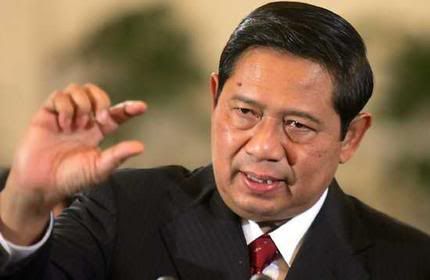
I am cheered that Dr Susilo Bambang Yudhoyono, better known as SBY, has won his second term in as president of Indonesia, with a very comfortable margin which pollsters estimate at over 60%. Although the official results are not due till later this month, SBY has already declared victory and world leaders like Singapore Prime Minister Lee Hsien Loong have already called him offering their congratulations.
This is a victory not only for him and his running mate, Boediono, the former central bank governor, but the great nation of Indonesia as well. The peaceful and fair election — contestations by SBY’s challenger Megawati notwithstanding — seals Indonesia’s transition from a military dictatorship under Suharto just over 10 years ago, to a thriving democracy with a free press and a steadily growing economy.
Continue reading “Victory for SBY, Indonesia…and ASEAN too?”
ST Forum: MAS should have been more objective
Png Eng Huat writes to the Straits Times Forum, 10 July 2009:
MAS should have been more objective
I REFER to Wednesday’s report, ‘MAS acts against 10 institutions’.
It seems the Monetary Authority of Singapore (MAS) has learnt little from the Lehman crisis. The crux of the sale of those toxic structured products was that their profits were oversold or misrepresented while their underlying risks were undersold.
In short, too much positive spin was put on the marketing of such products. In its latest report on the structured notes linked to Lehman Brothers, MAS has fallen into this ‘positive spin’ mode by highlighting the impressive statistics on settlement cases, while not addressing the pressing issue that most affected investors did not get any closure at all.
Continue reading “ST Forum: MAS should have been more objective”
Maria Hertogh dead, but the fearmongering will continue
Maria “Bertha” Hertogh (aka Nadra binte Ma’arof) died of leukaemia on 7 July 2009 in her home in Huijbergen, Netherlands, at the age of 72.
Hertogh’s name has been indelibly been printed on the minds of all Singaporeans, particularly those in the post-independence generations, as being synonymous with racial riots. Rarely is her name mentioned in local history and social studies textbooks, or National Education lessons, without the accompanying phrase, “We must never take our racial harmony for granted.”
Continue reading “Maria Hertogh dead, but the fearmongering will continue”
New NMP appointments
The new Nominated MP appointments are out:
- Mr Calvin Cheng Ern Lee, entrepreneur
- Mr Terry Lee Kok Hua, president, Singapore Insurance Employees’ Union
- Mrs Mildred Tan-Sim Beng Mei, managing director, Ernst and Young
- Assoc Prof Paulin Tay Straughan, NUS sociologist
- Mr Teo Siong Seng, chairman, Singapore Maritime Foundation
- Mr Viswaroopan s/o Sadasivan, CEO, Strategic Moves
- Mr Laurence Wee Yoke Thong, executive director, Presbyterian Community Services
- Ms Audrey Wong Wai Yen, artistic co-director, The Substation
- Ms Joscelin Yeo Wei Ling, former national swimmer
I’m glad that Mr Viswa Sadasivan was selected, my opposition to the NMP scheme notwithstanding. Viswa is a very insightful and frank political commentator, although he has not be quoted in the press much the last few years. I attended a very enlightening off-the-cuff talk by him last year, where he commented that there is a “crisis of leadership” in our nation. I blogged about it on TOC (with his permission). If he doesn’t pull his punches, and speaks what he really thinks, I think he will make a good contribution to the discourse in Parliament.
Malays deserve equal opportunities in the SAF
I was glad to learn that Colonel Ishak bin Ismail will be promoted to the rank of Brigadier General come 1st July. As Commander of the 6th Division since last August — division commanders in Singapore are usually BGs — his promotion was unsurprising.
What makes his achievement so significant is the fact that he became a BG despite having two “strikes” against him: He is Malay in the Singapore army, and he is not a government scholar. Although I have never served under him, I am confident that the SAF would not place a man in command of one of our three Combined Arms Divisions just for the sake of political tokenism.
Nevertheless, Singaporeans should not be lulled into thinking that full meritocracy has arrived in the SAF. There are still many “sensitive” units that have recently naturalised citizens but not a single Malay in their ranks.
Continue reading “Malays deserve equal opportunities in the SAF”
Surviving (suspected) H1N1
I became one of probably hundreds of patients who were hauled to Tan Tock Seng Hospital (TTSH) in the past week for suspected Influenza A (H1N1), also known as swine flu. It wasn’t a very pleasant experience, but I’m in a way glad I got to witness first hand the fight in the trenches against this viral illness.
The episode started with my 4-day business trip to Australia last week. When I returned on Monday evening, I had a little runny nose and sore throat so decided to head straight from the airport to my GP clinic, even though I had breezed through the thermal scanners at Changi Airport without incident.
Revamp the role of MPs to attract potential ministers
The Straits Times did an Insight piece about PAP MP Hri Kumar’s controversial proposal of having nominated (non-elected) ministers. They quoted some comments I made on my previous blog post:
For administrative aspects, there are already people like the permanent secretaries heading the various ministries, he notes.
The view is shared by IT consultant Gerald Giam, a founding member of the socio-political blog The Online Citizen.
He writes on his blog that ministers need to have the common touch; they need to be people who can empathise with ordinary Singaporeans.
‘If we open the doors to this segment of society to lead us, we will be fishing from the wrong pond. We will, in the long run, attract the wrong sort of people to lead our country – people with a different set of values and motivations,’ he says.
Mr Giam, Mr Siew and Dr Tan all say that a parallel cannot be drawn between Singapore’s parliamentary system and the presidential system in the United States, where the Cabinet is made up of people who are appointed, not elected.
Some friends have expressed to me publicly and privately that they in principle support the idea of non-elected ministers because some ministries (e.g., finance) need “technocratic minds”. However, I still maintain my disagreement with the idea.
Continue reading “Revamp the role of MPs to attract potential ministers”