New NMP appointments

The new Nominated MP appointments are out:

  1. Mr Calvin Cheng Ern Lee, entrepreneur
  2. Mr Terry Lee Kok Hua, president, Singapore Insurance Employees’ Union
  3. Mrs Mildred Tan-Sim Beng Mei, managing director, Ernst and Young
  4. Assoc Prof Paulin Tay Straughan, NUS sociologist
  5. Mr Teo Siong Seng, chairman, Singapore Maritime Foundation
  6. Mr Viswaroopan s/o Sadasivan, CEO, Strategic Moves
  7. Mr Laurence Wee Yoke Thong, executive director, Presbyterian Community Services
  8. Ms Audrey Wong Wai Yen, artistic co-director, The Substation
  9. Ms Joscelin Yeo Wei Ling, former national swimmer

I’m glad that Mr Viswa Sadasivan was selected, my opposition to the NMP scheme notwithstanding. Viswa is a very insightful and frank political commentator, although he has not be quoted in the press much the last few years. I attended a very enlightening off-the-cuff talk by him last year, where he commented that there is a “crisis of leadership” in our nation. I blogged about it on TOC (with his permission). If he doesn’t pull his punches, and speaks what he really thinks, I think he will make a good contribution to the discourse in Parliament.
Continue reading “New NMP appointments”

Malays deserve equal opportunities in the SAF

I was glad to learn that Colonel Ishak bin Ismail will be promoted to the rank of Brigadier General come 1st July. As Commander of the 6th Division since last August — division commanders in Singapore are usually BGs — his promotion was unsurprising.

What makes his achievement so significant is the fact that he became a BG despite having two “strikes” against him: He is Malay in the Singapore army, and he is not a government scholar. Although I have never served under him, I am confident that the SAF would not place a man in command of one of our three Combined Arms Divisions just for the sake of political tokenism.

Nevertheless, Singaporeans should not be lulled into thinking that full meritocracy has arrived in the SAF. There are still many “sensitive” units that have recently naturalised citizens but not a single Malay in their ranks.

Continue reading “Malays deserve equal opportunities in the SAF”

Surviving (suspected) H1N1

I became one of probably hundreds of patients who were hauled to Tan Tock Seng Hospital (TTSH) in the past week for suspected Influenza A (H1N1), also known as swine flu. It wasn’t a very pleasant experience, but I’m in a way glad I got to witness first hand the fight in the trenches against this viral illness.

The episode started with my 4-day business trip to Australia last week. When I returned on Monday evening, I had a little runny nose and sore throat so decided to head straight from the airport to my GP clinic, even though I had breezed through the thermal scanners at Changi Airport without incident.

Continue reading “Surviving (suspected) H1N1”

Revamp the role of MPs to attract potential ministers

The Straits Times did an Insight piece about PAP MP Hri Kumar’s controversial proposal of having nominated (non-elected) ministers. They quoted some comments I made on my previous blog post:

For administrative aspects, there are already people like the permanent secretaries heading the various ministries, he notes.

The view is shared by IT consultant Gerald Giam, a founding member of the socio-political blog The Online Citizen.

He writes on his blog that ministers need to have the common touch; they need to be people who can empathise with ordinary Singaporeans.

‘If we open the doors to this segment of society to lead us, we will be fishing from the wrong pond. We will, in the long run, attract the wrong sort of people to lead our country – people with a different set of values and motivations,’ he says.

Mr Giam, Mr Siew and Dr Tan all say that a parallel cannot be drawn between Singapore’s parliamentary system and the presidential system in the United States, where the Cabinet is made up of people who are appointed, not elected.

Some friends have expressed to me publicly and privately that they in principle support the idea of non-elected ministers because some ministries (e.g., finance) need “technocratic minds”. However, I still maintain my disagreement with the idea.

Continue reading “Revamp the role of MPs to attract potential ministers”

Don’t turn my country into an administrative state

I strongly reject PAP MP Hri Kumar’s suggestion in Parliament that the Prime Minister should be given the option to appoint individuals from outside the rank of elected MPs to his cabinet. He had argued that the pool of talent available to the PM will “increase substantially” and he can draw on the experience of many “capable individuals”.

This is a dangerous line of thinking which is not just undemocratic, but foolish as well.

Continue reading “Don’t turn my country into an administrative state”

Singaporeans strongly reject Myanmar generals

From CNA:

Myanmar’s military government has “strongly rejected” a statement by the Association of Southeast Asian nations condemning the trial of pro-democracy leader Aung San Suu Kyi, state media said Monday.

Myanmar accused Thailand, which issued the statement one week ago as the rotating chairman of the 10-member bloc, of interfering in its internal affairs, the New Light of Myanmar newspaper reported.

“This statement issued by the alternate ASEAN chairman — which is not in conformity with ASEAN practice, incorrect in facts, interfering in the internal affairs of Myanmar — is strongly rejected by Myanmar,” it said.

“It is sadly noted that the alternate ASEAN chairman failed to preserve the dignity of ASEAN, the dignity of Myanmar and the dignity of Thailand,” said the statement, which was also carried on state-run television and radio.

The ASEAN statement expressed “grave concern” over the treatment of Aung San Suu Kyi, a rare step by the group which hardly ever speaks out on the domestic political issues of its members, including Myanmar.

It is quite rare to hear a public rebuttal from the Myanmar government against ASEAN. The fact that they have taken this step indicates that they have been quite stung by ASEAN’s statement. At least is shows that the generals are not deaf to ASEAN.

Continue reading “Singaporeans strongly reject Myanmar generals”

Reserved Seating

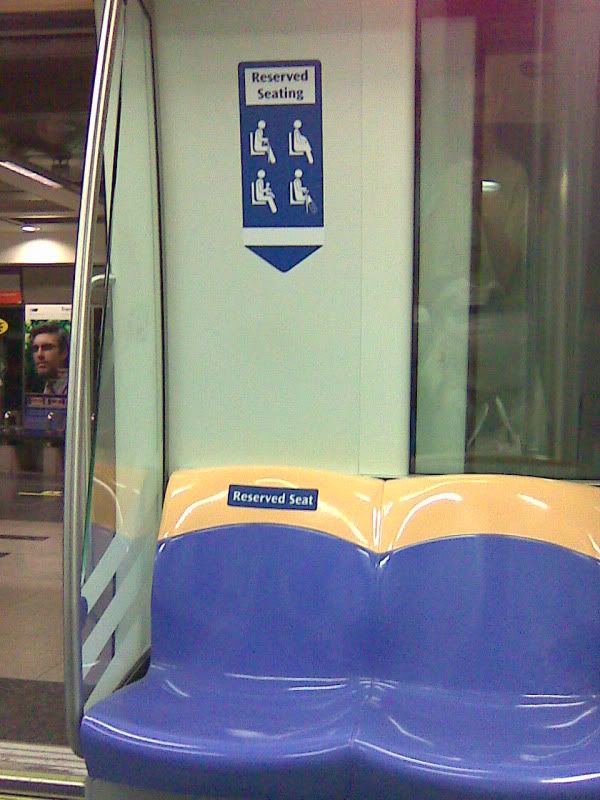
I am glad to see that the Public Transport Council and train operators have decided to change the seat signs on trains to read “Reserved Seating” instead of the less assertive “Priority Seating”.

Reserved Seating on Trains

This was a suggestion I made back in February 2008 in my paper titled Improving Singapore’s Public Transport System – A Commuter’s Perspective:

Continue reading “Reserved Seating”

Finding common ground on abortion

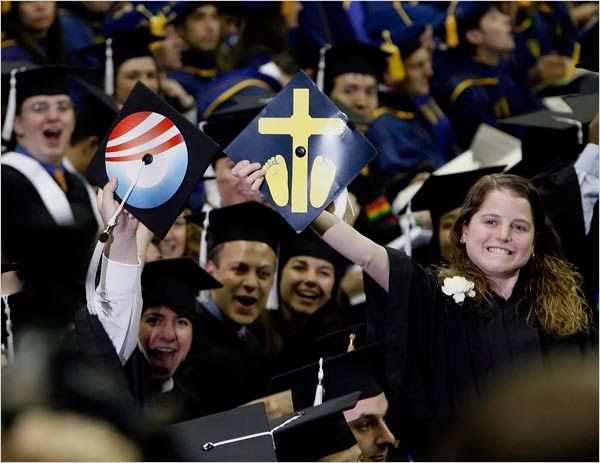
Barack Obama was invited to speak at the graduation ceremony of the University of Notre Dame, where he touched on the contentious issue of abortion.

Notre Dame, apart from being known for its football team, is one of the nation’s premier Catholic universities. It was thus very controversial for Obama, a strong advocate of abortion rights, to be invited. The Catholic Church strongly opposes abortion. Some students had attended their commencement but stated their stand by wearing anti-abortion symbols on their mortar boards.

Photo: New York Times

Continue reading “Finding common ground on abortion”

Peace vigil for Aung San Suu Kyi @ Speakers’ Corner

Message from Maruah (Singapore Working Group for an ASEAN Human Rights Mechanism), which is organising a peace vigil for Aung San Suu Kyi at 5.30pm on May 31 at Speakers’ Corner.

This is a peaceful rally to ask as many people in Singapore to give two hours of their time to show support to a courageous women – Daw Aung Sung Suu Kyi – who has been placed under house arrest for almost two decades and now is held in a formidable prison.

Continue reading “Peace vigil for Aung San Suu Kyi @ Speakers’ Corner”

ST Forum: Political changes must win over younger citizens

This is an excellently argued letter by Mr Michael Wee from today’s Straits Times, which deserves to be repeated here.

Political changes must win over younger citizens

Straits Times forum, 21 May 2009

TUESDAY’S report, ‘New strategies for a new world order’, on the President’s speech to Parliament hinted at what might be, to some, political liberalisation.

Given past precedents, any change made to Singapore’s political system will certainly be implemented with caution.

Such changes must be sufficient to overturn the cynicism of younger voters who want greater involvement and participation in the political process.

Where parliamentary politics are concerned, the best litmus test for any reform to the current group representation constituency system is its ability to elect a Parliament whose composition more closely reflects political parties’ percentage of votes.

Based on the last general election, the Workers’ Party garnered 16.34 per cent of the votes, but it holds only one of 84 seats in Parliament.

In Britain, which also uses a similar first-past-the-post system, the opposition Conservative Party holds roughly 31 per cent of parliamentary seats, which reflects the 32.3 per cent of the popular vote the party obtained.

Ambiguous or seemingly half-hearted attempts at reform will only further increase scepticism.

The People’s Action Party (PAP) should accept the possibility of greater opposition party involvement and acknowledge that other parties can also bring in a fresh generation of political leaders in their own right.

If the PAP can still be elected with the same resounding confidence even after meaningful reforms to the political system, it will certainly win over more fully the younger generation of voters.

Michael Wee