Debate with PAP MPs after my Parliament speech

After I delivered my maiden speech in Parliament on 18 October 2011, several PAP MPs rose to rebut some of the points I raised. Below are excerpts of the debate.

Gerald Giam in ParliamentAfter I delivered my maiden speech in Parliament on 18 October 2011, several PAP MPs rose to rebut some of the points I raised. Below are excerpts of the debate extracted from the Parliamentary Hansard, which contains the transcript of all Parliament proceedings.

“(…)” denotes portions of the MPs’ speeches which I have excluded because they do not refer to me or my speech.

———

The Minister of State for Trade and Industry (Mr Teo Ser Luck): (…)

I think Mr Gerald Giam raised some daily issues – healthcare, transport, housing. While there could be planning and forecasting in the past, but who can predict the right number between demand and supply so accurately? And it is always a challenge to always find the optimal balance. And as the Member Mr Lee Yi Shyan has also mentioned, there are a lot of trade-offs. But, nevertheless, with the issues that we face today, there are a lot of different policy announcements that have come out after the 2011 General Elections. Most notably, one of those that really interests me is healthcare. That is because in my own constituency, I do have a polyclinic and I do understand it is crowded. But I think the Ministry of Health has also made certain announcements. There were three major ones: community health centre which actually deals with partnering the community to provide health screening efforts, Primary Care Partnership Schemes, family medicine clinics. I think all these are actually policies and measures to help bring healthcare nearer to the community to ensure that they do not crowd into a centralised area. Personally for me, within my constituency and district, we have the intent to set up community health screening centres to help our constituency out there. So, these are policies put in place to help the situation. It is not that the Government has done nothing about it. There are things being done right now. I would suggest that we be patient, and I agree with the Member, Mr Gerald Giam, that we have to be constructive and, hopefully, with all these robust debates we can come up with a good solution for all. (…)

(Debate resumed after a break)

Mr Gerald Giam Yean Song: Mr Speaker, I like to respond to a point of clarification from Mr Teo Ser Luck. He asked who can predict the right number, the right figure between supply and demand in the area of transport, healthcare and housing capacity. Did the MOM and ICA not know we were letting in this huge influx of foreigners? Did they inform MOH, MOT and MND? And was the left hand not talking to the right hand, or was it because the imperative of economic growth took precedence over the welfare and the comfort of our people?

Continue reading “Debate with PAP MPs after my Parliament speech”

Parliamentary Questions on 20th and 21st October

These were my Parliamentary Questions (PQs) that were answered by the National Development Minister and Health Minister on 20th and 21st October 2011 respectivel

These were my Parliamentary Questions (PQs) that were answered by the National Development Minister and Health Minister on 20th and 21st October 2011 respectively:

Mr Gerald Giam: To ask the Minister for National Development (a) how many subsidised rental flats need to be built to meet the current high demand; and (b) when does HDB plan to build these flats.

Mr Gerald Giam: To ask the Minister for National Development what are the reasons for the lower application rates for smaller (2-room and 3-room) Built-to-Order (BTO) flats and Sale of Balance Flats (SBF) as compared to larger (4-room and 5-room) flats in recent HDB flat sales exercises.

Channel NewsAsia report: Locals form over 80% of private home buyers, foreign ownership up

————–

Mr Gerald Giam: To ask the Minister for Health what percentage of Singaporeans currently draw from their adult children’s Medisave accounts to pay for their own healthcare expenses.

Channel NewsAsia report: S$130m withdrawn from Medisave for parents’ healthcare expenses

Maiden speech in Parliament

At a time when our citizens are exposed to heightened risks in the form of global competition, increased economic volatility, rising inequality and wage stagnation, the Government is exposing them to even more competition from foreigners. Our workers are told to be “cheaper, better, faster”, more self-reliant and less selective about their jobs. This regressive transfer of risks from government to citizens must count as one of the PAP Government’s biggest policy failures in the last decade.

The following is the text of my maiden speech in Parliament today.

——

Mr Speaker, thank you for giving me the opportunity to make this, my maiden speech to this House.
In his address to Parliament, the President gave a broad outline of this Government’s goals for the next five years. The Government says it wants “every Singaporean worker to hold a skilled, well-paid job; every family to live in an affordable, comfortable home; every young person to develop himself fully and pursue his dreams; every senior citizen to stay active and to live with dignity”.
These are bold goals which my colleagues and I in the Workers’ Party will hold the Government accountable for over the next five years.
Sir, today I would like to focus on three areas that many senior citizens, families and workers have pressing concerns about. They are healthcare, public housing and public transport.
Healthcare financing
Mr Speaker, the axiom, “it’s better to die than fall ill in Singapore” has been heard time and again—twice during this debate alone.
Many Singaporeans, especially the elderly poor, worry greatly about falling ill. They are concerned not just about the painful treatment they will have to go through, but more often about the high costs involved, and the financial burden they may place on their struggling children.
In Singapore, government subsidies make up only a quarter of total health expenditure . Out-of-pocket expenses, employer benefits and private insurance make up most the remainder.
The much vaunted “3Ms” of Medisave, MediShield and Medifund pay for less than 10% of total healthcare expenses , the lion’s share of which comes from Medisave, which is really patients’ own savings. MediShield is a self-funding insurance scheme, which members pay premiums to join. These premiums rise as they grow older. They also have to fork out large deductibles and co-insurance before receiving pay-outs, and coverage ends at age 85.
The Government will say that we have Medifund. But Medifund is subject to extremely stringent means testing and the disbursements are not exactly generous. In 2009, an average of $1,029 was given to less than 24,000 in-patient Medifund applicants . This represented just 5% of the total hospital admissions that year.
For seniors with no income and little savings, the burden of healthcare is shifted to their children. In 2005, 60% of the elderly had their medical bills paid from their adult children’s Medisave accounts . This is a very high percentage, and is in fact a departure from the principle of “self-reliance”. If these patients’ children are also low-income earners—as is often the case—the Government is merely shifting the burden of poverty within the pool of the poor . Basically we are asking one disadvantaged group to pay for another.
The Government seems very reluctant it to take on a larger financial responsibility for caring for our senior citizens. Instead, it hides behind the mantras of self-reliance and filial piety to justify its relatively low expenditure on healthcare for the elderly.
Self-reliance is good in principle, but when a patient has exhausted his own savings and has to rely on his own struggling family members, then we as a society are not being fair to both the patient and his family.
The Ministry of Health claims to provide universal health coverage to citizens , but I believe we are still some way from that. The World Health Organization defines universal health coverage as having a healthcare financing system that provides all people with access to adequate healthcare services without suffering financial hardship paying for them.
If we are to achieve this goal, we need to expand the coverage of MediShield and reduce the over-reliance on direct payments by patients at the time they need the care . To fund this, we need to strengthen the current forms of prepayment and risk-pooling, and provide assistance to those who cannot afford the premiums, like housewives and the elderly. All this points to a need to perform some major surgery on MediShield.
Hospital capacity
Mr Speaker, for some time now, our public hospitals have been running at near full capacity, with bed occupancy rates often exceeding 90% for Tan Tock Seng Hospital and over 85% for National University Hospital. Khoo Teck Puat Hospital, which opened just last year, was supposed to ease the crunch. But it too has been running at almost 85% capacity for the past month. The Royal College of Surgeons in the U.K. has advised that bed occupancy rates above 82% put patients at an increased risk of infection .
It was reported in the Straits Times on 30th August this year that hospitals in Singapore are facing such a severe crunch in beds that some are “borrowing” space from other nearby organisations to house their patients.
How did we get into such a situation?
Between the year 2000 and 2010, our population has seen an increase of 26%, mostly through immigration. The number of hospital admissions has seen an increase of 15% in this same period. However, not only have the number of hospital beds not kept pace with population growth, but they have actually decreased during this period. In the past decade, there has been a 7% drop in the number public sector hospital beds, according to the Department of Statistics
Two years ago, the then-Health Minister admitted, that on hindsight, his ministry made a mistake by not building a new hospital two years earlier. Recently, the Health Minister floated the idea of bringing forward the opening of Sengkang Hospital, currently scheduled for 2020. I support this move, but this is still a long time to wait, and by that time, our population would have increased even more.
What is left unanswered is why this self-proclaimed “far-sighted” Government failed in the past 10 years to build our healthcare infrastructure to keep pace with population growth and an ageing population. Was the Government instead overly fixated on the near-sighted goals of boosting economic growth by increasing our population?
Housing shortage and prices
Mr Speaker, I would now like to address many Singaporeans’ concerns about the public housing situation in Singapore.
In the past 10 years, the HDB has grossly undersupplied new housing units to the market. According to figures from the HDB, between 2001 and 2009, an average of just 7,700 new flats were built each year . This was far short of the average annual resident household growth figure of 24,280 since 2005.
Even when the population surged from 2007 onwards because of the liberalisation of our immigration policies, the Government failed to react by building more flats for our people. Instead, they permitted more cash rich foreigners to purchase almost any types of private property, which increased their prices, and pulled up HDB flat prices, since the two are linked.
This combination of low supply and high demand resulted in a severe housing shortage, causing a sharp and sustained rise in property prices. HDB resale flat prices are now 92% higher than they were 10 years ago .
This has not only caused much distress for many Singaporean families, but has also created a potential asset bubble which could severely damage Singapore’s economy in a downturn.
The Government finally awoke from its slumber this year and ramped up the supply of Built-to-Order (BTO) flats to an expected 25,000 this year and another 25,000 next year. This is a move in the right direction. However, BTO flats do not solve the immediate housing problem, because it takes two or three years before the new flat owners get their keys. In the meantime, many are still without a home of their own.
Despite the bumper launches of BTO and Sale of Balance Flats (SBF) this year, we still saw the third-quarter HDB Resale Price Index shoot up 3.8% over the previous quarter. The cooling measures that the Ministry of National Development put in place earlier this year do not seem to be having their intended effects on the resale flat market.
The Government has gone some way in reducing the housing problems for first-timer couples, but not for singles, divorcees and those who need to downgrade to smaller flats because of financial difficulty. We need to find a way to help these people who are caught in between the policies. In particular, more measures need to be put in place to cool down the resale HDB flat market.
The HDB market, whether direct or resale, cannot simply be left to market forces. As a provider of this public good, the Government must step in to ensure that the welfare of its citizens comes first.
Public transport
Mr Speaker, please allow me to share some longstanding concerns about public transport in Singapore.
In March this year, just before the General Election was announced, SMRT and SBS Transit said they would add 590 additional MRT train trips. This was expected to ease the squeeze on trains. However, many regular commuters will testify that trains now seem even more crowded than ever. The recently opened Circle Line may improve the situation nearer the city, but for those commuting from the suburbs like Sembawang or Simei, finding room to board the trains will still be a challenge.
One key factor that affects the train loads is the waiting time. I understand that the current signalling systems on the ageing North-South and East-West lines allow for maximum train arrival intervals of about two minutes without compromising commuter safety.
If trains really arrived once every two minutes, the overcrowding problem would not be so severe. Unfortunately, this is seldom the case. Outside of the narrow window of about half an hour on weekday mornings and evenings, the frequency drops to three to five minutes, or more. This results in trains arriving packed with passengers, making it impossible for many of those on the platform to board. As a daily commuter myself, I often have to wait for two—sometimes three—trains to pass by before I can board, during morning and evening rush hours.
Sir, if the Government is serious about encouraging our people to drive less and use more public transport, it must give priority to tackling the overcrowding problem on trains. The solution lies not only in building more lines, but making better use of the existing lines by increasing train frequency and maintaining that high frequency for longer periods, especially during peak hours.
Why can’t the MRT operators maintain a train interval of two minutes from 7am to 9am, and from 5pm to 8pm? Is it because of technical constraints, or because it will increase their costs and reduce their profits?
Under the current profit-maximising model, operators are incentivised to cut costs and service levels, just to maintain their high margins. Their duopoly position in the local market reinforces this behaviour.
It is time for the Government to demand that these operators provide a higher level of service to commuters, even if it reduces their profit margins.
Summary
Mr Speaker, whether in healthcare, public housing or public transport, the Government has gone too far down the road of pursuing free market efficiency, often to the detriment of the elderly and low wage workers.
At a time when our citizens are exposed to heightened risks in the form of global competition, increased economic volatility, rising inequality and wage stagnation, the Government is exposing them to even more competition from foreigners. Our workers are told to be “cheaper, better, faster”, more self-reliant and less selective about their jobs.
This regressive transfer of risks from government to citizens must count as one of the PAP Government’s biggest policy failures in the last decade.
The demographic, social and economic changes of the 21st century demand a rethink of how much a government should provide for its people, and how much we can reasonably ask our citizens to provide for themselves.
Mr Speaker, we are at the dawn of a new era in the history of our nation. The phrase “new normal” has often been used to describe this new political reality. Now with more Workers’ Party members in the House, some pundits wonder if we will be a constructive, or destructive party in Parliament; will we help build our country, or be obsessed with tearing down our political opponents? This is related to some of Mr Lee Yi Shyan’s concerns earlier. I believe our party’s track record in Parliament answers these questions.
Having more Workers’ Party MPs does not change our rational and responsible approach to politics. We want to be a force for good in our country—to help to uncover solutions, not add to the problems.
However, it takes two hands to clap. The responsibility for ensuring fair and constructive debates, in and out this House, rests not only on the Opposition, but also on the Government. I hope that debates in this House will not just be about winning the argument or scoring political points, but leveraging on the arguments, and counter-arguments, to elicit better policy outcomes.
This will ultimately benefit Singaporeans, who put us here to serve them.
Thank you, Mr Speaker.
Gerald Giam in ParliamentMr Speaker, thank you for giving me the opportunity to make this, my maiden speech to this House.

In his address to Parliament, the President gave a broad outline of this Government’s goals for the next five years. The Government says it wants “every Singaporean worker to hold a skilled, well-paid job; every family to live in an affordable, comfortable home; every young person to develop himself fully and pursue his dreams; every senior citizen to stay active and to live with dignity”.

These are bold goals which my colleagues and I in the Workers’ Party will hold the Government accountable for over the next five years.

Sir, today I would like to focus on three areas that many senior citizens, families and workers have pressing concerns about. They are healthcare, public housing and public transport.

Continue reading “Maiden speech in Parliament”
Meeting Lord Peter Mandelson

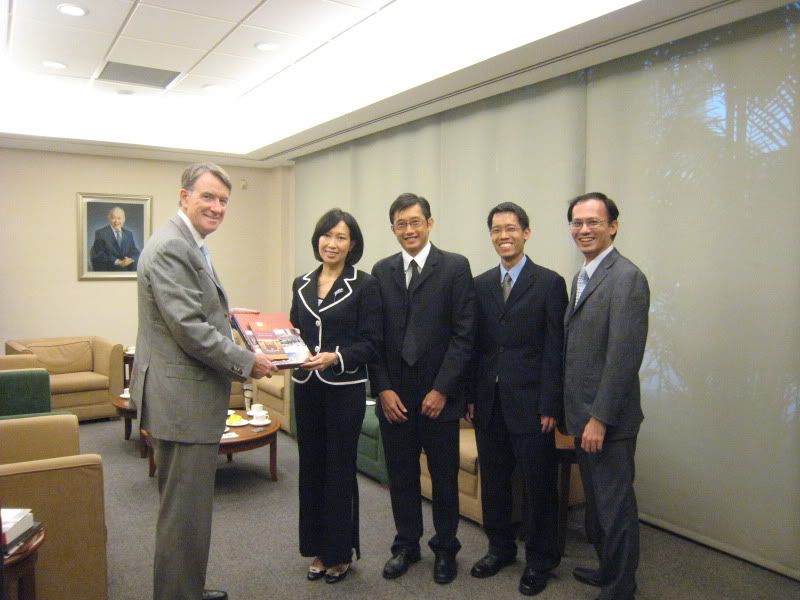
Yee Jenn Jong (Non-constituency MP) and I attended a meeting with Lord Peter Mandelson at Parliament House yesterday (20 September 2011). Also in attendance were Mr Antony Phillipson (British High Commissioner to Singapore), Teo Ser Luck (Minister of State for Trade and Industry) and Irene Ng (MP for Tampines, who chaired the meeting), as well as officials from the Ministry of Foreign Affairs and Parliament Secretariat.

Meeting Lord Peter Mandelson

Yee Jenn Jong (Non-constituency MP) and I attended a meeting with Lord Peter Mandelson at Parliament House yesterday (20 September 2011). Also in attendance were Mr Antony Phillipson (British High Commissioner to Singapore), Teo Ser Luck (Minister of State for Trade and Industry) and Irene Ng (MP for Tampines, who chaired the meeting), as well as officials from the Ministry of Foreign Affairs and Parliament Secretariat.

Lord Mandelson, together with Tony Blair and Gordon Brown, was one of the key architects of the reform of the British Labour Party in the 1980s and 90s to what is now known as “New Labour”. He served as a Cabinet minister under both prime ministers Tony Blair and Gordon Brown, and also as European Commissioner for Trade. He is visiting Singapore under the auspices of the Lee Kuan Yew Exchange Fellowship and will be giving a public lecture at the LKY School of Public Policy later today.

We had a lively discussion about both British and Singapore politics. Lord Mandelson had the benefit of hearing two contrasting perspectives of the latter!

Meeting up with Bedok residents

I had a good discussion over kopi with a few Bedok residents near the Blk 58 Bedok Market and Food Centre this morning. A larger-than-expected group of about 10 residents joined the discussion. Also present was Mohd Fazli, my fellow East Coast GRC candidate during the last elections.

I had a good discussion over kopi with a few Bedok residents near the Blk 58 Bedok Market and Food Centre this morning. A larger-than-expected group of about 10 residents joined the discussion. Also present was Mohd Fazli, my fellow East Coast GRC candidate during the last elections.
We discussed various local and national issues. Some were unhappy with the overcrowded feeder buses to Bedok interchange, even during the early hours of the morning. As many of them were in their 60s or older, they were disappointed that fare concessions for the elderly did not kick in until later in the morning, even though many elderly workers (esp cleaners) had to take public transport to get to work. On the issue of healthcare, they lamented that despite paying so much in Medishield insurance coverage, there were often unable to make any claims when they had to undergo treatment because of the high deductibles and co-insurance payments required.
It was a very fruitful and enjoyable session. I noted down a lot of feedback which I will study further and raise in Parliament where appropriate. I hope to have many more of such discussions in the future.
———-
Do you live in Bedok, Fengshan, Simei or Changi? Do contact me if you’d like me to come down to meet you and your friends/neighbours over drinks at a kopitiam near your place. My email is gerald.giam@wp.sg.

I had a good discussion over drinks with a few Bedok residents near the Blk 58 Bedok Market and Food Centre this morning. A larger-than-expected group of about 10 residents joined the discussion. Also present was Mohd Fazli, my fellow East Coast GRC candidate during the last elections.

We discussed various local and national issues. Some were unhappy with the overcrowded feeder buses to Bedok interchange, even during the early hours of the morning. As many of them were in their 60s or older, they were disappointed that fare concessions for the elderly did not kick in until later in the morning, even though many elderly workers (esp cleaners) had to take public transport to get to work. On the issue of healthcare, they lamented that despite paying so much in Medishield insurance coverage, there were often unable to make any claims when they had to undergo treatment because of the high deductibles and co-insurance payments required.

It was a very fruitful and enjoyable session. I noted down a lot of feedback which I will study further and raise in Parliament where appropriate. I hope to have many more of such discussions in the future.

———-

Do you live in Bedok, Fengshan, Simei or Changi areas? Do contact me if you’d like me to come down to meet you and your friends/neighbours over drinks at a kopitiam near your place. My email is gerald.giam {at} wp.sg.

Overhauling Singapore’s public transport model

The current model of provision of public transport has produced many undesirable outcomes, as evidenced by the “crush loads” experienced by commuters every day and the public outcry each time fares are increased. It would do Singaporeans no good if the government sticks dogmatically to its narrow philosophy of the virtues of privatisation and the profit motive, without considering the true economic reality of the public transport industry in Singapore.

This was an op-ed that was published in the Straits Times Review section on 19 July 2011, under the title “Consider the economic reality of transport here”. I would like to express my appreciation to my friends and fellow Party members who contributed to this article. It was a team effort.

————-

Minister for Transport Lui Tuck Yew recently criticised the Workers’ Party’s (WP) proposal for a not-for-profit National Transport Corporation to replace the current two listed public transport companies.

Mr Lui claimed that WP’s proposal had “serious downsides, chief amongst which commuters and taxpayers (yes, even those who don’t take public transport) are likely to end up paying more, and possibly, for a poorer level of service over time”.

He added that “it is the profit incentive of commercial enterprises that spurs efficiency and productivity improvements”.

Market failures in public transport

These are simplistic and tired old arguments about the virtues of private enterprises which fail to fully appreciate the economic reality of the public transport industry in Singapore.

Firstly, taxpayers who do not take public transport already contribute to the provision of public transport in the form of taxes that pay for the construction of roads, the development of rail lines and the purchase of the first set of trains on every new MRT line.

Secondly, public transport is an industry rife with market failures which the Minister seems to ignore.  The current regime where SMRT Corporation (SMRT) and SBS Transit (SBST) each provide both rail and bus services provides an illusion of competition.

The reality is that SMRT and SBST have clearly delineated areas of responsibility with no route overlaps.  This makes each of them a de facto monopoly provider in their own particular areas.

Commuters do not have the freedom to switch between providers whenever they choose to, nor do we see public transport operators (PTOs) fighting to acquire and retain customers like airlines do with promotions, discounts and loyalty programmes.

The monopoly status is also reflected in the consistent high returns these companies earn. Freed from the discipline of genuine market competition, they have few incentives to raise service standards and keep prices low.

To say that shareholder discipline will create such incentives is naïve at best, and wrong at worst.  Shareholders seek higher profits, not better or more affordable services.  The government must examine whether a public utility should be owned and operated by what are effectively private monopolists earning monopoly rents.

Mr Lui claims that the current regulatory regime is a “robust” one that does not allow operators to benefit at the expense of commuters.  This is a remarkable assertion once we consider the profits of PTO’s—$215.4 million last year alone.  The fines imposed for not meeting service standards pale in comparison to these profits.

Continue reading “Overhauling Singapore’s public transport model”

Public transport fare increases

The Workers’ Party (WP) has, in our 2006 and 2011 Manifestos, called for the MRT and public buses servicing major trunk and inter-town routes to be brought under a National Transport Corporation which will oversee and provide universal transport service to all. The National Transport Corporation should not be profit-oriented but should aim to provide public transportation services on the basis of cost and depreciation recovery.

The WP has, in our 2006 and 2011 Manifestos, called for the MRT and public buses servicing major trunk and inter-town routes to be brought under a National Transport Corporation which will oversee and provide universal transport service to all. The National Transport Corporation should not be profit-oriented but should aim to provide public transportation services on the basis of cost and depreciation recovery.

This would avoid a situation like we have seen on Monday where, despite earning profits of $215.4m last year, the two public transport operators are still applying for what threatens to be the single biggest fare increase to hit commuters in recent years. (I note that SMRT’s and SBST’s profits for the year ending March 31 were $161.1m and $54.3m respectively.)
Having a National Transport Corporation would not necessarily mean higher subsidies or a loss-making endeavour. If competently run, the Corporation could reduce costs associated with the duplication of functions and roles.

We have seen many examples of efficiently run publicly-run service providers in Singapore in the past. It is a fallacy to think that the two public transport operators today represent genuine competition which imposes market discipline that ensures

efficiency and good performance.

This was my response to media queries I received on Tuesday (12 July 2011) regarding public transport fare increases:

———

The Workers’ Party (WP) has, in our 2006 and 2011 Manifestos, called for the MRT and public buses servicing major trunk and inter-town routes to be brought under a National Transport Corporation which will oversee and provide universal transport service to all. The National Transport Corporation should not be profit-oriented but should aim to provide public transportation services on the basis of cost and depreciation recovery.

This would avoid a situation like we have seen on Monday (11 July 2011) where, despite earning profits of $215.4 million* last year, the two public transport operators are still applying for what threatens to be the single biggest fare increase to hit commuters in recent years.

Having a National Transport Corporation would not necessarily mean higher subsidies or a loss-making endeavour. If competently run, the Corporation could reduce costs associated with the duplication of functions and roles.

We have seen many examples of efficiently run publicly-run service providers in Singapore in the past. It is a fallacy to think that the two public transport operators today represent genuine competition which imposes market discipline that ensures efficiency and good performance.

—–

* SMRT Corporation’s and SBS Transit’s profits for the year ending March 31 were $161.1 million and $54.3 million respectively.

Medisave use for patients over 75

The Workers’ Party (WP) had in fact proposed in its 2011 Manifesto that “Medisave withdrawals for outpatient medical treatment should be further facilitated (e.g., for specialist and major outpatient services), subject to a cap on usage” and that “patients above 75 years old should be allowed to use Medisave for medical treatment without restriction”

Ms Sangeetha Bysheim wrote in to the TODAY newspaper on 7 July appealing for her 75-year old diabetic father to be allowed to use his Medisave to pay his full bills for his regular check-ups and medication. Currently only about 20 per cent of his bill can be charged to Medisave and the rest has to be paid in cash. She explained that her father has a lifetime’s worth of savings in his Medisave and argued that this was a perfect age to start tapping fully on the funds.

In their reply today (July 9th), the Ministry of Health reiterated the government’s long-standing position that they want to “manage the extended use of Medisave funds carefully to prevent the premature depletion of members’ funds”.

The Workers’ Party (WP) had in fact proposed in its 2011 Manifesto that “Medisave withdrawals for outpatient medical treatment should be further facilitated (e.g., for specialist and major outpatient services), subject to a cap on usage” and that “patients above 75 years old should be allowed to use Medisave for medical treatment without restriction” (Healthcare chapter, pg 37).

I had also raised this proposal during my General Election Rally speech on May 2nd at Moulmein-Kallang GRC. The proposal came at the tail end of a long list of other proposals on public housing and healthcare that I had expounded on in my speech.

At the time, I thought that it might have been a more niche issue that wouldn’t find much resonance with the crowd. To my surprise, when I read out that line, there was a huge cheer from the crowd (even though I didn’t exactly deliver it with much emotion or emphasis).

Continue reading “Medisave use for patients over 75”

Political sacrifices, political choices

A friend recently posed this question to me: If you were the managing director or country manager of your company, would you give it all up like Show Mao did? My answer: I didn’t wait to find out.

Many people were pleasantly surprised to learn about my Workers’ Party (WP) colleague Chen Show Mao’s announcement that he will be giving up this law firm partnership to focus on his duties as an MP. He was a partner of a major international law firm, Davis Polk, who has chosen instead to devote his time and energies to a noble endeavour that he believes in.

Show Mao has in one fell swoop demolished the PAP’s long-standing argument that you need to pay million dollar salaries to attract good people into politics. This was in addition to his pivotal role in demonstrating that the opposition–and the Workers’ Party in particular–is able to attract our country’s best into its ranks.

I applaud his move and I hope many more captains of industry and top professionals will follow his example and step forward to serve Singapore in the political arena.

A friend recently posed this question to me: If you were the managing director or country manager of your company, would you give it all up like Show Mao did?

My answer: I didn’t wait to find out.

Continue reading “Political sacrifices, political choices”

Fatherhood

Being a father has also given me a greater sense of responsibility and purpose. It’s not just about bringing home the bacon or living a good example for them to follow. I’m even more careful nowadays when I drive or cross the road, because I know that two young lives depend on me.

It’s Father’s Day today–my third as a father. My daughter is two-and-a-half and my son is approaching his 11th month.

My two kids have brought Elena and me so much more joy than we ever imagined. Neither of us were the “I adore kids” types before we had our own brood. In fact, we waited five years after getting married before having children. Fortunately we were in our mid-twenties when we tied the knot, so we had a bit of time to spare on our biological clocks to enjoy being dinks (double income, no kids).

Now that we have our own two kids, I can’t imagine life without them. Nothing beats coming home from a hard day of work and having my girl run up to me and exclaim, “Daddy, 回来了!” (Daddy’s home) and giving me a big hug; or picking up my son and looking into his bright eyes, full of excitement and promise.

A walk along the beach

Continue reading “Fatherhood”