I extend my heartiest congratulations to Team Singapore athletes and para-athletes who have qualified for, participated in and, for some, won medals at the recent SEA Games and ASEAN Para Games in Cambodia. These include Aljunied GRC residents Kimberly Ong, Colin Soon, Sophie Soon and Soh Rui Yong. You have done your family, the sports fraternity and your country proud by flying the Singapore flag high on the world stage. I also wish all our Asian Games athletes and para-athletes the best of success in their preparations and competitions at the upcoming Asian Games and Asian Para Games in October.
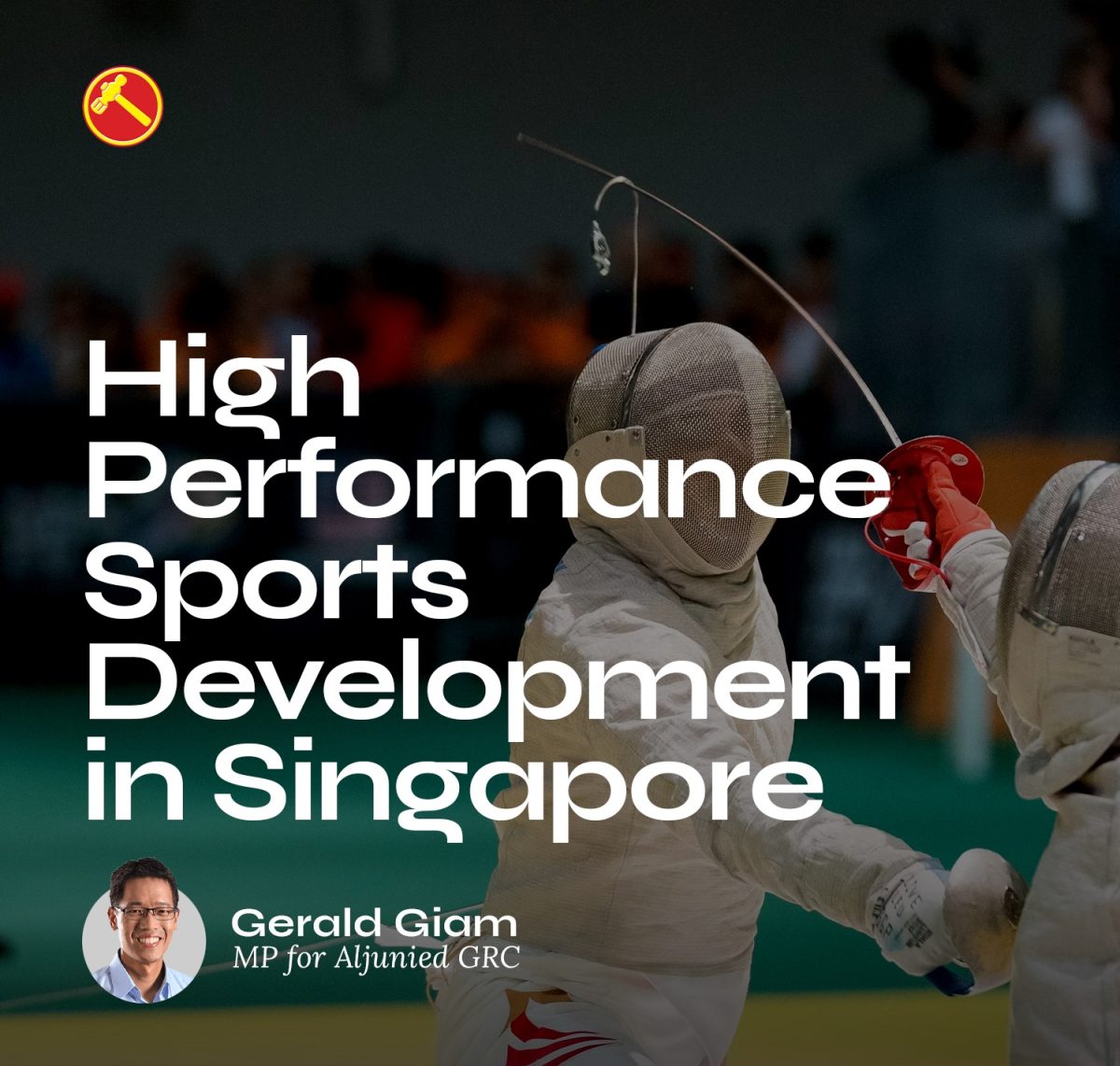
My speech today will focus on the development of high performance athletes in Singapore. I will delve into some of the challenges faced in the local sports ecosystem and will propose several ideas that I believe will enable Singapore to achieve greater success in the international sporting arena.
Before I continue, I wish to declare my interest in this matter as a parent with a child who trains in a high performance sports programme supported by Sport Singapore.
Most of us would be familiar with the 10,000 hours rule. It is a concept proposed by Dr Anders Ericsson and popularised by Malcolm Gladwell in his 2008 book “Outliers: The Story of Success”. The rule suggests that it takes approximately 10,000 hours of deliberate practice to achieve mastery in a particular field or skill. To clock 10,000 hours, an athlete would need to put in three hours of practice a day, six days a week, continuously for over 10 years. Going by this rule, if an athlete aims to be world class by the age of 18, they would need to start serious training when they are just eight years old. This does not even take into account the quality of their training and their innate talent, which are important factors in their future success.
In fact, many world class athletes today started training in a high performance environment from as young as the age of five. Many were handpicked while they were still learning to walk, often by their own parents. In his autobiography, “Black and White”, Richard Williams described how he came up with a plan to train his two daughters to become tennis champions before they were even born. We all know how successful Venus and Serena Williams became. There are also many other instances of fraught relationships between parents and their child athletes — even to the point of abuse — and I am not suggesting that Richard Williams’ approach is right for every athlete. However, this is the nature of the international competition our young athletes are up against.
For most sports, in order to become a world class athlete, the period of very high intensity training often starts from the age of 12. This coincides with the time Singaporean students are the busiest preparing for their PSLE, O level and A level exams.
Training for just a few hours a week with a school CCA sports team is not high performance training, and this pace of training will generally limit the student’s success in the sport to inter-school sports competitions. High performance athletes are generally expected to put in between 12 to 30 hours of high intensity training each week — with the number of hours increasing with age. One local National Sports Association (NSA) provides a training volume guideline of 28 hours a week and 27 tournaments a year for 16-year old male athletes in that sport. Athletes need to travel overseas — usually during the school term — to take part in tournaments, which are necessary for gaining competition experience and earning ranking points. It is extremely challenging for a secondary school student in a mainstream local school to balance this heavy load of training, travel and competition with their studies, without burning themselves out physically, mentally and emotionally.
An exception is found in the Singapore Sports School, where academic schedules are customised to accommodate the student-athlete’s training and competition commitments. The Hon. Member Poh Lee San shared about this earlier too. The Sports School has produced some very successful graduates, including badminton player Loh Kean Yew and table tennis player Clarence Chew, who have won gold for our nation in international competitions.
Sports and studies
This leads me to my next point: The Singaporean outlook towards the nexus of sports and studies. In Singapore, the well-established route for a young individual to achieve a comfortable income and provide for their family involves completing their education, graduating from either a polytechnic or university, and securing a professional position, preferably in a bank, tech company or law firm.
Becoming a professional athlete, on the other hand, is probably one of the most difficult paths a Singaporean can choose. It is not a ticket out of poverty in Singapore, as it is in some countries. Even if we look at some of the highest paying sports like golf and tennis, only the athletes ranked in the top 150 or so in the world rankings earn enough prize money to support themselves. Those outside these rankings may struggle to even cover their expenses, which include travel, accommodation, coaching and physiotherapy fees. In lower paying sports, athletes must depend on salaries paid by their clubs or NSAs to cover their expenses. It is a tough life!
Despite the desire for sports champions in Singapore, pragmatism often leads parents to view pursuing a professional sports career as impractical for their children. Consequently, many talented student-athletes choose to enter top mainstream secondary schools through the Direct School Admission (DSA) programme rather than attending the specialised Singapore Sports School. This is despite the fact that the latter offers a more favourable environment for balancing both sports and studies.
However, student-athletes enrolled in mainstream schools encounter constraints when compared to their peers at the Sports School. The fixed timetables in mainstream schools do not cater specifically to athletes, making it difficult for them to undergo long hours of training and overseas competition. While some mainstream schools offer limited flexibility on an individual basis, such as permitting athletes to skip a week of school for international competitions, the time away from lessons eventually takes a toll on their studies. With this reality in play, we should not be surprised that we continue to have a narrow pipeline of world-class athletes.
The academics-first approach is one that most Singaporeans have chosen over the years, and will continue to choose in the years to come. Given that many high performance athletes are of school-going age, if nothing is done to shift the youth sports development paradigm, we will continue to see many budding sports stars eventually fizzle out after they complete secondary school.
How do we shift this paradigm? I would like to offer some suggestions for MCCY, Sport SG, NSAs, coaches, schools, parents and student-athletes to consider.
Suggestion 1: Explore the “college pathway”
First, given how important academics are to Singaporeans, it is not fruitful to try to persuade them to choose sports over studies. We should therefore explore pathways that allow student-athletes to pursue both their studies and sports at the highest level. This is possible through what is known as the “college pathway”.
Most universities in the United States are members of the National Collegiate Athletic Association (NCAA). There are three divisions in these sports. The top tier — known as Division 1 — runs inter-collegiate championships in 13 male and 13 female sports, including swimming, soccer, track and field, tennis, golf, water polo, field hockey, basketball, volleyball and diving. Many of these are popular sports in Singapore, which our athletes compete in during major games like the SEA Games, Asian Games and the Olympics.
College sports is huge in the US and has a television audience comparable to the top professional sports teams. This popularity attracts commercial sponsors and television licensing rights, and is a huge revenue-earner for some universities, to the tune of some US$30 million a year. The quality of college sports in the US is so high that many of the best junior athletes from all over the world, including Europe, Australia and China, vie for the opportunity to study in these universities on full athletic scholarships while competing in their sport. Many of these universities have students that win more international championships than many small nations. The University of Southern California (USC), for example, had 65 past, present or incoming student-athletes competing in the 2020 Tokyo Olympics, compared to 23 from Singapore. USC athletes collectively won 11 gold medals in those Games.
Many of the top performing universities in inter-collegiate sports are also top ranked academic institutions. They include Stanford, UC Berkeley, Duke, University of Michigan, UCLA and USC. Harvard, Princeton, UPenn and other Ivy League universities are also NCAA Division 1 members. In fact, the Ivy League is a collegiate athletic conference comprising eight schools in northeastern US, although it is more commonly used to refer to academically elite American universities.
Division 1 athletes are sometimes offered “full ride” athletic scholarships. These can cover tuition fees, housing, meals, transport, apparel, equipment, coaching, sports science expertise and even academic tutoring for the athletes.
By pursuing the college pathway, more Singaporean student-athletes can have the opportunity to benefit from the best of both worlds — a top quality university education and elite level competition in their sport. College sports can be a springboard to the professional leagues after graduation. Several Singaporeans who competed for US colleges returned to represent Singapore in major games. These include swimmer Joseph Schooling (who graduated from the University of Texas at Austin), golfer Hailey Loh (who studies at California Baptist University) and our Parliamentary colleague, the Hon. Nominated Member Mark Chay (who graduated from Brigham Young University).
Even for those who do not ultimately make it into an American university, the disciplined focus on both academics and sports through their secondary school years will better prepare student-athletes to enter our local polytechnics and universities. Athletes are also much sought after by many companies after they graduate, because many employers recognise that athletes’ discipline, drive and good time management skills are among the many valuable skills that they bring to the workplace.
Despite the attractiveness of the college pathway, there appears to be a lack of awareness about it among many student-athletes and their parents about the steps they need to take to pursue it. Sport SG, NSAs, sports academies, schools and coaches should conduct more sharing sessions and provide more guidance for athletes and their parents on the college pathway. This will allow parents and athletes to make considered plans in developing their proficiency at their sport. The college pathway could provide a stronger pipeline of athletes in several sports that Singapore has the potential to excel in at major games.
Suggestion 2: Expand the Singapore Sports School
My second suggestion is that the Singapore Sports School should expand its enrolment of students beyond the nine “academy sports”, and provide a study-and-train environment for more student-athletes who can demonstrate their interest and potential to compete at an international level in their sport.
To make this successful, the Sports School and Sport SG need to better market the benefits of their sports and academic programmes to prospective students. The Sports School can arrange more sharing sessions at the various Primary Schools nationwide, in addition to the existing Sports School Open house. It could also invite the high performing athletes in primary school for holiday camps at the Sports School during the school holidays. These will enable the young athletes and parents to better understand and familiarise themselves with the Sports School. The Sports School will then be better able to attract a critical mass of students in each sport that will in turn make the school more attractive to prospective students.
Suggestion 3: Increase media coverage of local sports
Third, to spur interest in sports, the local media should play a bigger role in featuring local athletes in international competitions. When Singaporeans turn on their televisions to watch sports, they seldom see their compatriots competing. In fact, it is so rare to see Singaporeans in world class sports competitions, that when it does happen — like when Loh Kean Yew won the badminton world championships in 2021 — many of us will specially tune in to watch them. Unfortunately in the case of Kean Yew’s amazing win, it was so unexpected that even our public broadcaster did not make preparations to broadcast the finals match live to Singaporeans.
Matches featuring local athletes in the advanced stages of international competitions should be telecast live on free-to-air television or live-streamed online. During major games, all the matches and races where Team Singapore athletes are competing in should be uploaded to an online video platform like meWatch or YouTube. There shouldn’t just be a daily highlights programme which features a few athletes in action.
The media features could include interviews with high performance athletes sharing their insights about their day-to-day schedules and training. All this will spark interest in the various sports among athletes, fans and commercial sponsors.
Suggestion 4: Parents as enablers
My fourth and final suggestion is to parents of athletes and athletes themselves. Parents have an outsize influence on their children’s sporting ambitions and progress, from a very young age through their growing years. If you are a parent of a talented and athletic youngster, do take the time to listen to and understand your child’s motivations and dreams. Assess whether they truly love their sport and don’t push them to excel in a sport just to “DSA” into a good school or — worse — live your own dreams vicariously through them. I say this as a reminder to myself too!
Most athletes will only have the intrinsic motivation to push themselves to reach the pinnacle of their arena if they genuinely enjoy participating in the sport. Your child must also know that you love them regardless of their results on the field.
If your child has aspirations to become a world-class athlete, encourage them to pursue their dreams, take the time to find out the available pathways and support them within your means. The path will be less well-trodden than the ones most of their peers are taking, and there is no guarantee of success. It is therefore important to focus on enjoying the journey, not just the destination.
Conclusion
Sport has the potential to rally our nation together behind a common cause. When Singaporeans cheer in support of our sportsmen and women, listen to Majulah Singapura playing at the podium, or see Singaporean athletes giving their all on the field, in the pool or on the court, we all feel an immense rush of pride in our nation.
Yet for a nation as wealthy and diverse as Singapore is, our record of performance in sports on the world stage leaves much to be desired. I have outlined four suggestions aimed at improving Singapore’s sporting ecosystem to build a stronger and more sustainable pipeline of high-performance athletes in Singapore. This will help us take steps towards realising our goals for sporting success over the coming decade, and for decades to come.
I strongly support the Motion standing in the names of my Hon. Friends Assoc Prof Jamus Lim and Mr Muhamad Faisal Abdul Manap.
This was my speech on the Motion on Sporting Success in Parliament on 6 July 2023.