Vaccine diplomacy

Singapore donated 100,000 doses of the Moderna Covid-19 vaccine to Brunei in August. On 9 September, the Ministry of Health said Singapore will also donate 100,000 doses of the Pfizer-BioNTech Covid-19 vaccine to Johor. This is in addition to a 500,000 dose vaccine swap with Australia. The Prime Minister has also committed to donating Covid-19 vaccines to other countries under the COVAX vaccine-sharing initiative.

It is important that countries support each other to ensure fair and equitable access to Covid-19 vaccines. In fact, I supported this point in my speech on behalf of the Singapore delegation at the Inter-Parliamentary Union Forum of Young Parliamentarians in May 2021. Given our next door neighbour Malaysia’s current struggle in combating the virus, it makes sense to donate vaccines to Johor, the state closest to our border.

However, it was less clear to me why Singapore is donating vaccines to Brunei, an oil-rich state with a GDP per capita of over US$31,000. While I can see how it would serve some purpose in strengthening diplomatic ties with the sultanate, was it necessary to make an outright donation given they can quite easily afford to purchase vaccines? How much did these vaccines cost Singapore? Which other countries have we donated vaccines to and are these countries in real need of vaccine donations?

I will be asking the following question at the 14 September 2021 sitting of Parliament:

Mr Gerald Giam Yean Song: To ask the Minister for Foreign Affairs (a) which countries has Singapore donated COVID-19 vaccines to; (b) how many doses have been donated to each of these countries; (c) what is the total cost of these donations; and (d) what are the considerations for donations to higher income countries like Brunei which have the financial means to purchase their own vaccines.

Do you support donation of vaccines to other countries? If so, which countries should Singapore prioritise? Add your comments below or contact me directly at gerald.giam@wp.sg or WhatsApp 89250747.

$1.24 million corruption case involving ex-LTA officer

A former Land Transport Authority (LTA) officer was recently convicted of receiving $1.24 million in bribes from various contractors and sentenced to five-and-a-half years’ jail. He was the deputy group director of the Thomson-East Coast and Cross Island MRT lines, with oversight over the construction of tunnels and stations.

In addition to the scale of corruption involved, this case is also a cause for concern because it is unclear if the corrupt contractors continued their work on the two MRT lines and, if so, whether the works done by these companies have been compromised in terms of safety, quality and value for money.

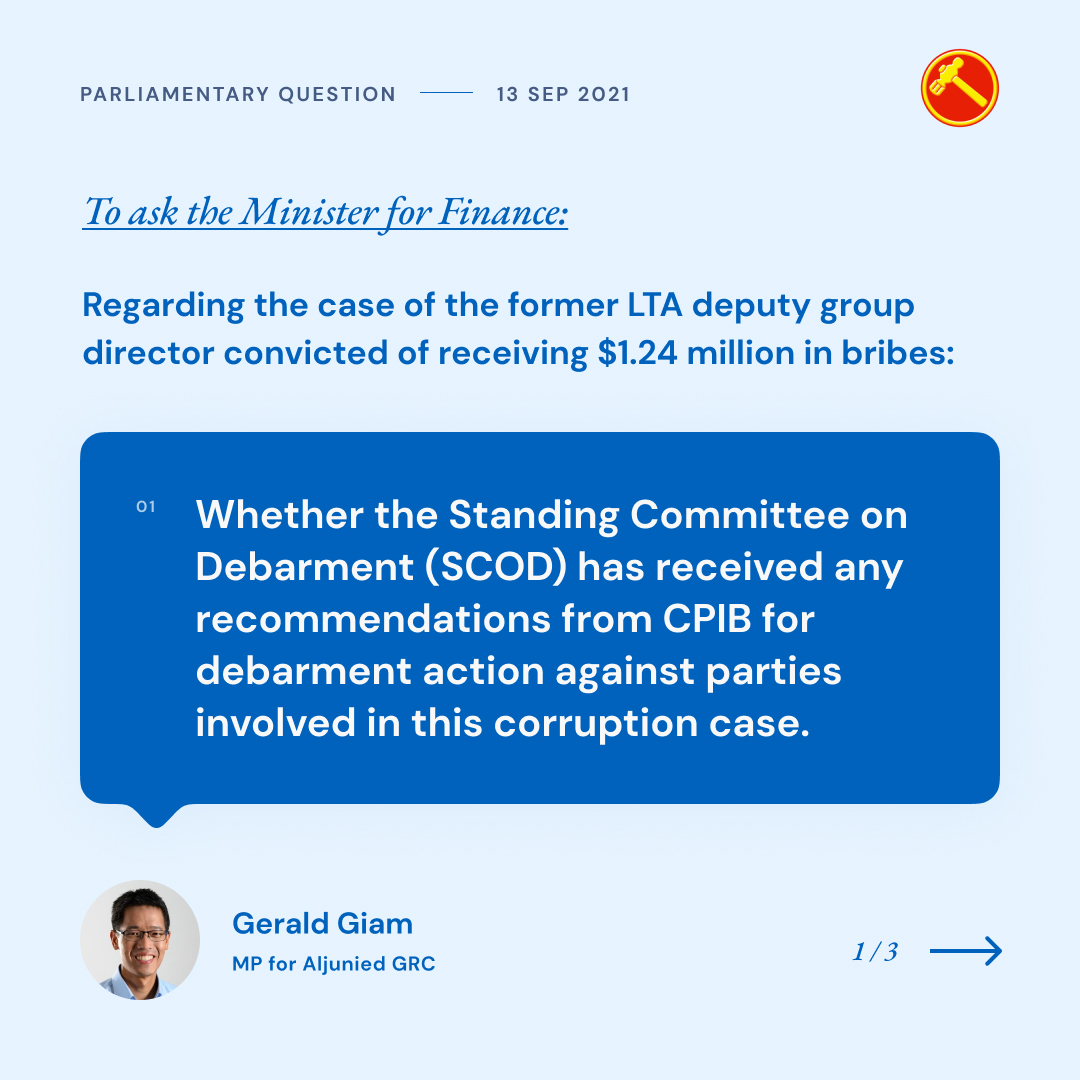
I have filed a Parliament question for 13 September 2021 to ask if the companies involved in this corruption case have been debarred:

Mr Gerald Giam Yean Song: To ask the Minister for Finance regarding the case of the former LTA deputy group director convicted of receiving $1.24 million in bribes (a) whether the Standing Committee on Debarment (SCOD) has received any recommendations from CPIB for debarment action against parties involved in this corruption case; (b) if so, whether SCOD has made any decision to debar any party and the respective periods of debarment; and (c) if not, whether SCOD will proactively request for CPIB to make recommendations for debarment.

The corrupt officer had also been diagnosed with a pathological gambling disorder, and had sought loans from not only contractors but also colleagues in LTA. I asked another Parliamentary question regarding indebtedness declarations among public servants:

Mr Gerald Giam Yean Song: To ask the Prime Minister (a) whether all public servants are required to make annual declarations of non-indebtedness; (b) if so, what is the maximum amount of unsecured loans each officer can have vis-a-vis their monthly income; (c) whether there is any obligation on the part of officers to report fellow officers whom they know have exceeded this amount; and (d) what are the consequences for non-reporting.

Free allergy specialist consultations for those with contraindications to some Covid-19 vaccines

Many residents contacted me over the last few months as the Covid-19 vaccination programme was being rolled out with concerns about safety of vaccinations. Many of them did get their first dose of one of the mRNA vaccinations but had adverse reactions that debarred them from their second dose. As a result, these individuals are not considered “fully vaccinated”, which comes with attendant risks to their health and inconveniences when dining out or operating at some workplaces.

To add to the uncertainty, medical advice on vaccinations is continually being updated. Some of those who were previously medically ineligible for the mRNA vaccines can now get them, and there are other non-mRNA vaccines available. This confusion may result in some medically eligible people not getting their shot, resulting in lower immunity from Covid-19.

MOH should offer these individuals a free consultation with an allergist (a medical specialist) to help them choose suitable vaccines to receive based on the latest medical findings and safety data.

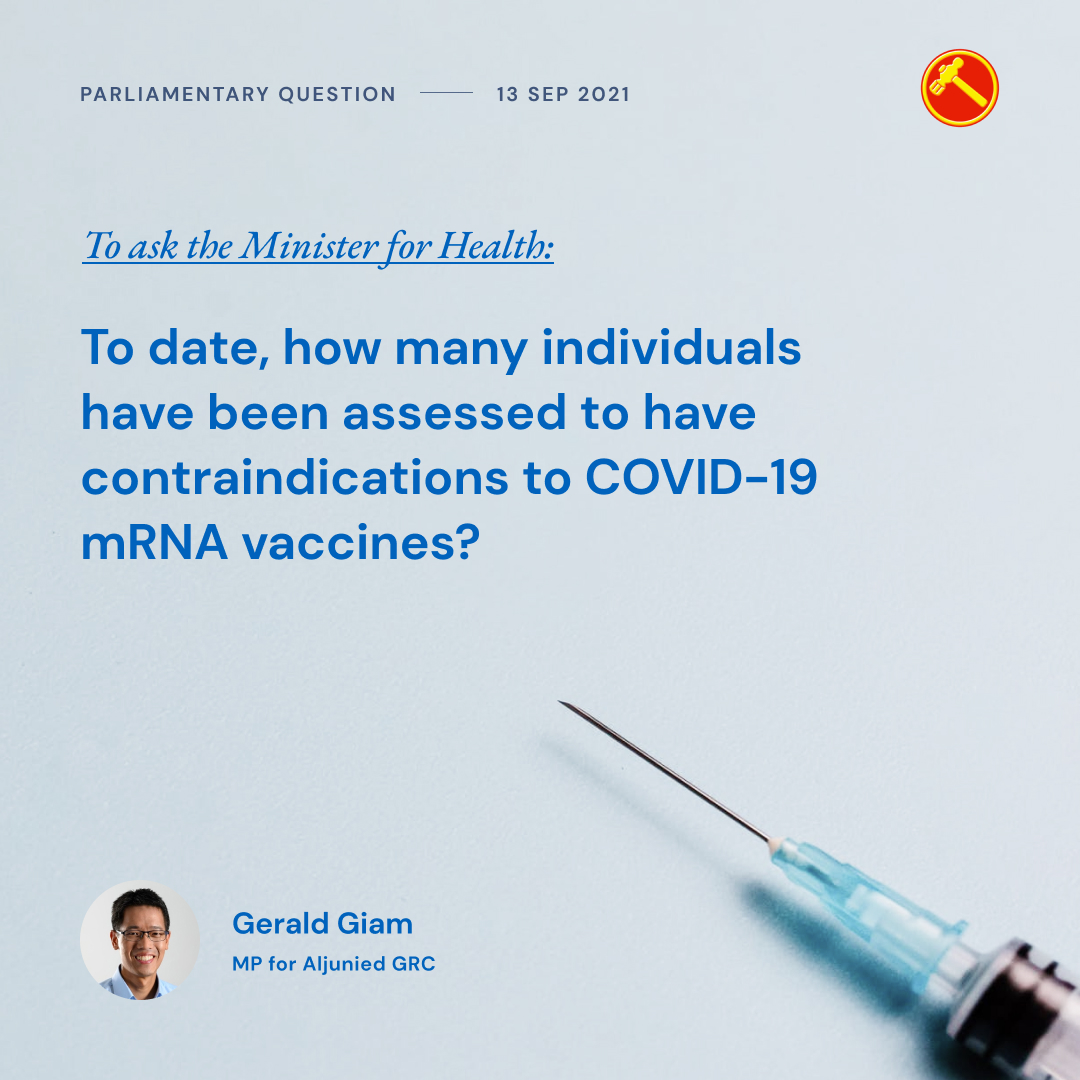
This is the subject of a question I filed for the 14 September sitting for Parliament:

Mr Gerald Giam Yean Song: To ask the Minister for Health (a) to date, how many individuals have been assessed to have contraindications to COVID-19 mRNA vaccines; and (b) whether these individuals can be provided with a free consultation with an allergist to help them choose suitable vaccines to receive based on the latest medical findings and safety data.

I thank one of my constituents for suggesting this question to me.

Infected persons serving quarantine at home

The care model for Covid-19 patients in Singapore is changing in line with higher vaccination rates. MOH is currently piloting a home-centric care model for the management of Covid-19 patients with mild or no symptoms. This enables these Covid-19 patients to be with their families, who can also support and care for them at home.

However, it is important to also ensure that such patients are closely monitored and treated. This is so they don’t end up being a source of spread of the disease, especially to their immediate family members, or see a worsening of their conditions which will require hospitalisation.

Many thanks to one of my constituents who raised this concern to me. I have filed this question for the 14 September sitting of Parliament:

Mr Gerald Giam Yean Song: To ask the Minister for Health (a) to date, how many persons who tested positive with COVID-19 have been allowed to serve their quarantine orders at home; (b) what are the criteria for allowing such individuals to quarantine at home; (c) what medical treatment is provided to such individuals to reduce the chances of them requiring hospitalisation; and (d) how are they monitored for a worsening of their condition which may require them to be admitted to a hospital.

Medical oxygen supplies in Singapore

Oxygen supplementation is critically important for patients who suffer severe illness as a result of Covid-19. Such patients often have breathing difficulties and a lack of oxygen could be fatal.

I have filed a question for the Minister for Health to get assurance that Singapore has sufficient oxygen supplies and sufficient domestic oxygen manufacturing capacity, should Covid-19 cases spike after re-opening, as we are already starting to see now.

This is the question I filed for the 13 September 2021 sitting of Parliament:

Mr Gerald Giam Yean Song: To ask the Minister for Health (a) how many patient-days of medical oxygen supplies are available for patients who require oxygen supplementation because of COVID-19 or other diseases; and (b) whether Singapore has sufficient oxygen manufacturing capacity to replenish our local supply should the number of COVID-19 cases increase rapidly as the economy reopens.

Covid-19 infections at bus interchanges

There were 469 Covid-19 cases linked to bus interchange clusters as at 5 September and this number is expected to continue growing. To date, we have heard no conclusive explanations of how the infections occurred, why they occurred only recently and why they spread so quickly. I therefore filed a question last week to be answered on the 14 September sitting of Parliament.

I asked what were the modes of transmission of Covid-19 infections at bus interchanges. Phylogenetic tests on the infected persons may reveal where the infection started.

Many commuters would be concerned about whether it is safe for them to take buses and public transport. I asked if any commuters have been infected at bus interchanges or while on buses with infected bus captains.

Finally, it was revealed that most, but not all bus captains have been vaccinated. I asked whether bus companies will require all their bus captains to get their innoculations.

This is my question as filed:

Mr Gerald Giam Yean Song: To ask the Minister for Transport (a) what have been the modes of transmission of COVID-19 infections at bus interchanges; (b) whether any commuters have been infected at bus interchanges or while on buses with infected bus captains; and (c) whether public transport companies will be requiring all their bus captains to be vaccinated.

Icons by LAFS and PictureWindow / CC BY-SA 3.0)

The Future of Political Leadership in Singapore

These were the opening remarks I made at a dialogue organised by the NUS Political Science Society, titled “The Future of Political Leadership in Singapore”, on 23 Aug 2021.

Thank you to Nelle and the NUS Political Science Society for inviting me to join you tonight. SMS Sim Ann, Assoc Prof Bilveer Singh and Dr Gillian Koh — it’s so good to be on the panel with you.

I am always thrilled to have the opportunity to speak with students who have an interest in political, social and economic developments in Singapore. 

The topics to be discussed today include the transition into the 4G leadership, the challenges of governance, and our crisis management response towards the Covid-19 pandemic.

The transition to 4G leadership is an internal party matter for the PAP to decide, although given their political dominance in Singapore, leadership succession in the PAP does take on national significance.

The Workers’ Party already had our fourth leadership transition in 2018 when our Party cadres elected Mr Pritam Singh as our secretary-general. He is now the Leader of the Opposition.

Regardless of who is at the helm of the Government or the Opposition in Singapore, there are practical realities that need to be dealt with. The world is changing at a breakneck pace, driven by technology, communications and changing values. Our citizens expect to be represented by men and women with a diversity of thought and a unity in purpose. This is what is needed for good governance — and good outcomes!

As Singaporeans, we must never develop a hubristic mindset, thinking we are better than others or that other countries are so “messed up” that there is nothing much we can learn from them. We must not get so carried away with praising ourselves, that we forget that our past performance is no guarantee of future success.

The Covid-19 pandemic presents an excellent case-in-point. The countries which did such a great job at the start in preventing the spread of infections, are now facing a quandary of whether to open up their economies or maintain their zero-Covid stance. Those countries that did well to vaccinate their populations early are seeing the delta variant breaking through and are tightening measures again. The lesson for Singapore is that we need to stay humble and continue to work hard to secure victory over this virus. 

I am supportive of the Government’s moves to transition to a new normal of vaccinations, testing and cautious reopening. I hope the Government sticks to the plan for reopening and communicates this clearly to the people. We should, as far as possible, avoid rolling lockdowns as they have a very detrimental effect on businesses and livelihoods — and possibly even lives.

I still maintain, as I proposed in Parliament, that we need better metrics to measure our progress and gauge the risk of the virus. These metrics need to be more easily understood by the general public so that there will be greater buy-in and voluntary compliance with safe management measures. 

It is very important for all political parties to place the national interest first and foremost, and especially so during times of crisis. Some of you would have seen the video of Mr Low Thia Khiang encouraging seniors to get vaccinated. I can share with you that not all our supporters agree with our stance on vaccinations. But we will support Government policies which we feel are good for the people, and oppose those that we feel will not benefit our society — like POFMA and the GST hike.

We don’t simply oppose, of course, but put forward proposals after considered study and consultation. We have been calling for the implementation of a national minimum wage since 2015 and are glad to see that there is finally some movement in this direction. We have also asked for a mandatory credentials assessment for all Employment Pass applications and the establishment of an independent and transparent electoral boundaries commission.

It is through constructive debate that I believe we can uncover the best solutions to the challenges we face as a nation. That is the spirit in which I look forward to our discussion today. Thank you.

Do local unis have enough computer science degree places to meet industry demand?

It was revealed in Parliament on 6 July 2021 that in the infocomm sector alone, 6,000 jobs remain unfilled. The Manpower Minister explained that Singapore currently does not have enough locals to fill the jobs available.

With this in mind, I asked the Minister for Education some questions regarding the number of Singaporean students admitted to computer science degree courses at local universities:

1) How many Singaporean students applied to study computer science (CS) at local universities each year over the past decade and what was their admission rate?

2) Why has the number of local graduates with CS degrees been insufficient to meet the IT sector’s demand?

3) What plans are in place to increase the intake to meet this demand?

In his reply, Mr Chan Chun Sing said that local universities had increased the number of places in Information & Digital Technologies (IDT) degree courses from 800 undergraduate places in 2010 to 3,100 in 2020. He did not provide the breakdown for places in each year. The admission rate was about 50% across all the universities.

The Minister also said that undergraduates in other courses also take up tech jobs when they graduate. About 50% of fresh grads in tech jobs did not major in IDT.

Have you applied unsuccessfully for computer science courses in local universities? Do you have a passion for tech but can’t break into the industry? Share your experiences and thoughts with me either in the comments below, or by email gerald.giam@wp.sg or WhatsApp 89250747.

Photo by Sean Lim on Unsplash


Here is the full Parliamentary Q&A (26 July 2021):

NUMBER OF SINGAPOREAN STUDENTS ADMITTED FOR COMPUTER SCIENCE DEGREES AT LOCAL UNIVERSITIES AND SUFFICIENCY OF SUCH NUMBERS

Mr Gerald Giam Yean Song asked the Minister for Education (a) how many Singaporean students have applied for computer science degrees in each Autonomous University in each of the last 10 years; (b) of these, how many have been offered admission in each year and each university; (c) why has the number of local graduates holding computer science degrees been insufficient to meet demand in the local IT sector; and (d) what plans have been considered to increase the intake of computer science students to meet industry demand for tech talent.

Mr Chan Chun Sing: The Ministry of Education works closely with the Ministry of Manpower and economic agencies to plan the supply of degree places across different course clusters every year. The Ministry takes into account their inputs on industry demand and national manpower needs across different sectors, as well as students’ interests and aspirations. 

Given the rise in industry demand for tech talent, we have increased the number of places in Information & Digital Technologies (IDT) degree courses over the past 10 years. Today, on average across the Autonomous Universities (AUs), about half of the applications received are offered a place. A single applicant may put in multiple application across the AUs. 

The number of local IDT undergraduate places rose four-fold from 800 in 2010 to 3,100 in 2020. As a proportion of all AU places, the number of IDT undergraduate places increased from 7% in 2010 to 17% in 2020. The breakdown of the 2020 IDT intake of 3,100 places across the AUs was: 1,200 in National University of Singapore (NUS), 600 in Nanyang Technological University (NTU), about 500 each in Singapore Management University (SMU) and Singapore Institute of Technology (SIT), and about 100 each in Singapore University of Technology and Design (SUTD) and Singapore University of Social Sciences (SUSS).

Apart from students in IDT courses, some undergraduates in other AU courses, for example engineering, also take up tech jobs when they graduate. According to Graduate Employment Surveys conducted by the AUs in the last five years, about half of the fresh graduates employed in tech jobs did not major in IDT, and they take up roles such as Software Engineer and Data Analyst. This is because the AUs have been facilitating students from various disciplines to take on IDT-related minors or second majors.

Our industry needs cannot be met by fresh graduates alone. Even as we grow the number of IDT places overall, and encourage more students to take on second majors or minors in IDT, we have to balance this with the manpower needs of other sectors, given our shrinking birth cohorts and limited graduate supply. To supplement this, MOE and sector agencies are ramping up Continuing Education and Training (CET) pathways significantly. This includes expanding TechSkills Accelerator (TeSA) programmes under IMDA, which has placed over 8,000 Singaporeans into tech jobs since its inception in 2016. 

MOE will continue to work closely with economic agencies and the AUs to further strengthen the local talent pipeline for tech jobs in the Singapore economy.


Find this and other Parliamentary questions I have asked at https://sprs.parl.gov.sg/search/result?mpId=356&section=PQ&parlno=14


Auditor-General’s report 2021: Wastage of fitness trackers

The latest report of the Auditor-General found lapses in the management of operations and weaknesses in controls at some public sector entities, including the Health Promotion Board (HPB), the National Heritage Board (NHB) and the Public Service Division (PSD).

At HPB, AGO noted wastage from excess National Steps Challenge fitness trackers not put to use. There were some 341,000 of such excess trackers valued at $5.39 million. AGO also noted that HPB’s processes were inadequate to ensure that the movement of fitness trackers was properly monitored and that the stock of trackers was properly accounted for. It found that there was no central monitoring of the movement and stock of trackers; records maintained were incomplete; and there was no periodic reconciliation of records with physical stock on hand.

On 3 Aug 2021, I asked Minister for Health Ong Ye Kung if HPB will consider distributing all the still-functional fitness trackers to members of the public in order to promote exercise and fitness, instead of disposing them. 

The Minister acknowledged that there was a surplus of 341,000 devices. Of these, just over a third (35%) are still functional and will be put to use, including for replacing faulty trackers and supporting organisations in their health and wellness initiatives. Unfortunately 221,000 fitness trackers have been disposed of, as they have exceeded the average useful life or were no longer functional. 

In explaining remedial measures taken, Mr Ong said that, moving forward, HPB will be more conservative in its projections of the number of fitness trackers to be procured. He said MOH will closely monitor the implementation of these measures, and work with HPB to determine accountability and the prudent use of resources.

Here is the full Parliamentary question and answer:

PROPOSAL TO DISTRIBUTE STILL-FUNCTIONAL FITNESS TRACKERS PURCHASED FOR NATIONAL STEPS CHALLENGE 

Mr Gerald Giam Yean Song asked the Minister for Health whether HPB will consider distributing all the still-functional fitness trackers from among the 341,000 excess fitness trackers purchased for the National Steps Challenge seasons 1 to 5 to members of the public in order to promote exercise and fitness instead of disposing of them. 

Mr Ong Ye Kung: In planning for the various seasons of the National Steps Challenge, the Health Promotion Board (HPB) would estimate demand based on past seasons’ trend and projected increases in demand due to the new season’s eligibility criteria. However, this resulted in an over-estimation of the demand, and surplus of 341,000 fitness trackers.

Of the excess fitness trackers, 120,000 remain functional. 48,000 have been used to replace faulty trackers, and those with expired warranties. About 3,000 trackers have also been used to support community partners, companies, and other government agencies in their health and wellness initiatives. The remaining 69,000 functional trackers will continue to be used for similar purposes. Unfortunately, the rest of the excess fitness trackers have been disposed of, as they have exceeded the average useful life or were no longer functional. 

HPB has conducted a full review of the matter. It has enhanced the processes for central monitoring of the movement and stocks of fitness trackers. HPB now tracks movement across and at all distribution channels closely on a daily basis to detect signs of excesses building up. Audits and physical stock checks will also be done twice a year instead of annually. Excess inventory from previous years will be counted towards providing trackers for the following year’s activity. 

Moving forward, HPB will be more conservative in its projections of the number of fitness trackers to be procured. Any additional purchase of trackers will be done only when excess bookings are received from participants. HPB has also broadened the criteria of replacement for the 1-to-1 exchange and will proactively inform our participants so that they will come forward to exchange the trackers if their trackers are defective. 

MOH will closely monitor the implementation of these measures, and work with HPB to determine accountability and the prudent use of resources as we continue with our efforts to encourage Singaporeans to adopt healthier lifestyles. 


Image credit: The Hooting Post Blogazine

Bringing us closer towards gender equality in Singapore

I strongly support the motion moved by Ms He Tingru and Mr Leon Perera that this House affirms that gender equality requires a whole-of-society effort to remove all barriers in order to empower every woman to freely realise her full potential and participation in society.

I would like to focus on three areas that I believe will bring us closer towards achieving gender equality in Singapore: residency and benefits for foreign spouses, support for single parents and flexible work arrangements.

Residency and benefits for foreign spouses

According to an answer to a PQ I asked last September, in the six months from February to July 2020, the Immigration and Checkpoints Authority (ICA) received 8,395 applications for extensions of Short-Term Visit Passes (STVP) from foreign spouses of Singaporeans. This was an increase of almost 2,000 applications from the year before. These extensions are typically for one to three months, but some are reportedly as short as one or two weeks. While the vast majority of applications are approved, over 250 were rejected during this six month period last year.

A number of my constituents have sought assistance regarding renewals of STVPs and applications for Long Term Visit Passes (LTVP) for their foreign spouses. I am sure many MPs would have also submitted such appeals to ICA.

In the majority of cases that I have come across, the foreign spouse is a woman. They face the uncertainty and anxiety of being separated from their Singaporean husbands — and in some cases, their children as well — if their passes are not renewed. 

I have also noticed that almost all of the residents who have approached me for assistance with their spouses’ visas are from lower income households. Applications for STVP extensions cost $40 for every three months of stay. While it may not seem much, this cost adds up over time. More importantly, their spouses’ immigration worries often add to their daily stresses of life.

To reduce the immigration-related stressors faced by Singapore citizens and their foreign spouses, I propose the creation of a more streamlined path towards obtaining LTVP, LTVP+ and PR status, and eventually citizenship for such spouses. 

There are strong reasons to pursue such a policy. For example, given that a quarter of marriages here are between a Singaporean and a non-resident, transnational marriages will continue to be an important contributor to family formation in Singapore. As such, fast-tracking parents, and potential parents, of Singaporean children for citizenship would facilitate the formation of stable family units with a full stake in Singapore.

Towards this end, the primary consideration for a PR application by LTVP holders who have a Singaporean spouse or child, should be their family ties and rootedness in Singapore — and not just their income or occupation. Their close family relationship with Singaporeans makes them part of the Singapore Core and we should facilitate, not inhibit, their integration into our society.

I am aware that not all foreign spouses may immediately qualify for PR status. However, foreigners who have entered into a bona fide marriage with a citizen should be granted LTVP status by default. I have constituents who have been married to foreigners for over a year and are still unable to obtain an LTVP for them. They need to continually renew their spouse’s STVPs, with no certainty of approval each time. 

One constituent told me of his desire to have children with his wife but he has shelved those plans because he is worried that his wife may be forced to leave Singapore if her pass is not extended, leading to a separation from any children they might have. Madam, our citizens and their foreign spouses deserve a better assurance of their place in Singapore. 

Support for single parents

Next, I would like to appeal for the Government to raise the level of support currently given to single parents, so that they and their children are not disadvantaged in our society. In a speech in 2013, I outlined the burdens faced by single parents who have to take on the role of both father and mother and perform caregiving duties while also holding onto a job to pay the bills. Compounding their challenges, they are denied some of the parenthood benefits that married, divorced and widowed parents receive. This could add to their feeling of marginalisation from society.

Since single mothers make up the bulk of single parents, changes in policies to support single parents will disproportionately benefit women. My former parliamentary colleagues, in particular Ms Lee Li Lian, as well as Dr Daniel Goh, Mr Png Eng Huat; and current MPs Mr Faisal Manap, Mr Dennis Tan, Mr Leon Perera and others have repeatedly advocated for greater support for single parents over the past eight years.

Government benefits and housing options for single unmarried parents and their children should be the same as for any other family unit. The distinction that the Government often makes between single unmarried parents and divorced parents, in terms of the benefits provided, should be removed. 

To be clear, we should not encourage single parenthood or having children outside of marriage, any more than we encourage divorce. It is hard enough raising children with both parents, let alone by oneself. However, once a woman has made the brave choice to carry her child to term despite not having the support of a spouse and likely family disapproval, we as a society must do all we can to support her. We should not make things more difficult for her by denying her benefits available to other parents.

We must also be mindful that unequal benefits inadvertently penalise the innocent children of single unmarried parents, who are often in need of greater support. According to a reply to a PQ by Mr Louis Ng, the median monthly income from work of single, unmarried mothers below the age of 35 was just $600 in 2017, which was 86% less than the national median income that year. Currently, many young single parents are not eligible to buy or rent a subsidised HDB flat to live with their children.

What this means in practice — and I have seen this among my constituents — is that they and their children have to squeeze into a flat with their parents, close relatives or friends. However, this is an inherently unstable arrangement. If they fall out with a family member, or are estranged from their families – as some are – they risk having nowhere to stay. Renting a flat in the open market is seldom a realistic option as it is prohibitively expensive. Singles below the age of 35 do not qualify to purchase HDB flats or rent flats under the Public Rental Scheme.

I note that HDB has said it will exercise flexibility in allowing unmarried parents to buy a 3-room or smaller flat in a non-mature estate from HDB, or a resale flat, and those who cannot afford to buy a flat may be considered for public rental flats. I would like to see this made the default for all single parents so that they are not denied a roof over their heads, and their children have a safe and homely environment to grow up in.

Single parents awaiting the construction of their BTO flats should also be allowed to rent a flat under the Parenthood Provisional Housing Scheme (PPHS), which is currently available only to married couples, divorcees or the widowed. 

All single parents and their children are a family in every sense of the word, and should be considered a family nucleus by HDB for the purpose of purchasing or renting flats.

Some single parents who are divorcees also continue to face difficulties getting their monthly maintenance from former spouses. The Government introduced the Maintenance Record Office (MRO) scheme in 2016 to assist the courts by identifying those who refuse to pay even though they have the means to do so, so that the courts can impose penalties on them. Mr Leon Perera previously asked in 2017 if MSF could provide a mechanism for spouses to request for an investigation of the MRO without having to go through a Court process. I hope the Ministry will give consideration to this proposal as it reviews the MRO programme.

I should also mention that we should give single fathers the same benefits as single mothers, as they face very similar challenges as single mothers in raising children alone. The Women’s Charter was changed in 2016 to allow men to apply for alimony. However, this is only possible if he is incapacitated and therefore is unable to work. This high bar should be removed. A man should be allowed to apply for maintenance from his ex-wife if he has custody of their children and has a much lower earning power than her.

Flexible work arrangements

The final point I wish to raise relates to work arrangements. 

I call for companies to redouble their efforts to make flexible work arrangements available to employees who can and wish to work from home. The Government can do its part to nudge enterprises in this direction through tax incentives and by leading the way through civil service human resource policies.

I recently met an elderly constituent at the wake of her deceased husband. As was my usual practice, I asked if she was in need of any assistance. I was glad to hear that she was doing fine as she was able to continue working from home because of the arrangements made by her enlightened employer. Her employer couriers her work to her flat daily and picks it up from her the next morning after she has completed it. This way, despite her inability to walk very far unassisted, she can apply her skills and earn some income to support herself. 

I believe that more businesses should explore such flexible work arrangements to meet their manpower needs while providing employment to those who can only work from home. 

This will empower many women with caregiving responsibilities, not to mention older workers and those with mobility issues. There are many women as well as some men who make a difficult choice to stop work temporarily to care for their young children or elderly parents. Very often, this dilemma could have been avoided if more companies allowed their employees to work from home.

One silver lining of the Covid-19 pandemic is that it has forced many companies to digitalise and make work from home arrangements. This has been helpful to many caregivers who need to look after their young children or elderly parents.

However, once Singapore starts to reopen, many companies may start summoning their workers back to the office. I hope companies will not forgo their digital gains this way. Companies should assess which jobs can be performed as productively at home as in the office, and give employees a choice of working remotely.

The labour force participation rate of women trails 14% behind men. The gap starts to form for women starting from their mid-twenties — the age when they start having children — and continues to increase throughout their childbearing years, with a peak of some 25% behind men of the same age.

This could point to what is known as a “child penalty”, which can have a negative impact on a woman’s earning power and retirement adequacy. Even with work from home arrangements, SMU sociologist Aliya Rao found that women bear a greater burden of handling both paid work as well as the unpaid work of managing the household. This is a point that Ms He Tingru also made earlier.

The key point here is flexibility. We need to promote a work environment that is more understanding of the various roles mothers and fathers desire to play, and avoid forcing them to choose one role over another. This will enable many more parents to continue pursuing their careers while providing for themselves and caring for their families.

Summary

In summary, I call for the streamlining of immigration procedures for foreign spouses of Singapore citizens to strengthen the Singapore Core; for more support to be extended to single unmarried parents; and for policies to promote flexible work arrangements, all of which will benefit both women and men.


I made this speech in Parliament on 3 August 2021 on a private member’s motion moved by Workers’ Party MPs He Tingru and Leon Perera on Empowering Women.