Protecting family members from scams

Mr Gerald Giam Yean Song asked the Prime Minister (a) whether there is currently a facility for an individual to prevent close family members whom they suspect are victims of scams from making outbound funds transfers from their bank accounts; and (b) what recourse do such families have to prevent unwitting loved ones from draining their savings due to such scams.

The number of scams in Singapore increased 165% in the first half of 2021 compared to 2020. The most common scams include internet love scams, loan scams, tech support scams and the impersonation of Chinese officials. I have met and assisted residents who have been victims of all of these scams. Listening to their stories is heart-rending. Some had lost their entire life savings after sharing a one-time password (OTP), while others watched helplessly as loved ones unwittingly continued to send money to scammers. 

I was particularly concerned about my residents in the latter group who approached me. After writing an appeal to the Monetary Authority of Singapore (MAS), the banking regulator, I realised that there is no facility to enable individuals to stop family members from making outbound fund transfers to suspected scammers. This was confirmed in a response to a Parliamentary question I asked on 2 Nov 2021. Senior Minister Tharman Shanmugaratnam said that banks generally act only upon the instructions of the account holder unless they had provided written consent and mandated another person to operate the account on their behalf.

While I understand the importance of not undermining the agency of bank account holders, I find the current policy position unsatisfactory. I was alarmed to learn that my resident’s mother may be preparing to sell the family home to cash out her money to give to a scammer. Surely there should be some recourse for families to prevent unwitting loved ones from losing their family savings to scammers. It was reported that some bank officers in OCBC have gone to great lengths to persuade their customers not to make transactions they suspected to be fraudulent. They deserve to be commended for their persistence. However, effective safeguards against scams cannot depend solely on the dedication of individual bank officers.

I hope the MAS will urgently look into putting in place more effective safeguards to protect Singaporeans and their loved ones from becoming victims of scams.

Here is the full answer to my question:

FACILITY FOR INDIVIDUAL TO PREVENT OUTBOUND FUNDS TRANSFER FROM BANK ACCOUNTS OF CLOSE FAMILY MEMBERS SUSPECTED TO BE VICTIMS OF SCAMS

Mr Gerald Giam Yean Song asked the Prime Minister (a) whether there is currently a facility for an individual to prevent close family members whom they suspect are victims of scams from making outbound funds transfers from their bank accounts; and (b) what recourse do such families have to prevent unwitting loved ones from draining their savings due to such scams.

Mr Tharman Shanmugaratnam (for the Prime Minister): There is no facility to enable an individual to stop outbound fund transfers from the bank accounts of family members whom they suspect may become victims of scams. Banks generally act only upon the instructions of the account holder unless he has provided written consent and mandated another person to operate the account on his behalf. This is to protect the rights of the account holder.

But Mr Giam also asks how family members can help one another avoid becoming victims of scams. Anyone who suspects that a family member has been a victim of a scam, or is being targeted by scammers, should advise the family member to contact his or her bank and make a police report.

In the event that the suspected victim does not agree to do so, the concerned family member can contact the Singapore Police Anti-Scam Hotline, where trained staff are available to provide independent advice to the suspected victim. 

We can help our family members to take pre-emptive measures to better protect themselves. We can share with them information and other resources on scam prevention. The National Crime Prevention Council (NCPC) has a dedicated website – scamsalert.sg – which provides useful tips on how to identify and avoid falling prey to scams, as well as a mobile application – ScamShield – which will block scam calls based on a list of numbers maintained by the Police. We can also discuss with family members the banking facilities they require for daily use, and advise them to protect their accounts by setting appropriate transaction limits and lowering transaction alert thresholds. These are basic measures that can help them stay alert to unauthorised transfers and limit their financial losses in the event of an unauthorised transaction. 

MAS, together with the Singapore Police Force and the financial industry, will continue to look into measures to help consumers defend themselves against scams.

Source: https://sprs.parl.gov.sg/search/sprs3topic?reportid=written-answer-9267 

Martial arts in Hougang

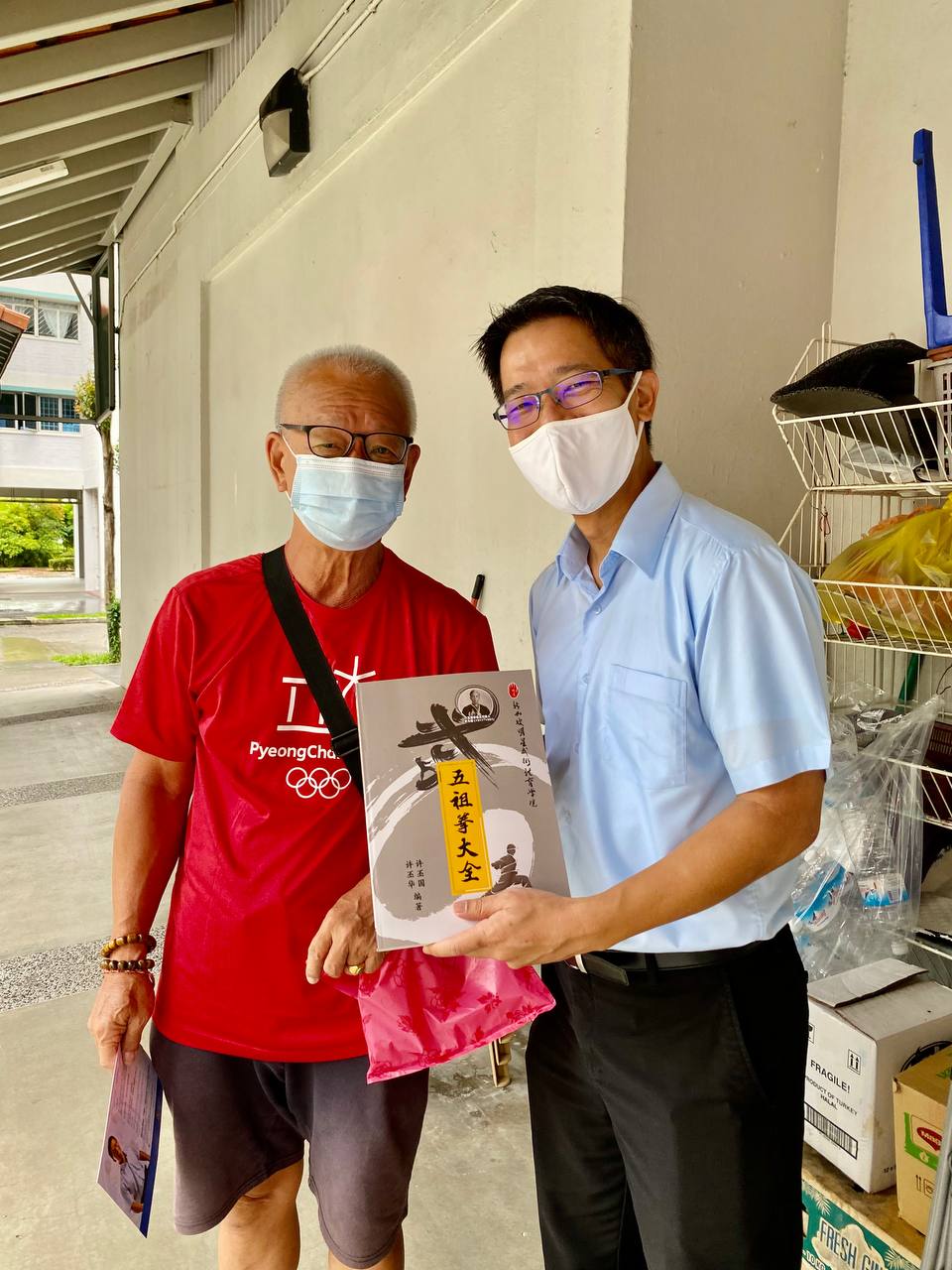
这个周末我在走访阿裕尼集选区的后港邻里时,碰到了许先生。他赠送了我一本他自己编著并亲笔签名的《五祖拳大全》。五祖拳是一门中华武术,许先生的父亲是第三代传人。我们很庆幸许先生能够延续传统,并编撰了这本记录这门拳法历史的书。

I had a delightful morning this weekend walking about Hougang estate in Aljunied GRC. I was pleasantly surprised and honoured to be presented with a personally autographed book, The Complete Guide to Five Ancestors Fist (五祖拳大全), written by my resident, Mr Koh. Five Ancestors Fist is a form of Chinese martial arts. Mr Koh’s father was among the third generation of practitioners. We are so fortunate that Mr Koh is carrying on the tradition and has written this book to record the history of this practice.

Use of Job Support Scheme payouts by companies

A building construction group in Singapore was recently asked by a shareholder why the remuneration for its key executives was higher than the previous year, even though net profit, excluding government grants, was lower. It responded that executive bonuses are calculated based on the group’s profitability. It said that additional operating costs due to the pandemic and government grants received to help defray such costs were included in the computation. It later issued a clarification that Covid-related expenses were “higher than the grant amount received”.

One of the key government grants that most companies and organisations received in the past year are the Jobs Support Scheme (JSS) payouts, which has cost the taxpayer (and the Reserves) more than $27.6 billion since Feb 2020.

This revelation raised questions about whether the JSS, which is supposed to support the wages of workers to reduce retrenchment during the economic downturn, has been used to benefit top executives instead.

I asked Minister Lawrence Wong how the Ministry of Finance (MOF) ascertains that JSS payouts are used for wage support and what are the MOF’s plans for claw backs if JSS payments are found to have been used for other purposes, including senior executive bonuses or stock buybacks.

There have been several companies and even non-profits who returned their JSS payouts because they felt they did not need it. This is commendable. I asked whether MOF will consider publishing the list of organisations which returned all or part of their JSS payouts so that they can be given due public recognition.

Here is the full Parliamentary question and answer on 2 Nov 2021:

ENSURING JOBS SUPPORT SCHEME PAYMENTS ARE USED DIRECTLY FOR WAGE SUPPORT AND NOT FOR EXECUTIVE DIRECTORS’ REMUNERATION OR BONUSES

26 Mr Zhulkarnain Abdul Rahim asked the Minister for Finance whether the Ministry tracks data on the number of companies which have obtained Government grants such as that under the Jobs Support Scheme but have paid their workers less based on the amount of CPF contributions disclosed while the executive directors received bigger bonuses or remuneration in the same year.

27 Mr Gerald Giam Yean Song asked the Minister for Finance (a) how does the Ministry ascertain that Jobs Support Scheme (JSS) payments are used for wage support; (b) what are the Ministry’s plans for clawback if JSS payments are found to have been used for other purposes, including senior executive bonuses or stock buybacks; and (c) whether the Ministry will consider publishing the list of organisations which returned all or part of their JSS payouts so that they can be given due public recognition.

Mr Lawrence Wong: The Government introduced the Jobs Support Scheme (JSS) in 2020 to provide rapid, broad-based wage support to help employers retain their local employees during the height of the COVID-19 crisis.

JSS payouts are computed based on actual mandatory employer CPF contributions made to bona fide employees. The CPF Act requires employers to make CPF contributions on wages payable to their employees, subject to the prevailing wage ceilings. Employers will not receive JSS payout if they fail to make CPF contributions for their employees for the respective reference month. Similarly, if employers cut wages for their employees during the respective reference month, their JSS payout will be correspondingly reduced. In other words, the JSS is designed as a reimbursement to help employers offset part of the wages already paid to their employees. Announcing the timing and schedule of JSS payouts allowed employers to take these payouts into account and retain local workers despite the challenging economic circumstances during the pandemic.

We also capped the Government’s co-funding under the JSS to first $4,600 of gross monthly wages paid to each local employee. This means that employees and senior executives whose gross monthly wages are higher than $4,600 will have a lower effective JSS support.

Given how JSS payouts are computed, the Ministry of Finance does not track the data that Mr Zhulkarnain asked about. To prevent abuse of JSS, IRAS, as the administrator of JSS, has instituted a robust anti-gaming framework since the first JSS payout in April 2020. For cases with high risk of fraud, such as irregular CPF contributions to get higher JSS payouts, IRAS requires the firms to authenticate their CPF contributions before the payouts are released. As of August 2021, 1,889 cases have been denied or had their JSS payout adjusted. Cases with strong corroborative evidence to support JSS abuse are reported to the Commercial Affairs Department (CAD) for further investigation and prosecution. As of August 2021, 10 cases are undergoing police investigations. 

Besides IRAS’ anti-gaming checks for JSS, the CPF Board also audits employers to check the accuracy of CPF contributions paid and wages declared. The CPF Board is also piloting the CPF Contribution Alert which allows employees to receive personalised notifications when their monthly CPF contributions are credited. Employees can conveniently verify the wages declared by their employers and CPF contributions paid by their employers against their payslip. Employees and whistleblowers can lodge reports to the CPF Board for any non-compliance of CPF contributions.

The JSS and other COVID-19 economic relief grants were meant to support businesses in this period of significant economic uncertainty. While the Government does not intervene in how business owners and board directors determine remuneration and bonuses for key executives, they are expected to practise good corporate governance and stewardship. In particular, a good practice is to exclude government grants in the computation of a company’s financial performance for the purposes of determining remuneration and bonuses for key executives. This is because government grants are not a result of the performance efforts of these key executives. We understand that the Singapore Institute of Directors will also be putting out some guidelines on best practices in remuneration governance soon.

For companies that are managing well, we encourage them to return the JSS to us, or donate the JSS received to a charity of their choice. It is commendable that companies which were able to cope well with the crisis, have declined to receive JSS or donated the JSS received. Some have asked to remain anonymous for internal organisational reasons. Meanwhile, there are also companies that have chosen to use the JSS in other responsible ways, such as providing additional training to upskill their employees or expanding their operations, hiring more Singaporeans as a result.

We will need to study carefully the implications of publishing the list of organisations that have returned part or all of their JSS, balancing public recognition, requests for anonymity, and the risks of placing undue pressure on other firms that have been using the JSS monies responsibly in other ways. 

Source: https://sprs.parl.gov.sg/search/sprs3topic?reportid=written-answer-na-9444

Energy resilience and Singapore’s energy transition

The recent natural gas supply disruptions and consequential increase in electricity prices have brought to the fore the importance of strengthening our nation’s energy resilience. 

To-date, five electricity retailers will be dimming their lights and others have stopped accepting new customers. This has impacted over 150,000 customers, who will most likely have to pay more for electricity in the coming months.

This may be just the tip of the iceberg of people affected by increasing electricity prices. About 714,000 households which had not previously switched to a retailer in the Open Electricity Market are paying a regulated electricity tariff which has increased by 32% since last September. According to the answer to a Parliamentary Question I asked in January, 79% of HDB 1-2 room households and 63% of 3-roomers are paying the regulated tariff, compared to just 40% of those living in landed properties. This indicates that lower income Singaporeans may be disproportionately impacted by higher electricity prices. 

Other households which have locked in lower rates in their retail contracts will soon face their day of reckoning when they renew their contracts, as the new rates will reflect the higher prevailing electricity prices.

This electricity price hike couldn’t have come at a worse time for many households. Our economy has yet to fully recover from the pandemic-induced downturn, and many Singaporeans are still struggling with job losses, salary reductions and disrupted careers. Many are working and studying from home, resulting in higher household electricity usage.

I would like to reiterate the request I made yesterday for lower income households to be given a one-off special additional electricity rebate during this difficult period. This should be on top of existing U-save rebates, which were calculated before the current electricity price increases occurred. I appreciate Minister Tan See Leng’s reply yesterday that he is exploring with MOF further means to help and is working out the details with them.

The current electricity price increase can be traced to disruptions in the supply of natural gas to Singapore and higher demand globally. In the last few months, the curtailment of the flow of gas from Indonesia’s West Natuna gas field and the low landing pressure of the gas supplied from South Sumatra has severely impacted a vital source of our power generation needs. 

Questions on the Bill

The Energy (Resilience Measures and Miscellaneous Amendments) Bill that is before the House today is timely as it seeks to better safeguard Singapore’s energy security. It enables the Energy Market Authority (EMA) to construct, acquire, manage and protect electricity infrastructure and authorises EMA to implement policies to reduce the emission of greenhouse gases in the generation of electricity.

It is comforting to know that EMA will be able to step in to build, own and operate power generation plants if needed. However in practice, this will be done only as a last resort, for example, if existing gencos fail in their roles? Or is EMA already making plans to directly build and operate critical electricity infrastructure like undersea cables to import electricity from overseas? 

I note the Minister just said in his Second Reading speech that the Government’s preference is for the private sector to build, own and operate electricity infrastructure, and that before exercising this power, EMA will explore the options available. 

The Minister also just assured the House that EMA will put in place governance structures to mitigate conflicts of interest. Can he elaborate on what these governance structures will be to ensure fair competition in the electricity market and mitigate conflicts of interest?

The Government has announced plans to embark on a multi-decade programme to transition our electricity generation to low-carbon generation sources through four supply “switches”. 

These are, first, by increasing the energy efficiency of natural gas power plants. Second, by accelerating solar deployment. Third, by tapping on regional power grids for low-carbon electricity imports. And fourth, by developing low-carbon solutions such as hydrogen and carbon capture, utilisation and storage (also known as CCUS).

Heavy reliance on natural gas

About 95% of our electricity is generated from imported natural gas. This is unusually high compared to other countries and it carries concentration risks.

Recently, the tiny European nation of Moldova, which gets almost all its gas from Russia, had to declare a state of emergency over a gas shortage. The Russian state gas giant, Gazprom, hiked its prices four-fold, then reduced supply when Moldova refused to pay. Moscow has been accused of “weaponizing” its gas monopoly in Moldova, which recently elected a pro-Western president and parliament.

In Singapore, around 70% of our natural gas is piped from Malaysia and Indonesia. Will we face similar threats should relations with our neighbours get rocky, as they do from time-to-time?

In fact, it may already be happening even in the absence of diplomatic problems. In February 2020, the Indonesian government announced that it intends to halt gas exports to Singapore by 2023, when one of our two gas pipeline contracts expires. This ought to set off alarm bells, given our heavy reliance on Indonesian piped natural gas.

Over the years, Singapore has worked hard to diversify our national water taps away from an overreliance on imported water from Malaysia, to ensure a more robust and sustainable water supply. We need to do the same for our energy supply switches.

How will the Government diversify our current 95% dependence on imported national gas for power generation?

Clearly, we cannot afford to shift back to dirty fuels like oil and coal, which in any case also need to be imported. Therefore our future lies in a greater reliance on renewable energy.

Political risk of energy imports

The third supply switch envisions tapping on regional power grids for clean energy imports. Singapore is planning to import up to four gigawatts of low-carbon electricity by 2035, which is expected to make up around 30% of Singapore’s electricity supply.

However, the proposed import of electricity generated from solar farms in Australia’s Northern Territory will be via undersea cables running through Indonesian waters. This could present the same political risks as transnational gas pipelines. The Indonesian government had to approve the undersea cable route last September, and it is unclear how long this approval will be for.

On 22 October, Malaysia announced that it will not allow renewable energy exports to Singapore. Their former prime minister Tun Dr Mahathir Mohamed questioned why non-renewable energy exports to Singapore were allowed. 

Australian support for the export of renewable energy to Singapore may also wane with political winds. Some NUS researchers recently warned that the Australian government may suffer some push back from its powerful coal lobby.

On the flip side, even countries which support the development of renewables might prefer to use their clean energy domestically to meet their own net-zero pledges.

With Singapore potentially sandwiched between competing interests that we have no control over, how will the Government manage the political risks associated with importing 30% of our electricity in the future?

More ambitious renewable energy goals

With both natural gas and electricity imports carrying risks, we need to strengthen our indigenous capabilities to produce clean energy.

Our geography and highly urban landscape limits our renewable energy options. We don’t have wide open deserts to set up large solar farms, but we have plenty of building rooftops and intense tropical sunlight. 

Solar power, however, tends to be intermittent. When the sun stops shining, the electrons also stop flowing. Fortunately battery technology has improved tremendously in recent years, driven by the growth in electric cars. At the same time, the price of lithium-ion batteries is expected to fall 45% between 2018 and 2030. Better energy storage systems will smooth out of the imbalances between supply and demand of solar power.

EMA has said that it is targeting a 2 gigawatt-peak of solar energy by 2030. Yet even if this target is met, solar will supply only around 3% of our total electricity demand. 

Is this really the best we can achieve with solar? Are we planning for a large-scale deployment of solar panels on building rooftops, reservoirs and even offshore islands? Are we providing companies sufficient incentives to boost adoption of energy storage systems that are paired with solar installations?

Besides solar energy, have we done a deep dive to explore other renewables like tidal energy, geothermal energy and offshore wind farms? 

We don’t have very much time to diversify our energy sources away from natural gas. As countries shut down their pollutive coal-fired power plants, natural gas will increasingly be used as a transition fuel. This will reduce the supply available to us and raise its price. 

The Government, industry and our people need to double down to innovate and come up with more clean energy solutions to diversify our energy mix, strengthen our energy resilience and meet our climate change pledges.

Singapore’s energy transition must be accelerated and managed well, to ensure that our lights stay on and our electricity bills remain affordable.

Sir, I support the Bill.


The above was a speech I delivered on 2 Nov 2021 in Parliament during the debate on the Energy (Resilience Measures and Miscellaneous Amendments) Bill.

Free ART kits for regular testing

New Covid-19 health protocols were announced on 8 Oct 2021, emphasising personal responsibility, self-management and a greater reliance on antigen rapid tests (ART). Singapore residents are now encouraged to test themselves regularly, especially before visiting elderly relatives or other Covid-vulnerable persons.

While it is laudable that the Government has distributed (or is distributing) 16 ART kits to each household between August and December, this may not be sufficient under the new protocols. A family of four testing themselves once a week will use up their free kits in just a month. The kits are available in pharmacies, but $36 per family per test is non-trivial. With such rationing and costs, most households will use their ART kits sparingly and only when required to by law. On a national scale, this will not help in arresting the spread of Covid-19 and protect our elderly and our healthcare system.

Of course, not everyone will be visiting grandma every week, so it would be wasteful to give free kits to every household. Instead, these kits could be available upon request to those who need it for their personal use. We already have a distribution channel for this — vending machines.

Here is the text of my question:

Mr Gerald Giam Yean Song: Asked the Minister for Health in view of the updated health protocols announced on 8 October 2021 emphasising personal responsibility, self-management and a greater reliance on antigen rapid tests (ART), whether the Government will allow individuals to collect free ART kits for their own regular testing, from designated vending machines, to supplement the free kits that will be distributed to all households from October to December 2021.

This was the Minister’s answer on 2 Nov 2021:

Mr Ong Ye Kung: Each individual who receive a Health Risk Warning (HRW) can
collect six Antigen Rapid Test (ART) kits from vending machines located islandwide. Workers on mandatory regular testing regimes are currently also provided with free kits by the Government. To support individuals to self-test regularly, we had distributed six kits to each household from August to September, and are distributing another ten kits from October to December. Individuals who need more kits can purchase them from major retailers and e-commerce platforms.

Vaccinations for inbound travellers and exceptions

I have filed a Parliamentary question for the Minister for Transport for the next sitting of Parliament, to ask whether all visitors, including those from countries with Air Travel Pass arrangements, are required to be fully vaccinated prior to arrival in Singapore. I have also asked what exceptions are being granted to this rule.

This is the full text of my question:

Mr Gerald Giam Yean Song: To ask the Minister for Transport (a) whether all visitors, including those from countries with Air Travel Pass arrangements, are required to be fully vaccinated prior to arrival in Singapore; (b) which groups of visitors are excluded from this requirement; and (c) what are the reasons for these exclusions, if any.

Update (14 Nov 2021):

This is the full text of the Minister’s answer on 1 Nov 2021, which was answered together with several other questions:

VACCINATED TRAVEL LANE ARRANGEMENTS WITH MORE TERRITORIES

The following question stood in the name of Mr Ang Wei Neng –

42 To ask the Minister for Transport whether Singapore is considering accelerating Vaccinated Travel Lane (VTL) arrangements with more territories, especially those with lower COVID-19 infection rates such as Australia, China, Hong Kong and New Zealand.

43 Mr Kwek Hian Chuan Henry asked the Minister for Transport whether the Ministry will consider increasing the quota for passengers from Vaccinated Travel Lane (VTL) flights given that VTL flights are from countries with similar risks and that the adult passengers are already vaccinated and tested multiple times prior to entry.

The Minister for Transport (Mr S Iswaran): Mr Speaker, Sir, may I have your indulgence. My reply would take a little bit longer than the allotted time.

Mr Speaker: Yes, carry on.

Mr S Iswaran: Mr Speaker, may I have your permission to take Question Nos 42 and 43 on the vaccinated travel lane, together?

Mr Speaker: Yes, please.

Mr S Iswaran: I also would like to address similar questions on this subject that have been filed by Mr Saktiandi Supaat1, Mr Louis Chua2, Mr Gerald Giam3, Mr Shawn Huang4 and Mr Dennis5 Tan for subsequent Sittings.

I want to start by taking stock of where we are in terms of border reopening. 

Members would be aware that MOH has established a risk-based categorisation of countries and regions. This framework is based on its public health assessment of a country or region’s COVID-19 situation, including its infection rate and vaccination coverage.  

Countries and regions in Category I are of the lowest risk. Currently, this includes Mainland China, Hong Kong, Macao and Taiwan. These are countries and regions which continue to adopt a “zero-COVID” approach, and which therefore continue to have very low COVID-19 incidence rates. To Mr Ang Wei Neng’s question, we have already opened our borders to all travellers from these countries unilaterally. They can enter Singapore quarantine-free and need only undergo an on-arrival PCR test. To Mr Gerald Giam’s question, we do not require the visitors who arrive from these Category I countries and regions to be vaccinated.

Countries and regions in Category II are of a similar incidence rate to Singapore or lower. Since 8 September 2020, we have reopened to vaccinated travellers from some of these countries in a cautious and calibrated manner through the Vaccinated Travel Lanes (VTLs). We started the VTL scheme with two countries, namely Brunei Darussalam and Germany, and have since extended it to eight others. We have also announced the commencement of VTLs with Australia and Switzerland from 8 November, and with the Republic of Korea from 15 November. In total, we have launched VTLs with 13 countries, which is a fraction of the countries that Changi Airport was connected to pre-COVID-19. Collectively, they accounted for about 15% of Changi’s annual passenger arrivals pre-COVID-19.

Mr Henry Kwek, Mr Saktiandi and Mr Louis Chua have asked about the quota and designated flights for the VTLs, and how these are distributed.

We set an overall quota for the VTL scheme as a safeguard to manage the public health risk. The quota is allocated to airlines operating flights to and from VTL countries based on the plans they submit. The allocation for each country and airline can vary based on demand, but the total will be kept within the overall quota. The airlines can only carry eligible passengers on the designated VTL flights. The Civil Aviation Authority of Singapore (CAAS) monitors the airlines closely to ensure their adherence to the stipulated measures and allocated quota. 

The quota for the first 10 VTL countries is 2,500. When the VTLs with Australia, Switzerland and the Republic of Korea commence later this month, the total daily quota for all 13 countries on the VTL scheme will be increased to 4,000. This is about 5% of the total daily arrivals at Changi pre-COVID-19. There will be about 19 daily VTL flights from these 13 countries, with an average VTL quota of 200 per flight.

 We will monitor the incidence rate and the proportion of imported cases closely, review the demand, before deciding on any further increases in the quotas.

 Mr Ang Wei Neng, Mr Shawn Hwang and Mr Dennis Tan have asked about our plans to extend the VTLs to more countries and our criteria for doing so.

 We are in discussions with several partners, including our regional neighbours, to reopen safely to each other. We hope to conclude these discussions soon and restore our connectivity with them. We will announce details when ready.

 I would like to emphasise that in these early stages of reopening our borders, it is more important that we do it well rather than scale up fast.

We have therefore expanded the VTL scheme step-by-step, informed by the public health assessment of the country’s or region’s COVID-19 situation, and also the operational risks and implications. This includes whether key safeguards under the VTL scheme can be effectively implemented, such as whether travellers from the VTL countries can present digitally verifiable and authenticated proof of vaccination as a precondition for entry. We work closely with MOH to regularly review safeguards such as the testing protocols based on the latest scientific evidence and testing technology. Even as we seek to reopen our border and restore connectivity with the rest of the world, safeguarding public health is our utmost priority.  

Mr Saktiandi has asked whether the VTL approach is transitory and what my Ministry’s plans are for reopening our borders thereafter. Sir, the VTL scheme is a pathfinder to restoring general air travel, enabling us to establish the protocols for safe reopening to vaccinated travellers. We will progressively expand the scheme as we gain experience and confidence in reopening our borders safely.

Ultimately, our goal is to restore safe two-way quarantine-free travel with countries and regions from around the world. As part of “Living with COVID-19”, we must be resolute and press on with the reopening of our borders, while staying vigilant with the essential public health safeguards. It is crucial to rebuilding and reclaiming our status as an international aviation hub. Much obliged, Speaker.


Note(s) to Question No(s) 42-43:

1 To ask the Minister for Transport (a) what factors will be considered in future adjustments to the quota of Vaccinated Travel Lane (VTL) travellers entering Singapore; and (b) if the VTL approach is transitory, what are the Ministry’s plans to eventually reopen without any country differentiation and with measures for vaccinated residents to travel overseas and return with or without quarantine.  

2 To ask the Minister for Transport for the 11 countries currently under the Vaccinated Travel Lane (VTL) (a) what is the total number of designated VTL flights per month and the average daily seat capacity on such flights based on current flight schedules registered with the CAAS; (b) what is total number of flights per month and the average daily seat capacity on all flights from these countries regardless of VTL designation; and (c) what are the factors and thresholds that the Ministry will consider before raising the designated VTL capacity.  

3 To ask the Minister for Transport (a) whether all visitors, including those from countries with Air Travel Pass arrangements, are required to be fully vaccinated prior to arrival in Singapore; (b) which groups of visitors are excluded from this requirement; and (c) what are the reasons for these exclusions, if any.  

4 To ask the Minister for Transport (a) what are the Vaccinated Travel Lane (VTL) assessment criteria; and (b) which other countries are expected to be included in the VTL list.  

5 To ask the Minister for Transport (a) whether the Government is working on establishing Vaccinated Travel Lanes for all ASEAN member countries; (b) if so, whether an update can be provided; and (c) what are the conditions which will be conducive to allow such access.  

Source: https://sprs.parl.gov.sg/search/sprs3topic?reportid=oral-answer-2641

Electricity price increases and energy resilience

Recently four electricity retailers announced they will be exiting the open electricity market while two others have stopped accepting new customers. This will impact over 150,000 households and businesses, who will most likely have to pay more for electricity in the coming months. The price increases can be traced to disruptions in the supply of natural gas to Singapore. About 95% of our electricity is generated from imported natural gas, of which around 70% is piped from Malaysia and Indonesia. 

I have filed two sets of Parliamentary questions for the Minister for Trade and Industry. 

First, I asked how many households are expected to have their contracts transferred back to SP Group in the next few months and what is the expected increase in electricity price they will face. How will the Government be assisting households who are negatively impacted? 

Second, I have asked why piped natural gas from Indonesia was curtailed recently and what other such disruptions have occurred in the last six months. How long will our reserves of liquified natural gas last under current conditions? I have asked for an update on how the Government is exploring alternatives to natural gas for power generation.

This is the full text of my questions to be answered on 1 Nov 2021:

Mr Gerald Giam Yean Song: To ask the Minister for Trade and Industry regarding the recent exit of several electricity retailers from the open electricity market (a) how many households are expected to have their contracts transferred back to SP Group in the next few months; (b) what is the expected increase in electricity prices they will face with this change; and (c) how is the Ministry assisting households negatively affected by these changes.

Mr Gerald Giam Yean Song: To ask the Minister for Trade and Industry (a) what are the reasons for the recent curtailment of piped natural gas (PNG) from West Natuna; (b) what other disruptions to PNG supplies have been experienced in the past six months; (c) whether Singapore has had to use its reserves of liquified natural gas; (d) how long will these reserves last under current conditions; and (e) how is the Ministry exploring alternatives to natural gas for power generation.

Migrant worker welfare in dormitories

The crisis at the Westlite Jalan Tukang migrant worker dormitory burst into public consciousness on 13 Oct 2021, when a group of workers collectively raised their grievances with the dorm management and posted photos and videos on social media. This resulted in armoured riot police being called in, although there were no news reports of violence. 

The workers’ grievances included catered meals served to them that allegedly contained insects, worms, hair and bits of newspaper (which their employer claims it has not found evidence of), and delays in isolating Covid-19 infected workers and transporting them to medical facilities. The incident also revealed that a relatively large proportion of the workers in this dorm were unvaccinated or had yet to have their vaccination status verified. It was reported that a quarter of the 2,000 workers got infected, despite the supposedly improved standards to strengthen public health resilience in migrant worker dorms.

The dorm is managed by Centurion Corp and houses mostly workers from Sembcorp Marine. Catering Solutions is being investigated by the Singapore Food Agency over meals it provided to workers in this dorm.

I have filed some questions in Parliament for the Minister for Manpower to answer on 1 Nov. I have asked what the reasons were for the delays in isolation and treatment of COVID-19 infected workers, the extensive cross infection of workers, the serving of food unfit for consumption and the relatively low vaccination rate of workers at the Westlite Jalan Tukang dormitory. I also asked what enforcement action will be taken against the operators, employers or food caterers, if they contravened any regulations.

It is possible that these unacceptable conditions are not isolated to the Tukang dorm. I therefore asked if MOM has received similar complaints from workers in other dormitories, and if it has acted on them.

This is the full text of my Parliamentary question:

Mr Gerald Giam Yean Song: To ask the Minister for Manpower (a) what are the reasons for the delays in isolation and treatment of COVID-19 infected workers, the extensive cross infection of workers, the serving of food unfit for consumption and the relatively low vaccination rate of workers at the Westlite Jalan Tukang dormitory; (b) what enforcement action will be taken against the operators, employers or food caterers; and (c) whether the Ministry has received and acted upon similar complaints from workers in other dormitories.


My Workers’ Party parliamentary colleagues, Leader of the Opposition Pritam Singh (Aljunied), Leon Perera (Aljunied), Faisal Manap (Aljunied), He Ting Ru (Sengkang) and Dennis Tan (Hougang) have also filed PQs on this matter.

Reducing second-hand smoke flowing into flats

Frequently breathing in second-hand smoke from a neighbour’s flat is an extremely vexing issue for many of my constituents. Each time I do house-to-house visits, I will almost always meet residents who express their frustration with a neighbour’s smoking patterns.

I too have faced this issue with my neighbours in the past. “The guy downstairs is smoking again! Quick close the windows!” went the nightly ritual. Thankfully (for me) those neighbours have since moved out. However, the problem persists for thousands of other families, including those with young children or elderly parents.

Previous appeals for the Government to prohibit smoking near windows have been met with resistance for reasons including avoiding government overreach into private spaces and difficulty in enforcement. Perhaps we need to take another approach.

I am glad that the Municipal Services Office has put out a call for proposals to find technological solutions to ameliorate this problem. I hope scientists and entrepreneurs will step forward to submit innovative and effective proposals before the 9 Dec 2021 deadline, for the benefit of thousands of longsuffering residents.

I asked a question about this in Parliament on 5 Oct 2021. This was the full Parliamentary question and answer:

TECHNICAL ASSISTANCE FROM HDB TO REDUCE DIFFUSION OF  SECOND-HAND SMOKE INTO FLATS 

Mr Gerald Giam Yean Song asked the Minister for National Development what  forms of technical assistance does HDB provide to flat occupants to reduce the diffusion  of second-hand smoke at its source or prevent smoke from entering their flats.  

Mr Desmond Lee: When secondhand tobacco smoke drifts from one HDB unit to  another, it could cause discomfort and nuisance to neighbours. When approached by  residents affected by secondhand tobacco smoke from neighbouring homes, HDB,  together with Town Councils and the National Environment Agency, would first  encourage neighbours to speak to each other to try to resolve the matter. Where  necessary, a Joint Advisory on Smoking in Homes will be issued to the flat reported to be  emitting second-hand smoke, encouraging considerate behaviour and emphasising the harmful impact that second-hand smoke may have on their neighbours. 

If this does not work, the agencies will advise the affected neighbour to seek  mediation, followed by a filing at the Community Dispute Resolution Tribunal.

The Member is likely to be referring to a recent joint Call for Proposals issued by the  Municipal Services Office (MSO) with the support of HDB, under the latter’s Cool Ideas  Enterprise programme. The objective is to tap on technology to find innovative ways to  tackle secondhand tobacco smoke. MSO welcomes proposals that can reduce second hand smoke at its source, or prevent it from entering neighbouring units. MSO also welcomes proposals to help residents gather evidence that they can then use in the dispute  resolution process, for example non-intrusive means of identifying the source of cigarette smoke and measuring its impact on the affected households. 

The Call for Proposals closes on 9th December, after which MSO will evaluate the  proposals with HDB’s technical input to determine which are suitable for further  development and trials. This complements ongoing efforts by an inter-agency committee led by MCCY to review the Community Dispute Management Framework. Among other  things, the committee is looking at strengthening the effectiveness of community  mediation, and to make the last resort of filing a Community Dispute Resolution Tribunal  case more accessible and expedient for claimants. 

Retired senior SAF officers in the public service

This was the full Parliamentary question and answer from 4 Oct 2021:

RETIRED SENIOR SAF OFFICERS HOLDING SENIOR POSITIONS IN  PUBLIC SECTOR ORGANISATIONS

Mr Gerald Giam Yean Song asked the Prime Minister (a) how many currently  retired SAF officers with the rank of colonel or ME7 and above have held senior  positions in public sector organisations; (b) how does PSD determine which officers have  sufficient competencies to lead these organisations despite not having had civilian work  experience; and (c) whether PSD has considered requiring these officers to spend several  years building up sectoral knowledge and skills before taking the helm of these  organisations. 

Mr Chan Chun Sing (for the Prime Minister): As at 24 September 2021, there are  15 officers formerly from the SAF who are currently holding senior leadership  appointments in the Public Service (e.g. Permanent Secretaries, Deputy Secretaries and  Chief Executives). They form around 10% of these appointments. Looking at the figures  another way, of the SAF personnel holding the rank of Colonel or ME7 and above who  retired between 2010 and now, about 7% went on to assume senior Public Service  appointments. 

In line with recruitment for other positions in the Public Service, we adopt the  principle of “best available person for the job” in recruiting for senior appointments.  Agencies typically consider candidates from within the ranks of their organisations, the  wider Public Service including the Uniformed Services, and where relevant, the private  sector. When it comes to former Uniformed Services officers, agencies would take a  considered view of the officer’s career experience and competencies/qualities, together  with other available candidates, before deciding on the best person for the senior role. 

Candidates from the SAF, or the Uniformed Services in general, including the Home  Team, would have served in roles that have developed in them a range of competencies,  such as strategic leadership, organisation transformation, policy formulation, running of large-scale operations, and technology management, that are generally relevant to senior  management positions in the Public Service. They also have valuable experience in  working with, understanding, motivating, and winning the confidence of Full-time and  Operationally Ready National Servicemen who are Singaporeans from all walks of life.  Officers who demonstrate the capacity to assume top leadership positions are tested and  prepared through challenging postings and leadership programmes. In addition, these  officers are provided opportunities to develop Whole-of-Government perspectives  through inter-agency projects, board directorships and external postings to the Public  Service during their military careers. These experiences prepare the officers to assume  senior appointments in the military, and also provide them with the background and  perspective to take on senior leadership positions in the wider Public Service, if called  upon and found suitable. 

Sector-specific knowledge and skills are part of the considerations, but not the only  consideration. Public Service leadership teams are expected to comprise leaders who  bring diverse experiences to the table and operate cohesively as a team, tapping on each  other’s skills and experiences.


This was a related question asked the same day by Ms He Ting Ru, MP for Sengkang GRC:

APPOINTMENT OF NEW CHIEF EXECUTIVE OFFICER OF EARLY  CHILDHOOD DEVELOPMENT AGENCY 

Ms He Ting Ru asked the Minister for Social and Family Development in relation  to the appointment of the new Chief Executive Officer of the Early Childhood  Development Agency (ECDA) from December 2021 (a) how many candidates were  considered for the role; (b) what were the factors and qualifications considered for the  candidates; and (c) why was the final decision made to appoint a CEO with no early  childhood or educational experience. 

Mr Masagos Zulkifli B M M: In coordination with the Public Service Division, the  Ministry of Social and Family Development (MSF) had considered several qualified  candidates to be appointed as the Chief Executive Officer of the Early Childhood  Development Agency (ECDA). Mr Tan Chee Wee was assessed to be the most suitable  among the candidates. Mr Tan is not unfamiliar with the social sector as he had  previously served in the then-Ministry of Community Development, Youth and Sports  from 2006 to 2008, where he supervised the macro-planning of government-funded social  services and development of the social service sector, building up capabilities and human  resources.