SAF Digital and Intelligence Service

This was my speech in Parliament during the debate on the Singapore Armed Forces and Other Matters Bill on 2 Aug 2022.

In my speech today, I will be focusing on the amendments to the Singapore Armed Forces Act to establish a new Digital and Intelligence Service (DIS). MINDEF plans to establish a DIS, which will be a fourth armed service, alongside the Army, Navy and Air Force. This is timely, given the growing importance of cyber warfare and cyber defence.

Importance of cyber capabilities

Cyber warfare involves attacks on critical infrastructure systems of an adversary. These could include “soft kills” that damage key operating software or hardware without kinetic action, such through hacking. The objective is to weaken the target country by compromising its core systems.

Cyber warfare takes many forms. Cyber attackers may conduct espionage using spear-phishing attacks to gain remote access to an adversary’s computer to extract sensitive information. They may hack critical infrastructure like the electrical power grid, which will disrupt communications and even cause deaths if, say, life-supporting medical equipment is shut down. Or they may crash modern economic facilities like banks and payment systems. 

Propaganda attacks may be employed to control the hearts and minds of the people living in the targeted country, or make them lose faith in their own country and sympathise with the enemy. 

These are not hypothetical scenarios. They have been employed by nation-states for many years. With the digitalisation of almost everything, the cyber threat is increasing by the day. Up until recently, a war was usually fought by sending in the air force to bomb the target nation’s critical infrastructure and defence installations, before any ground troops were sent it. In modern warfare, cyber-attacks are likely to be one of the first modes of attack, because they can be employed so easily without detection. The Gerasimov doctrine, which the Minister alluded to earlier in his speech.

All armed services are digital

The DIS aims to bolster the SAF’s capability to defend Singapore in the digital battlefield. With the establishment of the DIS, the other armed services must be careful not to develop a mindset that the DIS alone is responsible for all things digital in the SAF. 

In the commercial world, there is now much less distinction between tech companies and non-tech companies. The Fourth Industrial Revolution has forced all companies to become technology companies in some shape or form. Those that do not digitalise will find themselves losing customers to more digital-savvy competitors, and may even go out of business.

Similarly, in the military realm, every armed service — the army, navy, airforce and DIS — will need to use digital capabilities to keep ahead of our nation’s potential adversaries. Digitalisation, cyber defence and cyber security cannot be left to the DIS alone to handle

Could the Minister share the broad parameters regarding which digital responsibilities fall under the purview of the DIS and which do not?

Inter-agency digital cooperation

The DIS will not be the first technology-focused agency to be set up within the Government. 

How will the role of the DIS be different from that of the Cyber Security Agency (CSA) and the Home Team Science and Technology Agency (HTX) in countering cyber threats to Singapore?

How will these agencies, together with the Government Technology Agency (GovTech), work together so that knowledge and information is shared, where appropriate, and duplication of work is avoided?

I hope the DIS, CSA, HTX and GovTech plan to establish a common communication platform so as to not only share information occasionally but actively work together on a regular basis to counter the cyber threats that Singapore faces. I note that a Digital Ops-Tech Centre will be established as a centre of excellence for SAF’s digital expertise, partnering the Defence Tech Community, Whole-of-Government digital agencies, academia and the industry, to remain innovative in its approaches and culture. Could the Minister elaborate more on how this partnership will work in practice?

Legal safeguards and oversight

The DIS will likely have significant capabilities and powers to intrude in the private space of the functionaries of would-be adversaries. 

What protections are in place to make sure that such capabilities are not turned on citizens or abused? It is necessary, in any developed democracy, to put in place legal safeguards and channels for recourse to prevent the abuse of power by current and future governments.

One form of oversight would be for MINDEF to provide confidential reports to a cross-party Parliamentary Select Committee for Defence, which can scrutinise those reports and ask questions in a confidential setting.

Digital manpower

I note that DIS will focus efforts to attract and develop both military and non-uniformed digital experts to grow the SAF’s digital workforce. 

Will the need for a high level of security clearance mean that the DIS will hire only Singapore citizens? 

Will the DIS be engaging technology contractors to supplement their own manpower? If so, how will it ensure that contractors and their employees, who may be reporting to foreign managers based in other countries, will not leak sensitive information? 

Members will recall how Edward Snowden, who leaked highly classified information from the US National Security Agency (NSA), was not an NSA employee but a contractor with a consulting firm hired by the agency.

The need for security clearance will naturally limit the pool of manpower available to the DIS, in what is already a very competitive labour market for tech talent. This will make it a challenge to find sufficient local tech talent to join the DIS. In fact, the introduction of the DIS could further draw talent away from the private sector, as many Singaporean tech workers are likely to be attracted to the pay, benefits and job stability that the DIS has to offer.

In order to expand the pool of tech manpower, our polytechnics and local universities must urgently increase enrolment in IT and technology-related majors. This is a point I raised before in this House. More funding should be provided to our local institutions to achieve this. This will benefit the recruitment pipeline of both the DIS and the private sector.

I am glad to know that NSFs and NSmen with tech talents will be leveraged to support the SAF’s digital core. The Central Manpower Base should identify such talents early, even before enlistment, so that they can be drafted into the DIS during their Full-time National Service and later during their Operationally-ready NS cycles.

Zero-day vulnerabilities

Zero-day vulnerabilities are software or hardware bugs in systems that have yet to be discovered or patched by the developer or manufacturer. When governments or individuals discover these “zero-days”, they can create software code to exploit the vulnerabilities, known as “zero-day exploits”. 

Zero-day exploits can potentially enable their owner to access sensitive information in other computer systems or take control of those systems remotely, often undetected. One of the most well-known zero-day exploits is Stuxnet, a cyber operation that sabotaged Iranian nuclear centrifuges.

I would assume — but will not ask the Minister to confirm — that the role of the DIS will include building capabilities to conduct offensive cyber operations.

In the course of this, the DIS may discover and stockpile zero-day vulnerabilities in operating systems that run critical infrastructure and the military networks of potential adversaries. It would be natural for the DIS to want to keep the knowledge of these exploits secret, so that our potential adversaries do not patch their systems and the DIS maintains its offensive capability.

However, there is an offence-defence tradeoff between stockpiling zero-day exploits and helping other local government agencies and private organisations patch these vulnerabilities so our own critical infrastructure does not get hacked by others. 

In 2016, a group of hackers calling themselves the Shadow Brokers released a cache of top secret cyber spying capabilities that likely belonged to the NSA. Some of these included zero-day exploits, which could be used to exploit vulnerabilities in products, produced by companies like Cisco, Juniper and Fortinet, that protect US companies and critical infrastructure. The existence of these zero-days raised questions about whether the NSA should have told the vendors about these vulnerabilities, so that the vendors could patch them.

The US Government has a policy whereby any agency that wishes to keep a zero-day exploit has to argue their case through what is known as a Vulnerability Equities Process (or VEP). The VEP comprises an Equities Review Board chaired by the National Security Council and attended by senior officials from agencies concerned with the security of critical infrastructure, like the Department of Homeland Security and Department of Commerce. This Board reportedly meets quite regularly.

The Singapore Government should consider developing a VEP process of its own for determining whether to retain or disclose vulnerabilities to vendors, so that our own critical infrastructure is protected from hacking attempts. 

Commercialising defence technology

The last point I wish to raise concerns the potential for commercialising defence technologies to benefit Singapore. 

Many technologies that we use every day originated from military technology. The US Defense Advanced Research Projects Agency (or DARPA) invented TCP/IP, which is the plumbing that makes the Internet possible. The Global Positioning System (or GPS) was originally developed by the US Department of Defense, and is now used in almost all our mobile phones. Israel is widely recognised as a “start-up nation”. Many of Israel’s high-tech companies were founded by soldiers who completed their National Service in Unit 8200, the Intelligence Corps of the Israel Defense Forces.

In Singapore, we hardly hear of commercial technology or tech start-ups originating from the Defence Tech Community. I can understand why MINDEF would rather not share any defence technology discoveries publicly, because that may cause us to lose our edge over our adversaries. 

With the establishment of the DIS, there is likely going to be billions of dollars from the public purse spent on developing digital capabilities within the SAF. There should be some scope for allowing some limited commercialisation of defence technologies that would benefit our nation, economy or society.

MINDEF should develop a framework for allowing some of these technologies to be commercialised without compromising national security. This framework should also have safeguards in place to ensure that the commercialised products are not abused by private organisations or foreign governments for nefarious purposes, as this could have a negative effect on Singapore’s international reputation.

The interaction between defence and commercial technologists could also spark ideas, innovations and discoveries within the DIS and the wider Defence Tech Community, and help the SAF improve its technological edge.

Summary

In summary, I support the creation of the DIS within the SAF but hope the Minister will consider the concerns I have raised.

First, the DIS must not operate in a silo. All armed services need to continually digitalise in order to maintain their edge in the battlefield. The DIS should work closely with other digital government agencies to jointly counter the cyber threats that Singapore faces.

Second, the significant technological capabilities of the DIS must be balanced with adequate checks and balances, legal safeguards and oversight to prevent the abuse of power and violations of citizens’ right to privacy, especially during peacetime.

Third, the establishment of the DIS will create a greater demand for local tech talent. Local higher education institutions must increase the intake of Singaporeans in IT-related majors to meet this demand.

Fourth, to safeguard Singapore’s critical infrastructure from being hacked, the Government should consider implementing a Vulnerability Equities Process to decide whether to retain or disclose to vendors any vulnerabilities that its agencies, including the DIS, discover.

And fifth, MINDEF should develop a framework for allowing some defence technologies to be commercialised to benefit our nation, but without compromising national security or allowing the technologies to be abused.
Takeover of Sports Hub by the Govt

During the July 2022 sitting of Parliament, I asked the Minister for Culture, Community and Youth how SportSG will use the takeover of the Singapore Sports Hub as an opportunity to develop sports excellence at the junior level, notwithstanding the comparatively low commercial value of junior sports, so as to grow a broader pipeline of future high performance athletes and sports champions.

In today’s sitting (1 Aug 2022), Minister for Culture, Community and Youth Edwin Tong responded to this and other questions during his Ministerial Statement on “Unlocking the Sports Hub’s Full Potential for Singapore”.

Following his statement, I asked three supplementary questions:

Could the Government not have tapped on international private sector experience using the procurement model?

How will SportSG bring in more marquee events when SHPL, with all its international expertise, could not?

Will the Sports Hub and Kallang Alive precinct be used to host all National Sports Competitions and National Schools’ Games and can SportSG make greater efforts to market such events to a wider public audience? This will inspire our young athletes to push themselves harder, increase the public attendance at such competitions, and also free up other community sports facilities for the general public to use. As the Minister would be aware, these facilities tend to be block booked by National Sports Associations for competitions and training, to the consternation of some members of the public.

The Minister’s responses to these questions will be published in the Parliament Hansard in about two weeks’ time.

Voluntary Early Development Scheme (VERS)

VERS was announced almost four years ago, during the Prime Minister’s National Day Rally Speech in 2018. So far, we have yet to hear any substantial details of the scheme. Many HDB flats are fast ageing, with some already over 60 years old. This means that we have less than 10 years before some flats will be 70 years or older. Nevertheless, the Government said in 2018 that VERS would be launched in “about 20 years’ time” (ie, the year 2038).

Earlier this week (5 Jul 2022), I asked the Minister for National Development two Parliamentary questions on the Government’s plans and timeline for offering VERS. In his answer, the Minister said that the Ministry is still in the midst of working out the details. Read on for the full Q&A.

PLANS TO OFFER VOLUNTARY EARLY REDEVELOPMENT SCHEME TO RESIDENTS BEFORE YEAR 2039

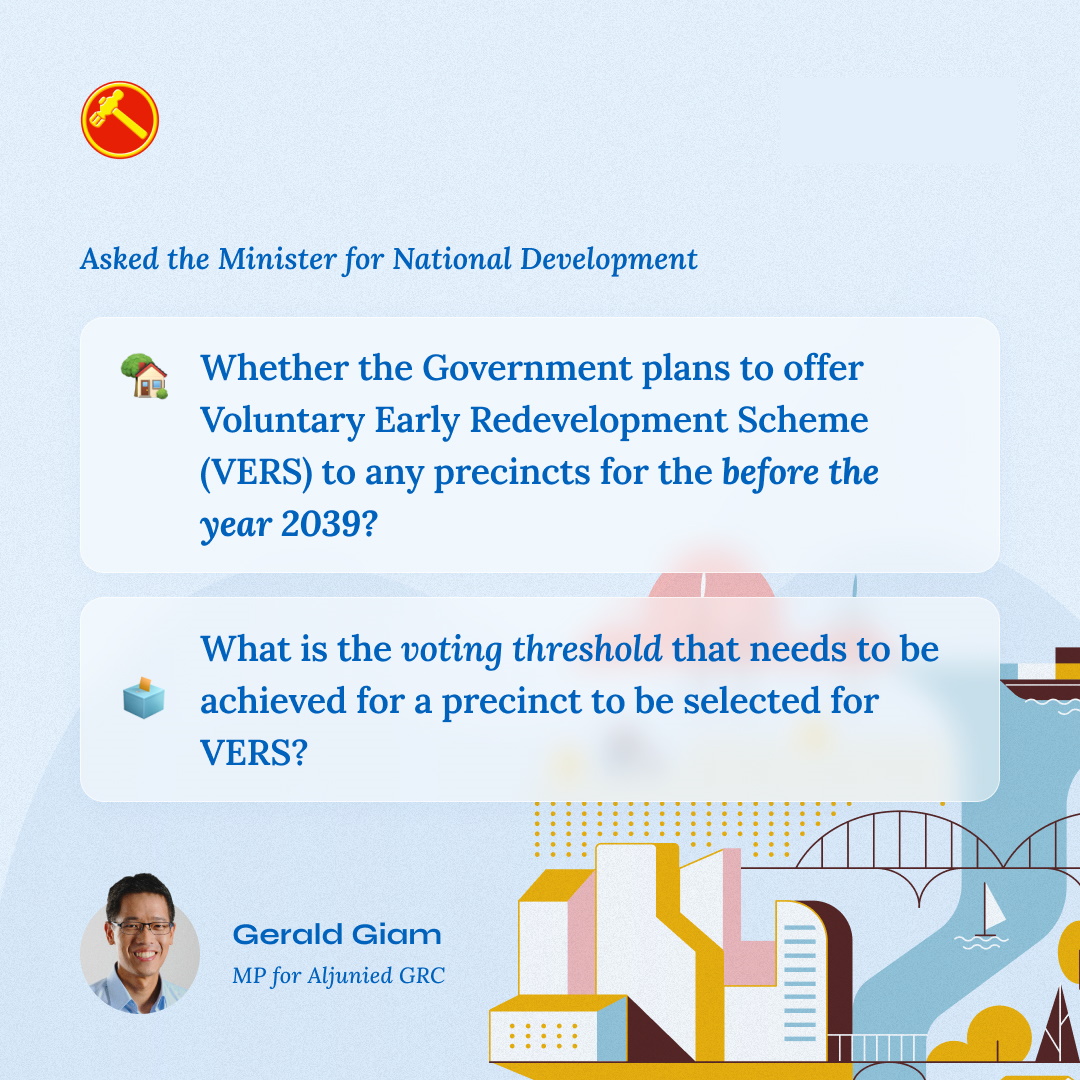
Mr Gerald Giam Yean Song asked the Minister for National Development (a) whether the Government has plans to offer Voluntary Early Redevelopment Scheme (VERS) to any precincts before the year 2039; and (b) what is the voting threshold that needs to be achieved for a precinct to be selected for VERS.

Mr Gerald Giam Yean Song asked the Minister for National Development what will be the terms of offer, including the compensation quantum, rehousing options and other benefits, to be provided to lessees of HDB flats selected for the Voluntary Early Redevelopment Scheme.

Mr Desmond Lee: The Voluntary Early Redevelopment Scheme (VERS) will be implemented in the longer term, as HDB flats and estates get older, to facilitate the orderly redevelopment and rejuvenation of these towns and estates. This will also allow more households to benefit from redevelopment before their flat leases expire, starting from when the flats reach around age 70 or older.

Unlike SERS, VERS will be a voluntary programme and residents will vote on the exercise in their precinct. If residents in a selected precinct vote in support of VERS, the Government will buy back all the flats and redevelop the precinct, and residents can use their sales proceeds to help pay for another flat. If the residents do not support VERS, they can continue to live in the precinct until their flat leases run out. The terms of VERS will not be as generous as SERS due to the lower redevelopment potential and hence smaller financial upside from the redevelopment.

VERS is a complex undertaking, involving detailed long-term town planning. We are in the midst of working out the details, such as how to identify the precincts, how to pace the redevelopment over time, the specific terms of the Government’s offer, the voting threshold that needs to be achieved for a selected precinct to proceed with VERS, and how to ensure fiscal sustainability in the long run. We will seek ideas and views from the public in the process, and will share more information with Members and Singaporeans when we are ready.

Cost of cancer treatment

The upcoming changes to the insurance coverage of cancer drugs not on the Ministry of Health (MOH)’s Cancer Drug List may affect patients with rare cancers, who may find themselves saddled with far higher bills for unsubsidised drugs.

On 4 July 2022, I asked the Minister for Health two Parliamentary questions on this issue:

Mr Gerald Giam Yean Song asked the Minister for Health (a) whether the Ministry has assessed to what extent the new limitations on insurance coverage and Medisave use for cancer drug treatments will impact doctors’ treatment decisions for their patients based on their clinical judgement; and (b) how it will affect patient care for those suffering from less common cancers.

Mr Gerald Giam Yean Song asked the Minister for Health whether his Ministry plans to establish and fund a National Cancer Care Appeals Board consisting of doctors from different specialties to discuss appeals from doctors on behalf of individual patients with complex cancers for whom standard therapies may be inappropriate or ineffective, review real world evidence and make timely decisions on whether to allow insurance coverage and Medisave use for off-label drugs or drugs not on the Cancer Drug List.

Senior Parliamentary Secretary (Health) Rahayu Mazam responded to my questions on 5 July 2022. After her answer, I asked her several supplementary questions:

I’m not sure if my question on the introduction of a National Cancer Care Appeals Board was answered. I understand from the Agency for Care Effectiveness (ACE) website which SPS just referred to that it takes 10-11 months from the time pharmaceutical companies submit their pre-submission form to ACE, to the time the Drug Advisory Committee (DAC) meets. However, for individual cancer patients for whom time is of the essence, anything more than one week may be too long to wait for a decision on a drug subsidy approval. Can we therefore have a National Cancer Care Appeals Board which can make rigorous yet speedy decisions to subsidise drugs for individual patients, to allow these patients to get the life-saving drugs they need? The DAC can then take the necessary time to review the drug for inclusion on the Cancer Drug List to benefit patients at the national level.

Secondly, has MOH modelled out how many patients per year will be adversely affected by these changes to the insurance policies, how much in cost savings are expected, and what is the price in human lives that MOH is prepared to accept in order to achieve these cost savings?

The SPS’ replies will be published in the Parliament Hansard and reported in the media.

Safeguards against scams involving CPF monies

Scams against senior citizens have become worryingly common these days. With many seniors able to withdraw large amounts of money from the CPF accounts once they reach 55, this group may be a prime target for scammers. I therefore asked a Parliamentary question on 9 May 2022 whether CPF Board imposes any daily withdrawal limits or enhanced scrutiny for extraordinarily large withdrawals of CPF funds to safeguard against scams. The Minister’s answer is below:

DAILY WITHDRAWAL LIMITS FOR CPF FUNDS AND SAFEGUARDS IN PLACE AGAINST SCAMS INVOLVING EXTRAORDINARILY LARGE SUMS

Mr Gerald Giam Yean Song asked the Minister for Manpower whether the CPF Board imposes any daily withdrawal limits for CPF funds that members are eligible to withdraw; and (b) whether the CPF Board has a threshold beyond which extraordinarily large withdrawal sums are subject to enhanced scrutiny to safeguard against scams.

Dr Tan See Leng: CPF Board takes a serious view towards safeguarding members against scams. At the same time, the CPF Board recognises that we should not unnecessarily inconvenience members for the vast majority of transactions that are legitimate. This is why we do not impose any daily withdrawal limits or thresholds. However, CPF Board will only pay to a member’s bank account after verification that the bank account belongs to the member.

CPF Board has put in place several measures to give members a greater peace of mind against illegitimate transactions. First, before any CPF withdrawals are authorised, CPF Board authenticates the identity of the person making the withdrawal request to ensure he or she is the owner of the CPF accounts involved. This is done by verifying against the member’s identification card for face-to-face requests or through the use of Singpass two-factor authentication for online requests.

Second, CPF members receive a notification via email or SMS for any withdrawal of CPF monies from their accounts. Members are encouraged to update their latest mobile number or email address via the CPF website by logging in with their Singpass so they do not miss out on such notifications. 

Third, CPF Board verifies that a bank account indeed belongs to the member before making any payment.  

CPF Board’s safeguards are in line with existing practices in the financial industry such that banks do not impose limits for transactions between verified accounts held by the same person within the same bank. As outlined in Minister Lawrence’s Ministerial Statement in February 2022, Monetary Authority of Singapore (MAS) and the banks are looking to introduce further measures for significant changes to their accounts such as fund transfers that are large relative to their overall balances. CPF Board will review these safeguards regularly to ensure that they are effective and align with industry practices, where applicable.

Citizen vigilance is imperative in the fight against scams. Members should take necessary precautions to guard against potential scams when they receive unsolicited calls and refrain from giving away their Singpass or internet banking credentials. CPF Board staff are also trained to assist members to respond to scam cases. When in doubt, always verify the authenticity of the information with CPF Board through multiple online and offline channels. 

Source: Parliament Hansard

Increase the frequency of feeder buses

The convenience and comfort of public transport is an important factor that commuters consider before going “car lite”. Fewer private cars on the road reduces both traffic congestion and carbon emissions. Conversely, inconvenient public transport can have the opposite effect of encouraging more driving or riding of private vehicles. Most residents, however, have no choice but to take public transport as cars in Singapore are unaffordable for them.

Many of my residents, especially those living along Bedok Reservoir Road, continue to voice their dissatisfaction to me about the Government’s decision last December to reduce the number of bus services plying routes to nearby bus interchanges and MRT stations, as well as trunk routes to other parts of the island. This represents an overall reduction in public transport convenience for them, particularly since the frequency of bus 228, which takes them to and from Bedok Interchange, has not increased enough to make up for their loss of bus service 66. The frequency of feeder bus services like bus 228 should be increased further, to make public transport a more attractive option for Singaporeans.

During the 9 May 2022 sitting of Parliament, I asked the Minister for Transport what percentage of bus services operate with frequencies (technical term: headways) of no more than five minutes during peak hours and 10 minutes during off-peak hours. This is the Minister’s reply:

Mr Gerald Giam Yean Song asked the Minister for Transport in the last six months, what percentage of (i) all public bus services and (ii) feeder bus services, operated with headways of no more than five minutes during morning and evening peak hours, and no more than 10 minutes during off-peak hours, respectively.

Mr S Iswaran: LTA monitors the performance of our bus operators against the standards stipulated under the Bus Contracting Model (BCM).

Under BCM, basic bus services have scheduled headways of 15 minutes or less during the morning and evening peak periods. At least half of these services are required to have scheduled headways of 10 minutes or less. Feeder services run at shorter intervals, with scheduled headways of no more than eight minutes during peak periods. In the last six months, bus operators have adhered to the standards set by LTA.

Source: Parliament Hansard

Read Land Transport Guru’s in-depth analysis of the bus service changes in Bedok Reservoir.

Cost of running General Elections

Elections are expensive, not just for the candidates and political parties, but also for the taxpayer. I asked a Parliamentary question on 9 May 2022 to obtain the breakdown of the amount spent organising and running each of the last three General Elections (GEs). Responding on behalf of the Prime Minister, Minister Chan Chun Sing revealed that the Election Department’s expenditure for the GEs increased from $13.5 million in 2011 to $30.3 million in 2020. This likely excludes the additional spending on security, which would be under the Ministry of Home Affairs’ budget.

In Singapore, elections are required by law to be held approximately once every five years, but can be called much earlier if the incumbent PM so chooses. This may confer an advantage on the incumbent, who can call elections when the ground is “sweet” for his or her own party. Be that as it may, an incumbent PM will do well to have an eye on the costs of organising and running an election, should he or she decide to call early elections.

Here is the full answer to my PQ:

Mr Gerald Giam Yean Song asked the Prime Minister how much is the Government’s spending on organising and running the General Elections in 2011, 2015 and 2020 respectively, including but not limited to the cost of manpower, security, publicity and materials.

Mr Chan Chun Sing (for the Prime Minister): The expenditures incurred by the Elections Department (ELD) for the 2011, 2015 and 2020 General Elections were $13.5 million, $23.2 million and $30.3 million respectively.

Across elections, expenditure will fluctuate depending on manpower, info-communications technology, transport, and other logistical needs. For example, GE2015 was fully contested unlike GE2011, and more election officials were deployed. Higher logistics costs were also incurred as election equipment such as polling booths and counting tables were due for replacement. In GE2020, which was held during the COVID-19 pandemic, almost $8 million were spent on safe management measures.

Source: Parliament Hansard

Doctors’ access to National Electronic Health Records

During the 9 May 2022 sitting of Parliament, I asked the Minister for Health what percentage of polyclinics and GP clinics are currently able to access the National Electronic Health Records (NEHR) system. I also asked whether this access will be extended under the proposed Healthier SG initiative. His answer is below:

PERCENTAGE OF POLYCLINICS AND GP CLINICS ABLE TO ACCESS AND INPUT INTO NATIONAL ELECTRONIC HEALTH RECORDS SYSTEM

Mr Gerald Giam Yean Song asked the Minister for Health (a) what percentage of polyclinics and general practitioner clinics (GP) are currently able to access the National Electronic Health Records (NEHR) system; and (b) to what extent will polyclinics and GPs be able to access and input details of outpatient consultations for their patients under the proposed Healthier SG initiative.

Mr Ong Ye Kung: As of April 2022, all polyclinics and close to 60% of private medical clinics have access to the National Electronic Health Record (NEHR). All healthcare professionals who are involved in direct patient care can apply to access NEHR.

To support the outcomes of the Healthier SG programme, care providers will be able to access patients’ medical records, track their patients’ conditions and progress over time, and share the records with other healthcare providers, using the NEHR. To govern these processes and to ensure secure data sharing, we intend to table a Health Information Bill.

Source: Parliament Hansard

Criteria for selection of SERS blocks

Four blocks on Ang Mo Kio Avenue 3 were recently selected for SERS (Selective En-bloc Redevelopment Scheme). Why were these flats selected for SERS when they are only 43 years old? This was one of the questions I asked the Minister for National Development on 9 May 2022. Here is the full question and the Minister’s answer:

Mr Gerald Giam Yean Song asked the Minister for National Development (a) in selecting precincts for the Selective En bloc Redevelopment Scheme (SERS), what are the weights given to (i) the age of the blocks (ii) their redevelopment potential (iii) the availability of suitable replacement sites (iv) the Government’s financial resources and (v) other factors; and (b) what are the reasons for selecting the four HDB blocks in Ang Mo Kio Avenue 3 for SERS despite them being only 43 years old.

Mr Desmond Lee: SERS was introduced in 1995 as part of our estate renewal strategy for older HDB estates. It allows us to optimise land through the redevelopment of selected HDB precincts which have high development value.

SERS involves compulsory acquisition and is therefore highly selective. The identification of suitable sites and the pace of SERS require careful site-by-site evaluation of various factors, including the redevelopment potential of the site, the availability of suitable replacement sites to rehouse the flat owners involved, and the Government’s financial resources. While the age of the precinct is a consideration, there is no fixed age criteria to determine if a precinct is suitable for SERS.

Countering Misinformation

In an increasingly digital world riven with military conflicts and great power rivalries, it is important for Singaporeans to be equipped with modern media literacy skills. We need to view all news reports, whether on television or on Telegram, with a critical eye and take the effort to check the facts before forming our own opinions, lest we fall victim to misinformation campaigns. 

On 4 Apr 2022, I raised three questions in Parliament on countering misinformation. Read my full Parliamentary Questions and the answers here:

Mr Gerald Giam Yean Song asked the Minister for Foreign Affairs how does the Government intend to respond to Singaporean key opinion leaders who express or transmit partly false information that can potentially undermine Singapore’s foreign policy positions.

Dr Vivian Balakrishnan: In this digital age, the spread of misinformation that sows fear, suspicion and discord in a population is a clear and present danger. All of us should exercise discretion and not share anything unless we are certain of its veracity. This responsibility to avoid disseminating misinformation applies particularly to public figures and opinion leaders.

A Singaporean public that is well-informed, that recognises the geostrategic forces at play and understands our national interests, is essential for our defence against misinformation and disinformation campaigns. We encourage the public to verify information with official sources, and apply a critical mind to what you read and share.


Mr Gerald Giam Yean Song asked the Minister for Communications and Information (a) what is being done to increase public education and enhance awareness of Singapore’s national interests with regard to the Russia-Ukraine conflict and Singapore’s relations with the US and China; and (b) whether the Ministry has considered (i) pushing out factual information on the situation through messaging apps and social media and (ii) providing information about independent fact-checking websites which the public can use to counter misinformation.

Mrs Josephine Teo: The Member asked what is being done to increase public awareness and understanding of Singapore’s national interest in the Russian-Ukrainian conflict. He also asked what we are doing to put out accurate information on the conflict.

First, understanding Singapore’s position on the conflict: The Government has taken a strong and unambiguous position, starting with the ministerial statement by the Minister for Foreign Affairs in February. Government agencies and their community partners have explained this position on a wide range of platforms – not only on social media and messaging platforms, but also in print and broadcast media, as well as directly to schools, business associations, grassroots organisations, to youth and public officers, national servicemen, as well as the general public. It is of the utmost importance that Singaporeans know the national position, the principles at stake for Singapore, why the Government has taken certain actions as a result, and why our position has nothing to do with taking sides.

Most Singaporeans understand, and agree. A publicly available poll conducted by Blackbox Research found last month that 95 per cent of Singaporeans supported or sympathised with Ukraine. Almost 70 per cent blamed Russia for the conflict; 60 per cent supported Singapore’s sanctions on Russia; while 35 per cent said they were unsure or had no opinion.

We accept that there are some differences in views and opinions among Singaporeans. That is understandable in any country. The Government will continue to communicate our position clearly as the situation develops, and counter whatever misinformation there might be about our position.

But as for pushing out factual information on the conflict itself, this cannot be the Singapore Government’s responsibility. We are in no position to independently verify the truth or otherwise of every report, image, photograph, video or post emanating from or on Ukraine. For the most part, we are dependent on the international media, including our own, to vet this avalanche of information. The National Library Board has published a set of third-party fact-checking resources about the conflict on its website. We urge all Singaporeans to exercise caution and apply a critical eye to all that they read and view on the conflict.


Mr Gerald Giam Yean Song asked the Minister for Education to what extent are teachers engaging students to discuss with them, in age-appropriate ways, the positions Singapore has taken on complex foreign policy and security issues like the Russia-Ukraine conflict, Singapore’s relations with the US and China and hostile information campaigns targeted at Singapore’s population.

Mr Chan Chun Sing: In schools, issues relating to international relations and geopolitics are discussed in subjects like History, Social Studies, General Paper and Character and Citizenship Education (CCE). At the Institutes of Higher Learning (IHLs), students also take modules and courses that help them make sense of key issues affecting Singapore and the world.

In the classroom, teachers use real-world case studies, including recent incidents, to help students understand complex issues concerning security and international relations, and Singapore’s role and perspectives on these issues. For example, in secondary and pre-university History, students examine how countries’ relations with each other evolve over time and the role of regional and international organisations like ASEAN and the UN in dealing with conflicts and promoting cooperation. In Secondary Social Studies, students learn about transnational terrorism, cyber security challenges and Singapore’s responses to these challenges. In General Paper, teachers engage pre-university students in discussions anchored on current affairs about foreign policy and security issues from different perspectives, while guiding them to understand Singapore’s context and positions.

Through CCE lessons and talks by invited speakers, secondary and pre-university students learn about Singapore’s strengths and vulnerabilities as a small country and the key principles of Singapore’s foreign policy that keep our nation safe. The commemoration of International Friendship Day and Total Defence Day is another avenue. This year, these sessions will offer insights on the ongoing situation in Ukraine and the importance of a rules-based international order, and discuss how Singapore upholds our national sovereignty through diplomacy and strong military defence.

To facilitate such discussions in age-appropriate ways, teachers receive specialised training, including workshops and talks by subject matter experts such as diplomats, academics, and policy makers.

The IHLs similarly engage students on contemporary global issues. The LifeSkills curricula in the IHLs emphasise the importance of critical thinking, global perspectives, and responsibility to the community, nation and the world. Through relevant LifeSkills modules, IHL students engage with educators and peers on current affairs, such as Russia’s invasion of Ukraine, and distil insights for Singapore’s context. Beyond this, they have access to external resources that provide insight on Singapore’s place in the world.

Given the proliferation of information, schools and IHLs also equip students with information and media literacy skills. Through the curriculum, students are taught to critically evaluate different sources of information, distinguishing fact from opinion, applying logic and verifying the authority of sources. This is part of a wider education efforts to guard against the dangers of fake news and develop in our students the ability to discern misinformation campaigns.