Select Committees for Ministries

Committee of Supply Debate, Parliament, 7 March 2024


Parliament currently has seven Standing Select Committees, but none of these are specific to individual Ministries. This is quite unlike many other legislatures around the world. The UK’s House of Commons, for example, has select committees for every government department like defence, home affairs and transport, to name a few. Australia’s parliament has House Standing Committees on Health, Aged Care and Sport; and on Employment, Education and Training, among others.

These Select Committees examine each Ministry’s policies, spending and administration. They are empowered to inquire into and report on any matter referred to them by the House or a Minister. The Committees may call in subject matter experts to give testimony and answer questions from Members that can inform their considerations.

Select Committees also provide a platform for Members to better understand each other’s positions and that of the government. The government may share in confidence with Committees information that shapes its policy stances. The Committees can discuss legislation or major policy changes before they are officially tabled, so that there is more room to work out compromises before each party stakes its position publicly.

After a thorough scrutiny of legislation and policies, the Select Committees can make recommendations to Parliament before Bills and Motions are debated and voted on by all MPs.

This process will lead to more informed and constructive debate, and better decision-making in Parliament. The Committees thus help to contribute to more effective governance, build political consensus and strengthen national unity.

For these reasons, I call on Parliament to set up Standing Select Committees for each Ministry or group of related ministries, consisting of MPs from all political parties represented in Parliament. They should be supported by the Parliament Secretariat and meeting minutes should be made available to all Committee members. Ministries should endeavour to engage them on a regular basis.
Licensed childminding services

Committee of Supply debate, Ministry of Social and Family Development, 6 March 2024.


Parents who are engaged in shift work often require childminding support outside of childcare centres’ operating hours, which are typically from 7am to 7pm. Many of these parents are from the lower income groups, for whom shift work is more common. 

The Forward Singapore report said that childminding service options will be expanded.

Could the Minister share further updates on this programme, including how many families have benefited from it so far?

Can MSF look into subsidising wages for childminders in order to attract more to join this scheme? 

In order to scale up the service to benefit more parents, could MSF take the lead to roll out this programme islandwide? 

What are the current efforts in promoting this service to parents, and can it be integrated into KidSTART, ComLink and related programmes for the low income?

Smoke free generation

Committee of Supply debate, Ministry of Health, 5 March 2024


The healthcare costs and lost productivity caused by smoking in Singapore has been estimated to be at least $600 million a year

Singapore has some of the world’s toughest anti-smoking laws. Yet, continuing to raise tobacco taxes and extending public smoking bans may be seeing diminishing returns. Stricter rules in public spaces have ironically driven smokers to light up at home or create informal smoking corners, harming their children’s health and sparking neighbour complaints about second-hand smoke.

In January 2023, the Ministry of Health stated it is reviewing international practices on cohort smoking bans. The UK plans to increase the minimum smoking age every year until eventually no person can legally buy cigarettes. New Zealand initially implemented a cohort smoking ban, but the new conservative government revoked it to fund tax cuts.

DPM Lawrence Wong stated in January 2024 that public health and not potential tobacco tax revenue loss were factors in banning e-cigarettes. I trust this principle will also apply to any government decision on a cohort smoking ban.

A generational smoking ban is specifically designed to safeguard the future, without imposing restrictions on current smokers. This forward-looking approach ensures that today’s adults can make their own choices, while laying the groundwork for a healthier legacy for their children and grandchildren.

I urge the government to implement a cohort smoking ban for all individuals in Singapore born on or after 2010. This will give us four years to prepare new smoking regulations before we see our first smoke-free generation for all children currently aged 14 and under.

Healthcare subsidies for persons with disabilities

Committee of Supply debate, Ministry of Health, 5 March 2024


Currently, Pioneer Generation, Merdeka Generation and Public Assistance cardholders receive special subsidies under CHAS

I would like to propose adding persons with disabilities or special needs as another group of Singaporeans to receive special subsidies under CHAS. They should also receive additional MediSave top-ups and more subsidies for intermediate and long-term care. 

All this will help persons with disabilities or special needs — and their families — to defray their medical expenses, which are likely to be larger over their lifetimes.

I would also like to suggest that MOH track the number of individuals under CHAS who are persons with disabilities or special needs, so as to better understand the healthcare expenses and needs of this group of Singaporeans.

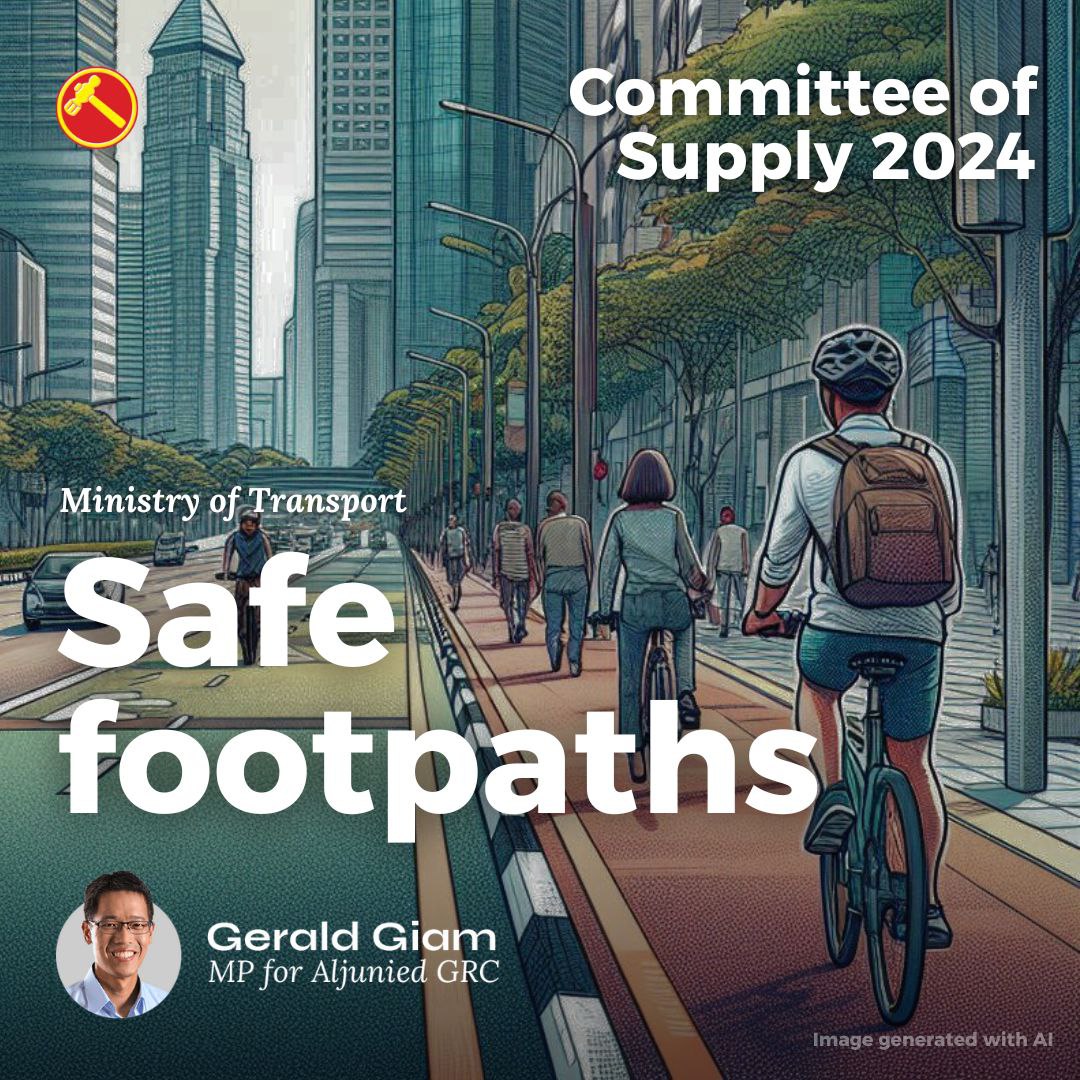
Safe footpaths

Committee of Supply Debate, Ministry of Transport, 5 Mar 2024


Footpath safety is a concern for many of my residents. Accidents often occur along footpaths due to a lack of awareness and courtesy among pedestrians, cyclists and personal mobility device users. Some of my residents have suffered severe injuries as a result. I call on the Ministry to conduct more public safety education for all footpath users. 

For instance, cyclists should be encouraged to sound their bell when they are still some distance away from pedestrians to alert them of their approach — and not wait until they are directly behind. Pedestrians should be educated to avoid suddenly changing direction without looking over their shoulders. Cyclists who disregard pedestrian safety should be taken to task.

By promoting a culture of mutual respect and responsibility, we can make our footpaths safer and more pleasant for everyone. This is not only a matter of convenience, but also of public health and social cohesion. 

Lift Replacement Fund

Committee of Supply debate (Ministry of National Development), 5 Mar 2024


The Lift Replacement Fund (LRF) was introduced during the 2017 amendment to the Town Councils Act. It addresses the substantial, deferred costs associated with lift renewals in our ageing estates. This provision ensures minimal disruption due to lift breakdowns for our residents, notably the elderly, young children and those with mobility challenges.

Nonetheless, the current apportionment of Service and Conservancy Charges (S&CC) and government grants — 26% to the Sinking Fund (SF) and 14% to the LRF — may be precipitating a skewed emphasis towards the LRF. Looking at the 17 town councils’ latest annual reports, I notice that for many of them, their LRF is expanding at a significantly faster pace compared to their SF.

The stipulated use of the LRF may be unduly restrictive. Currently, expensive lift components like the automatic rescue device, the main controller PCB, the emergency battery operated power supply and the uninterrupted power supply can only utilise the Routine Fund, despite their considerable capital expense.

Hence, I would like to put forth three proposals to MND:

First, rebalance the funding distribution between the Sinking Fund and LRF, slightly increasing the SF’s proportion and reducing the LRF’s proportion.

Second, broaden the permissible applications of the LRF to encompass all lift components with a lifespan exceeding 10 years.

And third, permit Town Councils to transfer funds between LRF and SF to fund necessary cyclical works without compromising the original intent of setting aside adequate reserves for the two funds.

These recommendations seek a more efficient balance between addressing current exigencies and future preparations, assuring all residents benefit from dependable lift and escalator facilities.

Menopause support for female workers

Committee of Supply debate, Ministry of Manpower, 4 Mar 2024


The number of women aged 40 to 59 in the labour force has risen by 97,000 from 2012 to 2022. Many in this group of workers would be undergoing perimenopause, which can present various physical and emotional challenges that may impact their well-being and work performance. 

Awareness of the health-related impact of perimenopause on women’s well-being does not seem to be widespread in Singapore. The Straits Times, in a piece titled “Is Singapore ready for the menopause wave from a super ageing society?” interviewed women who quit their jobs or suffered through the pain at work.

This loss in productivity may ultimately be costly to businesses and the economy, not to mention the human toll it takes on female workers. Based on an NUH study, and extrapolating for the current midlife working population, as many as 388,800 women may be bearing the ill effects of perimenopause at work.

It is important for employers to recognise and accommodate these changes, and foster a supportive work environment that addresses the unique needs of these women. It is notable that the UK and Australian parliaments have convened MP-led consultations to raise awareness nationally.

In Singapore, we can start with incentives for women who turn 45 to seek pre-emptive check ups and for those we need physiotherapy for their joint and muscle pain to either subsidise the treatment or give them time off for it. 

If women are forced to cut short their working life during their menopause transition, their health and finances may worsen, and our economy will lose out on their valuable contributions. This scenario is entirely preventable.

Tradesperson Jobs

My “cut” on the Committee of Supply debate (Ministry of Manpower), 4 Mar 2024.


There are approximately 186,000 craftsmen and trades workers in Singapore. Their median salary is $2,700, and their median age is 56 years. Over 70% are foreigners. The low wages, ageing workforce and heavy reliance on foreign labour in this crucial sector is concerning.

I acknowledge the efforts by MOM, industry associations, unions and IHLs to professionalise these trades. However, attracting young Singaporeans remains a pressing challenge.

To overcome this, we first need to boost societal respect for skilled tradespersons — or “tradies”, as they are affectionately called in Australia.

Schools and trades associations can create greater public awareness about what tradies do. They are not all dirty, difficult and dangerous jobs. For example, licensed plumbers often do more supervision and inspections of plumbing works than the “dirty work” themselves.

Young people who prefer working with their hands should be encouraged to consider skilled trades instead of forcing themselves to study an academic subject they have little interest in.

Second, we need to lower the barriers for entry for Singaporeans to become licensed tradespersons. All courses and mentorship programmes leading to licensing should be more subsidised under SkillsFuture, even for workers under 40, and more places should be set aside for Singaporeans. 

Third, to raise incomes of skilled tradespersons, agencies must rigorously enforce regulations against unlicensed individuals performing tasks that are legally reserved for licensed tradespersons. This will uphold the required quality and safety standards and prevent licensed tradespersons’ earnings from being unjustly undercut by unlicensed competitors.

Sir, for avoidance of doubt, I declare that I am the director and shareholder of a company that provides technology solutions to training providers.

Artificial Intelligence in Education

My speech during the Committee of Supply debate on the Ministry of Education’s budget, 1 Mar 2024.


Given the increasing demand for AI skills in the workforce, it is crucial to help our students develop not just good foundations and fundamental skills, but also become proficient in using common AI tools.

For example, all students need to be taught how to correctly input prompts into generative AI tools like ChatGPT to get their desired output. They also need to be taught how to check for hallucinations, avoid plagiarism, and adhere to ethical and legal boundaries, so that they can use these technologies safely and responsibly. 

I emphasise that this needs to be taught to all students, starting at the primary and early secondary levels, and not just to those who sign up for AI student outreach programmes or in individual schools on an ad hoc basis.

More well-resourced families often enrol their children in AI enrichment classes to enhance their digital skills, while lower-income families have less access to them, creating a digital divide across socioeconomic groups.

Unequal access to AI education could exacerbate existing inequalities, leaving some ill-prepared for an AI-driven world. This is why we need to bridge this gap by making dedicated AI education a fundamental component of the national curriculum. 

We must also invest in more professional development for teachers to equip them with the skills to incorporate AI into the classroom.

Lastly, while AI tools are important, impassionate machines cannot replace an inspirational and empathetic teacher. Therefore, AI tools should always augment, not replace teachers. By doing so, we can combine technology and traditional teaching, to build a holistic and comprehensive educational experience for each student.

Politically significant persons

My speech during the Committee of Supply Debate (Ministry of Home Affairs), 29 Feb 2024.


Recently, Mr Philip Chan, a Singaporean businessman and former People’s Association grassroots leader was designated by MHA as a politically significant person (PSP) under the Foreign Interference (Countermeasures) Act (FICA). 

MHA said that Mr Chan has “shown susceptibility to be influenced by foreign actors, and willingness to advance their interests”. I understand there are other Singapore residents who are publicly known to be associated with foreign political organisations, but have not been designated as PSPs.

I would like to request for more details of the Ministry’s criteria for designating PSPs. How does the Ministry assess the risk of foreign interference and the public interest in applying FICA’s measures to PSPs? What are the factors that distinguish Mr Chan from other persons who engage in similar activities but who are not designated as PSPs?

I understand the Ministry might be reluctant to be too transparent about the criteria to prevent people from circumventing the FICA provisions. However, MHA should provide better guidance to the public on where the out-of-bound (OB) markers are, so that they can avoid becoming unwitting agents of foreign influence and interference.