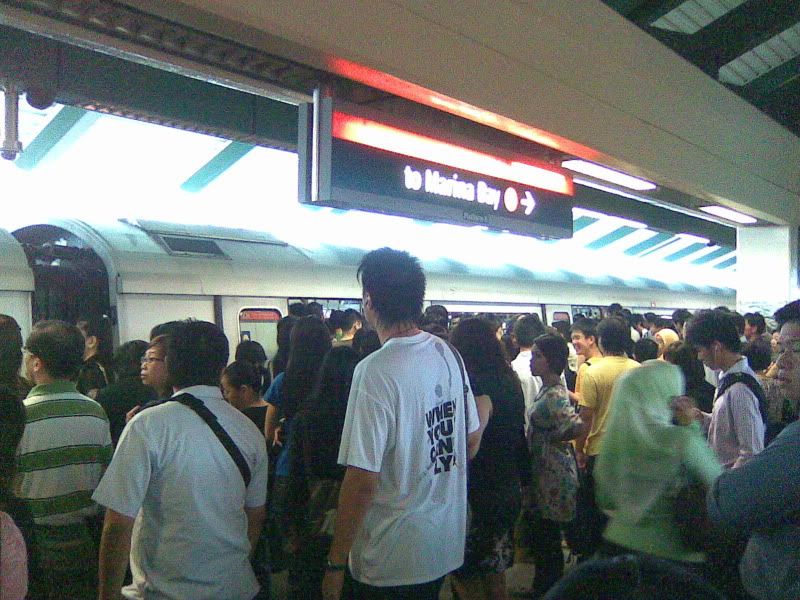
Fare increases and quality of service (COS – MOT)

The PTC chairman acknowledged that service reliability needs to improve, but said that this issue should be kept separate from fare raises, which are to cover rising costs for operators. This is quite baffling for most commuters, myself included. In most service industries, customers will demand good service before they even agree to pay. But for public transport in Singapore, we seem to be expected to pay more just to get satisfactory service.

Parliament, 11 March 2014

Madam,

In January, when the Public Transport Council (PTC) approved hikes in bus and MRT fares, many commuters asked why fares were being raised when they had yet to see satisfactory improvement in service reliability.

The PTC chairman acknowledged that service reliability needs to improve, but said that this issue should be kept separate from fare raises, which are to cover rising costs for operators.

This is quite baffling for most commuters, myself included. In most service industries, customers will demand good service before they even agree to pay. But for public transport in Singapore, we seem to be expected to pay more just to get satisfactory service.

Can the Ministry consider revising the fare review formula to incorporate service reliability as one of its components? This will create is a direct link between service quality and fare adjustments, and will better align the incentives for transport operators with the interests of commuters.

Public transport fare increases

Mr Gerald Giam Yean Song asked the Minister for Transport (a) what is the quantum of MRT and bus fare increases sought by each public transport operator in their latest submission; (b) whether the new fare subsidy schemes recommended by the Fare Review Mechanism Committee will be rolled out before any fare increases take place and all eligible commuters given ample time to apply for the subsidy schemes; and (c) how the Ministry will reach out to all commuters to ensure that they benefit from the subsidies they are eligible for.

This was a question that I asked the Minister for Transport during the 20 January 2014 sitting regarding the public transport fare increases that the public transport operators had sought. I had filed it before the announcement of the fare increases on 16 January. (Parliamentary questions have to be filed 7 working days before the sitting).

————–

Mr Gerald Giam Yean Song asked the Minister for Transport (a) what is the quantum of MRT and bus fare increases sought by each public transport operator in their latest submission; (b) whether the new fare subsidy schemes recommended by the Fare Review Mechanism Committee will be rolled out before any fare increases take place and all eligible commuters given ample time to apply for the subsidy schemes; and (c) how the Ministry will reach out to all commuters to ensure that they benefit from the subsidies they are eligible for.

Mr Lui Tuck Yew (The Minister for Transport):

The Public Transport Council (PTC) announced its decision on the 2013 fare adjustment last week. Although both public transport operators had applied for a fare increase of 6.6%, which is the combined fare cap for 2012 and 2013, the PTC approved an overall net fare increase of 3.2%, and rolled over the remaining 3.4% to the 2014 fare review exercise.

I would like to thank the Council for taking into consideration my earlier request during the November 2013 parliamentary sitting for the fare increase not to exceed the average national wage increase for 2013, which should come in at about 4-5%. The 3.2% fare increase is well below this, and hence public transport fares will continue to be affordable for the average commuter.

At the same time, the PTC decided to implement several enhancements to existing fare concession schemes as recommended by the Fare Review Mechanism Committee (FRMC). Up to half a million commuters stand to benefit. These include young children, students, in particular, polytechnic students, senior citizens and adult commuters who are heavy users of public transport.

The PTC decided that these enhancements will come into effect on the same day as the fare increase, that is, 6 April 2014.

On its part, the Government has decided to implement fare concession schemes for two groups of commuters who may be most impacted by the fare increase, that is lower-wage workers who are under MOM’s Workfare Income Supplement (WIS) Scheme, and persons with disabilities.

Eligible recipients will be notified around 6 April to apply for the two concession schemes, which will take effect from 6 July 2014. Transport vouchers will be provided to help them for the interim period between the fare increase on 6 April, and 6 July when the concessions take effect. These being new schemes, we need more time to set up the frameworks and processes, and to cater to potentially half a million applicants.

Let me assure the Member that my Ministry, the public transport operators and TransitLink will extensively publicise the enhanced and new concession schemes in the coming weeks, so that potential beneficiaries are made aware and can apply for and enjoy the concessions.

[Source: Singapore Parliament Reports]

——————–

See also the Workers’ Party’s statement on 17 January 2014 in response to the announcement of the fare increases:

The Workers’ Party (WP) welcomes the new and enhanced concession schemes to make public transport more affordable for people with disabilities, senior citizens, low-wage workers, students and full-time national servicemen. These groups will finally enjoy some overdue relief for their travel needs, for which the public and the WP have lobbied for years.

The concessions, however, should not be used as a sweetener to make the latest fare increases palatable.

With an initial increase of 3.2% in 2014 and an increase of 3.4% rolled over to the fare review exercise next year, this could mean a heftier increase in 2015. We are concerned that the majority of the commuters may still experience a very large overall fare increase of up to 6.6% in the next two years.

This latest round of fare hikes comes on the back of a substantial $1.1 billion government subsidy in our public transportation system through the Bus Services Enhancement Fund (BSEF) last year.

The fare hike has also come despite train breakdowns having become a regular affair, further compounding the frustrations of commuters, who are frequently affected by such service quality and reliability lapses.

We are disappointed that the fare hike will take place three months before the concession schemes for low-wage workers and people with disabilities are to be implemented. We call for the fare hike to be delayed until the new concession schemes are implemented.

The WP believes that public transport should be provided as a public good and not for profit. Service quality, reliability and fare affordability should come before the need to ensure the profitability of PTOs.

DENNIS TAN LIP FONG (陈立峰)
Executive Council Member
The Workers’ Party

Bus Service Reliability Framework

This is a Parliament Question I asked the Transport Minister on 20 January 2014 regarding the new “Bus Service Reliability Framework”, which includes incentives for public bus operators for exceeding service standards set by the Land Transport Authority (LTA).

This is a Parliament Question I asked the Transport Minister on 20 January 2014 regarding the new “Bus Service Reliability Framework”, which includes incentives for public bus operators for exceeding service standards set by the Land Transport Authority (LTA).

——————

Mr Gerald Giam Yean Song asked the Minister for Transport with regard to the new Bus Service Reliability Framework (a) what evidence does the LTA rely on to determine that providing financial incentives rather than just penalties to public bus operators to arrive at bus stops on schedule will improve waiting times; and (b) whether the incentive amounts will be funded by taxpayers.

Mr Lui Tuck Yew (The Minister for Transport): Bus operators have to incur additional costs to monitor and improve en-route reliability and regularity of the trial bus services under the Bus Service Reliability Framework (BSRF). For example, the operators need to hire and train more bus controllers to manage bus services more closely, instruct bus drivers to slow down and mobilise standby buses. The operators may also need to modify and enhance their operations control systems. Hence, there must be some net financial incentive in the design of this Framework.

We have also looked closely at overseas examples, in particular, the London system which has worked well and been carefully refined over many years. For a start, we have modelled our incentive-penalty structure for this BSRF pilot quite closely after the London system, but we will certainly review and improve along the way to make it cost-effective to benefit commuters who have consistently mentioned reliability of buses as a priority area for improvement.

The BRSF will be funded by the Government, as it is a trial to assess whether it can improve the reliability of our bus services.

[Source: Singapore Parliament Reports]

——————–

There was also a debate during Question Time that same day on the service delivery requirements under the Bus Service Reliability Framework. This is a supplementary question I asked the Minister and his reply:

Mr Gerald Giam Yean Song: Would it not be more straightforward to just set high enough standards and then penalise the PTOs for failing to meet those standards? Because this can certainly spur improvements at the backend as well, and the PTOs’ reward really is in more satisfied customers and bigger ridership.

Mr Lui Tuck Yew: We also have to try and arrive at a position and at a model that is fair to all parties concerned. With greater demand, there will be calls for greater injection of resources. So we are trying to find a balance between incentives and penalties in order to arrive at a better situation than what we have today.

[Source: Singapore Parliament Reports]

Supper Club interview with the Straits Times

I did a two-hour long interview with the Straits Times for its “Supper Club” series, which was published on 18 January 2014. I shared my thoughts on a range of issues, including healthcare financing, public transport, media regulation, education and the Workers’ Party’s approach to political engagement. I also shared about my work as a Non-constituency MP and about my family.

I did a two-hour long interview with the Straits Times for its “Supper Club” series, which was published on 18 January 2014. I shared my thoughts on a range of issues, including healthcare financing, public transport, media regulation, education and the Workers’ Party’s approach to political engagement. I also shared about my work as a Non-constituency MP and about my family.

Click the two links below to read the interview and watch the video.

Part 1:

Gerald Giam: ‘Rethink health-care financing philosophy’
Non-Constituency MP Gerald Giam is the Workers’ Party’s point man on health care issues. In Part 1 of this Supper Club interview, he speaks about what he thinks should be changed in health-care financing and public transport.

Gerald Giam: ‘Rethink health-care financing philosophy’

Non-Constituency MP Gerald Giam is the Workers’ Party’s point man on health care issues. In Part 1 of this Supper Club interview, he speaks about what he thinks should be changed in health-care financing and public transport.

Part 2:

Gerald Giam: ‘We’re a moderate party, not fence-sitters’

In Part 2 of this Supper Club interview, Non-Constituency MP Gerald Giam of the Workers’ Party talks about whether he sees a shift in the Government’s policy approach, the difference between being moderate and sitting on the fence, and his personal life.

Raising bus fares leads to greater efficiency?

I found it odd, to say the least, for the Minister to suggest that fare increases will incentivise PTOs to provide better service and be more efficient. There is little incentive for PTOs to be more efficient if they know they can count on receiving more fare revenue whenever their costs go up. Neither is there much incentive to improve service beyond the minimum standard set by the regulator, when the PTOs are primarily accountable to their shareholders, not the public.

I have spoken at length in Parliament about the deep shortcomings of the profit-oriented public transport model that we currently have in Singapore. Here is some excerpts of what I said during the debate on the Land Transport Authority of Singapore (Amendment) Bill on 9 July 2012.

I was asked on Thursday by the Straits Times for my thoughts on Transport Minister Lui Tuck Yew’s Facebook post explaining the impending rise in bus fares. Mr Lui said that “The purpose of fare increases is not to boost the short term profits of PTOs (public transport operators). It is also not just to improve salaries of bus drivers but to improve service to commuters while keeping public transport operations commercially viable.”

I found it odd, to say the least, for the Minister to suggest that fare increases will incentivise PTOs to provide better service and be more efficient. There is little incentive for PTOs to be more efficient if they know they can count on receiving more fare revenue whenever their costs go up. Neither is there much incentive to improve service beyond the minimum standard set by the regulator, when the PTOs are primarily accountable to their shareholders, not the public.

I have spoken at length in Parliament about the deep shortcomings of the profit-oriented public transport model that we currently have in Singapore. Here is some excerpts of what I said during the debate on the Land Transport Authority of Singapore (Amendment) Bill on 9 July 2012:

*    *    *    *    *

Continue reading “Raising bus fares leads to greater efficiency?”

MRT train crush and the solution right under our noses

Why did it take so long for SMRT to finally “look into” extending the peak period? Perhaps it’s because the “crush loads” don’t exactly hurt profits, but buying new trains and hiring more train drivers will. So it took a bit of political pressure to get things moving.

MRT crush load

At the risk of sounding like a broken old record, I’m going to point out once again that the PAP government failed in the last 10 years to adequately plan our infrastructure for the huge influx of immigrants and foreign workers that we saw between 2005 and 2010. One bugbear for many Singaporeans (mostly from the middle to lower classes, who take public transport), is the overcrowding on buses and MRT trains.

The government’s grand solution to all this was to build more MRT lines. Hence the huge investment of over $10 billion to build the Circle Line (up from a budgeted $6.7 billion) and another $1.4 billion to build the Downtown Line. While I don’t begrudge this necessary investment in a public good, the benefits from this investment are playing a game of catch up with our ever-growing population.

What we needed were interim solutions to solve the immediate problem of “crush loads” on our bus and train networks. This could not be achieved by building more lines, as they take years to complete. Hence, Singaporeans have been forced to squeeze on unbearably crowded trains with fellow commuters for the past few years while construction of the new lines was going on. We were repeatedly told by the government, “Don’t worry, relief is coming soon. We’re building more lines.”

One interim solution that could have been carried out much faster (and at much lower cost) than building new lines was to increase train frequency, within the limits of the ageing signalling system.

I had raised this proposal during my maiden speech in Parliament last month. I had said:

…if the Government is serious about encouraging our people to drive less and use more public transport, it must give priority to tackling the overcrowding problem on trains. The solution lies not only in building more lines, but making better use of the existing lines by increasing train frequency and maintaining that high frequency for longer periods, especially during peak hours.

Why can’t the MRT operators maintain a train interval of two minutes from 7am to 9am, and from 5pm to 8pm? Is it because of technical constraints, or because it will increase their costs and reduce their profits?

Continue reading “MRT train crush and the solution right under our noses”

Raymond Lim once proposed a way for “completely free” public transport

Actually Minister Raymond Lim had once proposed a way to have completely free public transport. Here’s what he said about public transport concessions during a constituency visit back in 2008.

In response to NCMP Sylvia Lim’s call in Parliament on 11 March 2010 for transport concessions for the disabled, Transport Minister and MP for East Coast GRC, Raymond Lim, said: “I’d be very slow in stipulating (to operators) how best to run the concession policy.”

But actually the Minister had once proposed a way to have completely free public transport. Here’s what he said about public transport concessions during a constituency visit back in 2008:

“The money still must come from somewhere, right? It is about 1.5 percentage point increase in your GST. So now it’s 7 (per cent), you want it to be free? You want the GST to go up to 8.5 per cent, to run a completely free bus and MRT system?”

Sylvia Lim asks for concessionary travel for disabled on public transport

According to a 2001 MOH survey, less than 2 per cent of Singaporean adults below 60 have some sort of disability. Is the number of disabled too much for the PTOs? The PTO’s operations are reaping profits of tens of millions of dollars annually and this is part of their corporate social responsibility.

This was a speech in Parliament on 11 March 2010 by NCMP, Sylvia Lim,during the Committee of Supply debate, on the budget for the Ministry of Transport. Read other Workers’ Party speeches and statements at wp.sg.

—————-

Disabled persons face challenges fitting into society for work, recreation and social interaction. Travel is a necessary step towards integration, to work, to socialise and to be consumers.
There are currently no public transport concessions for the disabled.
The disabled here have low earning capacity. Many do not work; those who do, earn a few hundred dollars per month, spending up to a third on travel expenses.
The government has often said that we should build an inclusive society. It therefore should not take a back seat on this issue.
Other governments are proactive. In the UK, disabled persons qualify for a special “Railcard” which entitles them to travel throughout the UK at one-third off from the normal fare. In addition, disabled persons in London can travel off-peak for free on buses, the Underground and trains.
The government cannot wash its hands off the matter by saying that the public transport system is operated commercially and it is up to the public transport operators (PTOs) to decide. The disabled have no bargaining power against the big companies.
For instance, the Land Transport Authority, as regulator, can make it a licensing condition that the PTOs recognize disabled passengers for concession travel.
According to a 2001 MOH survey, less than 2 per cent of Singaporean adults below 60 have some sort of disability. Is the number of disabled too much for the PTOs? The PTO’s operations are reaping profits of tens of millions of dollars annually and this is part of their corporate social responsibility.

Disabled persons face challenges fitting into society for work, recreation and social interaction. Travel is a necessary step towards integration, to work, to socialise and to be consumers.

There are currently no public transport concessions for the disabled.

The disabled here have low earning capacity. Many do not work; those who do, earn a few hundred dollars per month, spending up to a third on travel expenses.

The government has often said that we should build an inclusive society. It therefore should not take a back seat on this issue.

Continue reading “Sylvia Lim asks for concessionary travel for disabled on public transport”

Install fans on MRT platforms

SMRT should install fans at all above-ground MRT station platforms, with LTA co-funding if necessary.

I hope SMRT will seriously consider installing electric fans on all above-ground MRT station platforms. I have written twice to SMRT over the past two years to make this request. Both times I received the same reply: Platforms have sufficient natural breeze and there is no need for fans.

Most of my fellow commuters will attest that this is not always the case. Some above-ground MRT stations are sandwiched between blocks of flats or shopping malls, leaving little chance for much breeze. With the introduction of the new platform safety screens which are made of solid plexiglass, commuters will now have to endure stuffy platforms that are often overcrowded with people.

One of the bugbears of taking public transport in Singapore is getting all sweaty and sticky en route to one’s destination. After walking from one’s flat to the MRT station under the tropical sun, we often end up waiting on wind-less platforms, getting our clothes drenched with sweat. While there’s nothing we can do about Singapore’s weather, I believe it is possible to cool down the waiting areas on the MRT stations with the installation of fans, in order to provide a more pleasant overall commuting experience.

If cost is an issue for SMRT, I would like to suggest that LTA (Land Transport Authority) co-fund the installation of these fans. If the Government is serious about getting Singaporeans to switch to using public transport, this is a small investment in that could reap surprisingly good returns in the form of increased ridership and improved commuter satisfaction.

(This is the original letter that was sent to TODAY newspaper. It was published on 9 September 2009.)

Reserved Seating

I am glad to see that the Public Transport Council and train operators have decided to change the seat signs on trains to read “Reserved Seating” instead of the less assertive “Priority Seating”.

Reserved Seating on Trains

This was a suggestion I made back in February 2008 in my paper titled Improving Singapore’s Public Transport System – A Commuter’s Perspective:

Continue reading “Reserved Seating”