Questions to the Minister on inflated newspaper circulation numbers

On 16 June 2023, SPH Media Group’s Audit and Risk Committee published its report investigating the issues surrounding the inflated circulation numbers of SPH. 

The report highlighted a barter arrangement between SPH and another media company, which it called “X”. Media company X provided an unspecified number of e-paper digital subscriptions to SPH in exchange for 15,000 Straits Times and Business Times digital subscriptions (from SPH). The amounts paid by X to SPH and vice versa were offset against each other. SPH reported these 15,000 copies in its (inflated) circulation numbers. According to the report, there was no evidence that the digital access codes for the Straits Times and Business Times digital copies were distributed.

In Parliament on 6 July, I asked Minister for Information and Communications Josephine Teo whether there would be any investigation into media company X as to whether they too were inflating their circulation numbers. The Minister replied that she was not at liberty to disclose the full range of the Police’s investigations. She added that it was for the Police to decide whether to specifically look into establishing liability on the part of X.

Separately, a fund, known as the NIE Fund, was set up to pay for the distribution of newspaper samples to students, needy families, halfway houses and charities. The report found that during the review period, approximately $748,000 from the NIE Fund was used to pay for bulk copies of newspapers to “shore up” the circulation numbers, cushion the fall in print circulation numbers and to meet circulation number KPI targets. The report found evidence to suggest that some of SPH’s clients were not aware that monies they had paid would be used for the purposes of purchasing bulk copies.

I asked the Minister what kind of accountability had been given to the donors and the clients who had contributed to the NIE Fund on the understanding that they were helping the underprivileged in society but were instead used to shore up the circulation figures for SPH. The Minister replied that the purpose of making “full disclosure” on the findings was to allow these entities to decide if they wanted to take further action. She added that they could, if they chose to, but the Government would not decide on their behalf.

This is the link to the full Audit and Risk Committee Report: https://static.sph.com.sg/uploads/2023/06/Annex-ARC-Report.pdf

This is the Parliament exchange I had with the Minister:

Mr Gerald Giam Yean Song (Aljunied): Thank you, Madam. Madam, the ARC report stated that the X Barter Deal was not a genuine arrangement. The corresponding revenue and expenses should not have been recognised and the corresponding circulation numbers should not have been counted. So, my question is, if it was found that the X Barter Deal was not a genuine arrangement, will there be any investigation into the other media company, which was named as “X” in the report, and whether they were also inflating their numbers?

Secondly, the Minister said that the question of loss of public funds does not arise. But what kind of accountability has been given to the donors and the clients who had contributed to the NIE Fund on the understanding that they were helping the underprivileged in society but were instead used to shore up the circulation figures for SPH?

Mrs Josephine Teo (Minister for Communications and Information): Mdm Deputy Speaker, at this point, we will not be at liberty to disclose the full range of the Police’s investigations. Are they specifically looking to establish liability in the context that Mr Giam described? That is for the Police to decide.

On the Member’s second question on accountability to the donors and the other parties that made resources available to SPH Limited, the purpose of making full disclosure on the findings is precisely to allow these entities to decide if they want to take further action. So, they can, if they choose to. It is not for us to decide on their behalf.

Source: Singapore Parliament Reports (Hansard)

Scams involving SMS OTP diversions

There were several scam cases previously where scammers intercepted the SMS one-time password (OTP) sent by banks and used them to make unauthorised transactions without the customers’ knowledge. At the sitting of Parliament on 5 July 2023, I asked the Prime Minister how many fraudulent bank transactions had been made as a result of SMS OTP diversions.

I had previously raised concerns in Parliament in October 2021 and May 2023 about the insecurity of SMS OTPs. Given the concern about SMS OTPs, I further asked whether MAS had a timeline for requiring banks to phase out the use of SMS OTPs in favour of other multi-factor authentication (MFA) methods. For those customers who were already using other MFA methods, I asked whether MAS would require banks to provide them with the option to stop the use of SMS OTPs.

Replying on the Prime Minister’s behalf, Mr Tharman Shanmugaratnam acknowledged that between September 2020 and December 2020, there were cases reported where malicious actors diverted SMS OTPs to perform fraudulent bank transactions. He said local telco operators had since implemented additional security safeguards to mitigate the risk. Hence, the risk of SMS OTPs being diverted had now been largely addressed and the Police had not found any confirmed cases of SMS OTP diversions since January 2021.

However, given the inherent vulnerability of the SMS channel, Mr Tharman said that the Monetary Authority of Singapore (MAS) has required banks to phase out SMS OTP as a sole factor to authenticate high-risk transactions. He said the transition has commenced, and MAS will set a deadline for all retail banks to complete this. Indeed, I received a notification from my bank on 18 July stating that they will be moving away from SMS OTP and manual verification questions progressively as they transit to push notifications for authentication purposes.

This is the full answer provided by the Government:


REVIEW OF PAST CASES GIVEN RECENT ADVISORY ON MALWARE-
RELATED UNAUTHORISED BANK TRANSACTIONS

Mr Gerald Giam Yean Song asked the Prime Minister (a) in the past year how
many fraudulent bank transactions have been made a result of SMS one-time password (OTP) diversions; (b) whether MAS has a timeline for requiring banks to phase out the use of SMS OTPs in favour of other multi-factor authentication (MFA) methods; and (c) whether MAS will require banks to provide customers with the option to stop the use of SMS OTPs in the interim, if they are already using other MFA methods.


Dr Tan Wu Meng asked the Prime Minister in view of the police advisory
informing the public that malware was used to compromise mobile devices resulting in unauthorised transactions made from bank accounts, whether MAS will consider reviewing previously closed cases of customer disputes with banks where unauthorised transactions were reported despite one-time passwords not being divulged or received.

Mr Tharman Shanmugaratnam (for the Prime Minister): My response will cover the questions raised by Mr Gerald Giam and Dr Tan Wu Meng in today’s Order Paper.

Globally, and in Singapore, scam cases have been rising. Scammers have been quick to evolve their tactics to trick consumers into divulging their banking credentials as well as to evade detection. As previously explained in this house, Singapore has adopted a multi-layered strategy to combat scams. Agencies are continuing to work closely with the industry to strengthen our anti-scam measures to fight the evolving threats.

Before 2021, there were cases reported where malicious actors diverted SMS one-time passwords (OTPs) to perform fraudulent bank transactions. These occurred between September 2020 and December 2020. The attacks were caused by unauthorised access to the systems of overseas telecommunication (telco) operators to divert the SMS OTPs sent by the banks to their customers, which were then used to authenticate fraudulent online card payment transactions. While our local telco networks were secure and not compromised, the telco operators had since implemented additional security safeguards to mitigate the risk. Hence, the risk of SMS OTPs being diverted has now been largely addressed. The Singapore Police Force has also not found any confirmed cases of SMS OTP diversions since January 2021.

Nevertheless, given the inherent vulnerability of the SMS channel, the Monetary Authority of Singapore (MAS) has required banks to phase out SMS OTP as a sole factor to authenticate high-risk transactions. Banks in Singapore have already moved away from sole reliance on SMS OTP for high-risk online banking activities, like adding of payees and changing of fund transfer limits. MAS expects the same for high-risk card transactions, such as authorising online card payments. The transition has commenced, and MAS will set a deadline for all retail banks to complete this.


MAS does not currently see the need to require banks to provide customers the
ability to opt out of SMS OTPs as this would limit the authentication toolkit that the banks have and dilute the effectiveness of multi-layered security for protecting customers. When used in combination with other authentication factors such as biometrics or digital tokens, SMS OTP provides an additional layer of security that fraudsters have to overcome. In addition, SMS OTP is an authentication method that is accessible by all customers as it can be received on any type of mobile device. It allows all customers to perform low-risk activities, such as viewing of account balance and paying of bills, conveniently without the need for an additional device. Removing SMS OTPs entirely will exclude a significant number of online banking customers who do not own mobile devices that can install digital tokens.

The transition away from sole reliance on SMS OTP for high-risk online banking activities will however not deal with other scam types, such as those related to phishing and malware to steal banking credentials, that has been growing recently. Scam cases involving malware infections of customer devices are not new. However, scammers are exploiting newer technologies. In more recent cases, they have acquired the ability to control customers’ devices using malware. In such cases, the customer may not be aware that SMS OTPs had been delivered to his mobile device, or that unauthorised transactions had been performed, as the scammer who has obtained control over the mobile device has deleted both the SMS OTPs and transaction notifications. Such cases are concerning.

The Cyber Security Agency of Singapore has published an advisory on an ongoing malware campaign targeting Android Devices in May 2023. Members of the public are strongly reminded and urged to take these necessary measures, which have also been amplified by the banks, to protect themselves against malware:
(a) Pay attention to the security permissions requested by the application and be wary of applications that ask for unnecessary permissions on mobile devices.
(b) Install applications only from the official Google Play Store.
(c) Uninstall any unknown applications that are found in mobile devices
immediately.
(d) Perform anti-virus scans and keep regular backups of important data.
(e) Ensure that mobile devices’ operating systems and applications are updated
regularly to be protected by the latest security patches.

When customers discover any unauthorised transactions in their accounts or suspect that their mobile device may have been compromised by malware, they should immediately contact the bank or activate the “kill switch” that the banks provide to freeze their accounts. They should work in cooperation with the bank to establish the facts surrounding the transaction. They should also report fraudulent activities to the Police. For malware cases, the Police may request that customers submit their mobile devices for investigation.

MAS expects banks to treat customers fairly in all cases of dispute over unauthorised transactions. Banks must consider whether they have fulfilled their obligations, and whether customers have done their part in protecting their accounts. Customers can ask banks to reassess their cases should new information relevant to their disputes surface.

Source: Singapore Parliament Reports (Hansard) and MAS

Photo by Mikhail Nilov on Pexels

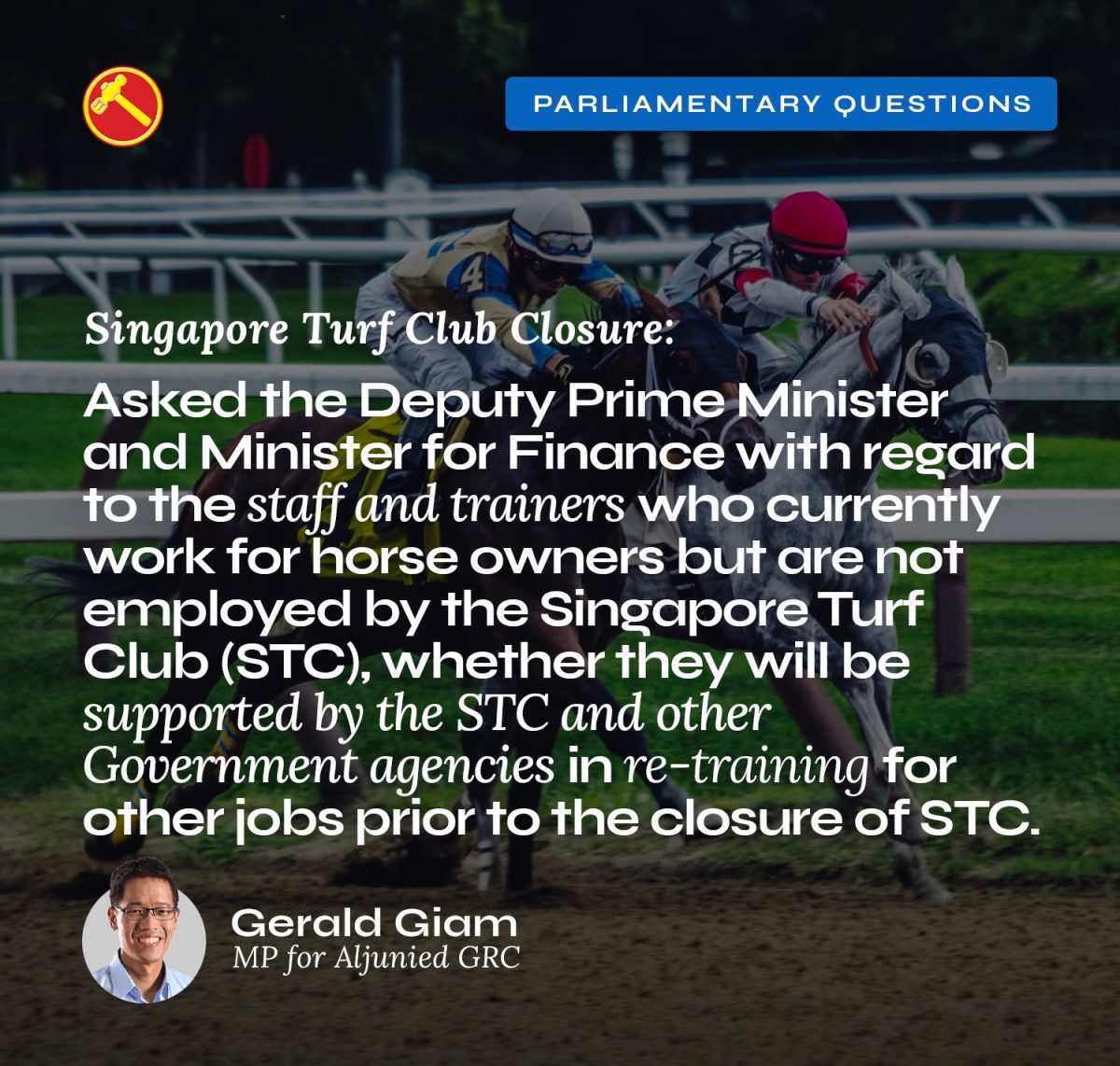
Turf Club closure and impact on stakeholders

In June 2023, it was announced that the Singapore Turf Club (STC) will cease operations in March 2027, and its final race will be on 5 October 2024. I am concerned about the staff and trainers who currently work for horse owners, and the athletes and other stakeholders in the equestrian sports community in view of this impending closure, and asked the Minister several questions in Parliament on 3 July 2023.

First, I asked the Minister for Finance how staff and trainers will be supported in re-training for other jobs.

Second, I asked whether the development of equestrian sports will be impacted and what assistance the government is extending to athletes and other stakeholders in the equestrian sports community.

And third, I asked if Singapore Turf Club employees, contractors and members of the public were consulted on these changes.

These were my full questions and the Minister’s answers:

Mr Gerald Giam Yean Song asked the Deputy Prime Minister and Minister for Finance with regard to the staff and trainers who currently work for horse owners but are not employed by the STC, whether they will be supported by the STC and other Government agencies in re-training for other jobs prior to the closure of STC.

To ask the Deputy Prime Minister and Minister for Finance (a) how will the development of equestrian sports in Singapore be impacted by the closure of the Singapore Turf Club (STC); and (b) what assistance is the Ministry extending to athletes and other stakeholders in this community in view of STC’s impending closure.

To ask the Minister for National Development (a) whether the land use for the Singapore Racecourse under the current URA Master Plan stipulated for sport and recreation has been revised to include use for housing including public housing; (b) if so, when was the revision made; (c) whether consultations were conducted with stakeholders and who were these stakeholders; and (d) whether the stakeholders included Singapore Turf Club employees, contractors and members of the public.

Ms Indranee Rajah (Second Minister for Finance and National Development): The decision to close STC was not an easy decision, nor was it made lightly. Given Singapore’s small size and land constraints, the Government continually reviews our land use plans to meet present and future needs. At the same time, local horse racing has also experienced declining spectatorship over the years.

In developing our long-term land use strategies and plans, the Government has actively engaged the public to understand their needs and aspirations. These engagements have strongly affirmed that we need more land for housing, as well as a diversity of spaces for leisure and recreation, to provide a quality living environment for Singaporeans. With the demand for more land for housing and the declining spectatorship for local horse racing, the Government made the difficult decision to redevelop the STC site to better meet our future needs.

Mr Gerald Giam asked whether the use of the Singapore Racecourse site under the current Urban Redevelopment Authority (URA) Master Plan has been revised to include housing. At the Committee of Supply debate earlier this year, the Ministry of National Development (MND) announced that we have started on our Draft Master Plan review, which will take place over the next two to three years. The Government intends to update the revised land use for the site to include housing in the upcoming Master Plan.

Ms Hany Soh, Mr Gerald Giam, Mr Sharael Taha and Mr Edward Chia, have asked what assistance will be given to workers affected by the cessation of horse racing. We will make every effort to assist and ease the transition for them.

There are two different groups of workers affected – those employed by STC and those employed by the trainers.

About 350 STC employees are affected. The STC employees will continue to be employed for at least the next 15 months up till October 2024, with some staying until closure in 2027. Upon cessation of their employment, they will receive retrenchment packages in line with the Minister of Manpower (MOM) guidelines. In addition, they will receive job placement assistance, career guidance, skills training and counselling so that they can find new jobs. The National Trades Union Congress (NTUC) has also stepped in to offer support.

The horse trainers employ or engage about another 420 workers. While these are not STC employees, STC will nevertheless lean forward to work with their employers, the trainers, to provide support to these workers and ease their transition. The media had recently reported that some equestrian entities are prepared to offer them jobs. STC will also be extending employment facilitation, skills training and career counselling.

Members have also asked what will happen to the racehorses. There are approximately 700 racehorses. They will have to be rehomed once the races cease. In the meantime, STC has already rolled out support for racehorse owners and trainers for horse maintenance, as well as horse exportation and placement. STC is discussing with owners and trainers what additional support they may need to rehome their horses and will do its best to meet reasonable requests.

Some trainers have highlighted concerns that the owners might abandon their horses. I hope that this is indeed not the case and I would caution any owner against so doing. Owners have the responsibility to look after their horses. It would be an offence under the Animals and Birds Act to abandon their horses or fail to care appropriately for them. STC is committed to working with owners to manage their horses in a responsible manner, such as through rehoming, either overseas or in a stable in Singapore.

Members have also asked about the impact of the closure of STC on equestrian activities in Singapore. While horse racing will cease, other equestrian activities are not affected by STC’s closure. Sport Singapore engages regularly with the Equestrian Federation of Singapore which oversees our national team’s training. The STC’s closure does not affect our national equestrian team’s training, which is located at Jalan Mashhor.

Mr Deputy Speaker: Mr Gerald Giam.

Mr Gerald Giam Yean Song (Aljunied): I thank the Minister for her comprehensive replies. The Minister said that other Equestrian sports will not be affected. Is there currently any scheme to use retired racehorses for other equestrian sports and, if so, would this supply of horses not be constrained after the Singapore racecourse closes down, leading to higher costs for buying and importing horses for equestrian sports?

Ms Indranee Rajah: On the question of retired racehorses going to other equestrian sports, I think that may have to be directed to the Ministry of Culture, Community and Youth (MCCY) in terms of sports. But I just want to clarify something about these horses. These are racehorses and the majority of them would probably continue racing. So, the question is how to get them to places where they can continue to race. So, exportation would be one of the main strategies to deal with these horses. There are other countries — in fact, the exportation of horses does take place quite regularly.

I understand from STC that every month, there are actually a few. They may go to Malaysia, for example. I think some interest has been expressed in Malaysia in taking some of the racehorses from STC when it closes. Australia is another destination although, for Australia, they take in a smaller number.

So, I think the primary strategy for these racehorses would actually be exportation – to allow them to continue to race if their owners so choose. But obviously, this is a conversation that we are having with the owners to see what they would like to do with the horses. But bottom line, we will find homes for all the horses.

Photo by Noah Silliman on Unsplash

Proactively preventing scams

The Online Criminal Harms Bill (“the Bill”) was introduced for the purpose of empowering the authorities to combat online crimes more effectively, and safeguard the public in Singapore from various online harms. It is also supposed to enable swift government action against online criminal activities, proactively preventing scams and malicious cyber activities to protect potential victims. 

Scams are the online criminal activities that loom largest against Singaporeans these days. While I support the Bill, I would like to seek clarification on how the Bill will be able to empower the authorities to deal with scams in ways that existing legislation does not.

According to data from the Singapore Police Force (SPF), the victims of some 31,700 scam cases were cheated of almost $661 million in 2022 — $29 million more than the year before. This works out to an average of almost $21,000 cheated per case. These are staggering amounts of hard earned savings of Singaporeans lost to scammers. Quite a few victims are my residents who approached me for help to recover their lost savings. Sadly, in most cases, the money had been spirited overseas and could not be recovered.

The Infocomm Media Development Authority (IMDA) and police currently work with Internet service providers to block scam websites. In 2021, 12,000 suspected scam websites were blocked, many with the help of artificial intelligence (AI) algorithms that can quickly detect and block scam websites. This means that if a new phishing website was set up to collect usernames and passwords of bank customers, the Government is already empowered to immediately order that website to be blocked, so that no more users in Singapore can access it. What difficulties have the authorities faced in expeditiously blocking actual scam websites, that necessitates the introduction of this Bill?

I note the Minister’s explanation in her speech just a moment ago that this Bill will enable the authorities to block websites if there is reasonable suspicion that they are being prepared in advance of a scam. Can I confirm that this means if someone were to register a domain name that is a variant of, say dbs.com, it will get proactively blocked, even if the website does not contain any content yet and even if that domain is registered overseas? 

Similarly, if a telephone number is reported to have been used to carry out scams, is the Government already empowered to direct telcos to immediately block such numbers? Are there any encumbrances to doing so now that require this Bill?

The Minister previously said that scam calls made over the Internet, such as through messaging apps like WhatsApp, are currently not blocked. With this Bill, would scam calls made over the internet now be blocked through an Account Restriction Direction that can be issued to Online Service Providers?

Will SMS redirection attacks, which redirect text messages containing OTPs sent from banks to hackers, be more effectively blocked under this Bill, and if so how will it be more effectively prevented than under the current regime?

The National Crime Prevention Council (NCPC) and Open Government Products has developed ScamShield, an anti-scam app which automatically blocks scam calls, detects scam messages and allows users to report scam messages and calls. I’m glad to note that a version of ScamShield for Android devices has finally been released. However, in order for SMSes from known scam numbers to be blocked, a user will need to install the ScamShield app and give the app permissions to read their SMS and contacts. This is a multi-step process, which some non-technical users may struggle with. Indeed, even technical users may be reluctant to grant such intrusive access on their phones.

The NCPC says that more than 600,000 people have downloaded the ScamShield app. This means more than 5 million residents in Singapore still do not have ScamShield installed, and presumably more do not have the app setup to block scam messages. To better protect potential victims of scams who are unaware of ScamShield or choose not to install the app on their phones, the Government should direct telcos to block all verified scam messages and calls, without depending on end users to install ScamShield. These should include those scam phone numbers reported by end users through ScamShield and verified by the NCPC and the police. Time is of the essence, since it only takes seconds for an unwitting victim to click on a phishing link and enter their username, password and OTP, and for the scammers to clear out their bank account or CPF accounts.

While the ScamShield app, ScamShield bot and website do provide forms for people to report suspected scams, how many people are aware of these reporting channels and actually use them? How does the Government intend to promote its use? How will they encourage their use and explain it to those who find it challenging with adopting such technology?

The ScamShield bot is able to take in reports of scam messages in non-English languages, but can only reply to users in English. Are there plans to enable it to reply in Chinese, Malay and Tamil, so that more non-English speakers can interact with the bot?

More should be done to leverage the knowledge of the entire population to more quickly and comprehensively identify scams, and block scam numbers before more people fall victim to them. This can be done through better publicity of these reporting channels, giving updates to users when their reports were used for police investigations or when the number is blocked, and making it easier for users to report scams.

The scam epidemic is a gargantuan problem which needs to be tackled more effectively by the Government, telcos and financial institutions. I hope that this Bill will give these agencies and organisations more levers to do so, to prevent more Singaporeans from falling victim and losing their hard earned savings to these criminals.


This is a speech I delivered during the debate on the Online Criminal Harms Bill on 5 July 2023 in Parliament.

Photo by Andras Vas on Unsplash

Developing High Performance Sports in Singapore

I extend my heartiest congratulations to Team Singapore athletes and para-athletes who have qualified for, participated in and, for some, won medals at the recent SEA Games and ASEAN Para Games in Cambodia. These include Aljunied GRC residents Kimberly Ong, Colin Soon, Sophie Soon and Soh Rui Yong. You have done your family, the sports fraternity and your country proud by flying the Singapore flag high on the world stage. I also wish all our Asian Games athletes and para-athletes the best of success in their preparations and competitions at the upcoming Asian Games and Asian Para Games in October. 

My speech today will focus on the development of high performance athletes in Singapore. I will delve into some of the challenges faced in the local sports ecosystem and will propose several ideas that I believe will enable Singapore to achieve greater success in the international sporting arena.

Before I continue, I wish to declare my interest in this matter as a parent with a child who trains in a high performance sports programme supported by Sport Singapore.

Most of us would be familiar with the 10,000 hours rule. It is a concept proposed by Dr Anders Ericsson and popularised by Malcolm Gladwell in his 2008 book “Outliers: The Story of Success”. The rule suggests that it takes approximately 10,000 hours of deliberate practice to achieve mastery in a particular field or skill. To clock 10,000 hours, an athlete would need to put in three hours of practice a day, six days a week, continuously for over 10 years. Going by this rule, if an athlete aims to be world class by the age of 18, they would need to start serious training when they are just eight years old. This does not even take into account the quality of their training and their innate talent, which are important factors in their future success.

In fact, many world class athletes today started training in a high performance environment from as young as the age of five. Many were handpicked while they were still learning to walk, often by their own parents. In his autobiography, “Black and White”, Richard Williams described how he came up with a plan to train his two daughters to become tennis champions before they were even born. We all know how successful Venus and Serena Williams became. There are also many other instances of fraught relationships between parents and their child athletes — even to the point of abuse — and I am not suggesting that Richard Williams’ approach is right for every athlete. However, this is the nature of the international competition our young athletes are up against.

For most sports, in order to become a world class athlete, the period of very high intensity training often starts from the age of 12. This coincides with the time Singaporean students are the busiest preparing for their PSLE, O level and A level exams. 

Training for just a few hours a week with a school CCA sports team is not high performance training, and this pace of training will generally limit the student’s success in the sport to inter-school sports competitions. High performance athletes are generally expected to put in between 12 to 30 hours of high intensity training each week — with the number of hours increasing with age. One local National Sports Association (NSA) provides a training volume guideline of 28 hours a week and 27 tournaments a year for 16-year old male athletes in that sport. Athletes need to travel overseas — usually during the school term — to take part in tournaments, which are necessary for gaining competition experience and earning ranking points. It is extremely challenging for a secondary school student in a mainstream local school to balance this heavy load of training, travel and competition with their studies, without burning themselves out physically, mentally and emotionally.

An exception is found in the Singapore Sports School, where academic schedules are customised to accommodate the student-athlete’s training and competition commitments. The Hon. Member Poh Lee San shared about this earlier too. The Sports School has produced some very successful graduates, including badminton player Loh Kean Yew and table tennis player Clarence Chew, who have won gold for our nation in international competitions.

Sports and studies

This leads me to my next point: The Singaporean outlook towards the nexus of sports and studies. In Singapore, the well-established route for a young individual to achieve a comfortable income and provide for their family involves completing their education, graduating from either a polytechnic or university, and securing a professional position, preferably in a bank, tech company or law firm.

Becoming a professional athlete, on the other hand, is probably one of the most difficult paths a Singaporean can choose. It is not a ticket out of poverty in Singapore, as it is in some countries. Even if we look at some of the highest paying sports like golf and tennis, only the athletes ranked in the top 150 or so in the world rankings earn enough prize money to support themselves. Those outside these rankings may struggle to even cover their expenses, which include travel, accommodation, coaching and physiotherapy fees. In lower paying sports, athletes must depend on salaries paid by their clubs or NSAs to cover their expenses. It is a tough life!

Despite the desire for sports champions in Singapore, pragmatism often leads parents to view pursuing a professional sports career as impractical for their children. Consequently, many talented student-athletes choose to enter top mainstream secondary schools through the Direct School Admission (DSA) programme rather than attending the specialised Singapore Sports School. This is despite the fact that the latter offers a more favourable environment for balancing both sports and studies. 

However, student-athletes enrolled in mainstream schools encounter constraints when compared to their peers at the Sports School. The fixed timetables in mainstream schools do not cater specifically to athletes, making it difficult for them to undergo long hours of training and overseas competition. While some mainstream schools offer limited flexibility on an individual basis, such as permitting athletes to skip a week of school for international competitions, the time away from lessons eventually takes a toll on their studies. With this reality in play, we should not be surprised that we continue to have a narrow pipeline of world-class athletes. 

The academics-first approach is one that most Singaporeans have chosen over the years, and will continue to choose in the years to come. Given that many high performance athletes are of school-going age, if nothing is done to shift the youth sports development paradigm, we will continue to see many budding sports stars eventually fizzle out after they complete secondary school. 

How do we shift this paradigm? I would like to offer some suggestions for MCCY, Sport SG, NSAs, coaches, schools, parents and student-athletes to consider.

Suggestion 1: Explore the “college pathway”

First, given how important academics are to Singaporeans, it is not fruitful to try to persuade them to choose sports over studies. We should therefore explore pathways that allow student-athletes to pursue both their studies and sports at the highest level. This is possible through what is known as the “college pathway”.

Most universities in the United States are members of the National Collegiate Athletic Association (NCAA). There are three divisions in these sports. The top tier — known as Division 1 — runs inter-collegiate championships in 13 male and 13 female sports, including swimming, soccer, track and field, tennis, golf, water polo, field hockey, basketball, volleyball and diving. Many of these are popular sports in Singapore, which our athletes compete in during major games like the SEA Games, Asian Games and the Olympics.

College sports is huge in the US and has a television audience comparable to the top professional sports teams. This popularity attracts commercial sponsors and television licensing rights, and is a huge revenue-earner for some universities, to the tune of some US$30 million a year. The quality of college sports in the US is so high that many of the best junior athletes from all over the world, including Europe, Australia and China, vie for the opportunity to study in these universities on full athletic scholarships while competing in their sport. Many of these universities have students that win more international championships than many small nations. The University of Southern California (USC), for example, had 65 past, present or incoming student-athletes competing in the 2020 Tokyo Olympics, compared to 23 from Singapore. USC athletes collectively won 11 gold medals in those Games.

Many of the top performing universities in inter-collegiate sports are also top ranked academic institutions. They include Stanford, UC Berkeley, Duke, University of Michigan, UCLA and USC. Harvard, Princeton, UPenn and other Ivy League universities are also NCAA Division 1 members. In fact, the Ivy League is a collegiate athletic conference comprising eight schools in northeastern US, although it is more commonly used to refer to academically elite American universities.

Division 1 athletes are sometimes offered “full ride” athletic scholarships. These can cover tuition fees, housing, meals, transport, apparel, equipment, coaching, sports science expertise and even academic tutoring for the athletes. 

By pursuing the college pathway, more Singaporean student-athletes can have the opportunity to benefit from the best of both worlds — a top quality university education and elite level competition in their sport. College sports can be a springboard to the professional leagues after graduation. Several Singaporeans who competed for US colleges returned to represent Singapore in major games. These include swimmer Joseph Schooling (who graduated from the University of Texas at Austin), golfer Hailey Loh (who studies at California Baptist University) and our Parliamentary colleague, the Hon. Nominated Member Mark Chay (who graduated from Brigham Young University).

Even for those who do not ultimately make it into an American university, the disciplined focus on both academics and sports through their secondary school years will better prepare student-athletes to enter our local polytechnics and universities. Athletes are also much sought after by many companies after they graduate, because many employers recognise that athletes’ discipline, drive and good time management skills are among the many valuable skills that they bring to the workplace.

Despite the attractiveness of the college pathway, there appears to be a lack of awareness about it among many student-athletes and their parents about the steps they need to take to pursue it. Sport SG, NSAs, sports academies, schools and coaches should conduct more sharing sessions and provide more guidance for athletes and their parents on the college pathway. This will allow parents and athletes to make considered plans in developing their proficiency at their sport. The college pathway could provide a stronger pipeline of athletes in several sports that Singapore has the potential to excel in at major games. 

Suggestion 2: Expand the Singapore Sports School

My second suggestion is that the Singapore Sports School should expand its enrolment of students beyond the nine “academy sports”, and provide a study-and-train environment for more student-athletes who can demonstrate their interest and potential to compete at an international level in their sport. 

To make this successful, the Sports School and Sport SG need to better market the benefits of their sports and academic programmes to prospective students. The Sports School can arrange more sharing sessions at the various Primary Schools nationwide, in addition to the existing Sports School Open house. It could also invite the high performing athletes in primary school for holiday camps at the Sports School during the school holidays. These will enable the young athletes and parents to better understand and familiarise themselves with the Sports School. The Sports School will then be better able to attract a critical mass of students in each sport that will in turn make the school more attractive to prospective students. 

Suggestion 3: Increase media coverage of local sports

Third, to spur interest in sports, the local media should play a bigger role in featuring local athletes in international competitions. When Singaporeans turn on their televisions to watch sports, they seldom see their compatriots competing. In fact, it is so rare to see Singaporeans in world class sports competitions, that when it does happen — like when Loh Kean Yew won the badminton world championships in 2021 — many of us will specially tune in to watch them. Unfortunately in the case of Kean Yew’s amazing win, it was so unexpected that even our public broadcaster did not make preparations to broadcast the finals match live to Singaporeans. 

Matches featuring local athletes in the advanced stages of international competitions should be telecast live on free-to-air television or live-streamed online. During major games, all the matches and races where Team Singapore athletes are competing in should be uploaded to an online video platform like meWatch or YouTube. There shouldn’t just be a daily highlights programme which features a few athletes in action.

The media features could include interviews with high performance athletes sharing their insights about their day-to-day schedules and training. All this will spark interest in the various sports among athletes, fans and commercial sponsors. 

Suggestion 4: Parents as enablers

My fourth and final suggestion is to parents of athletes and athletes themselves. Parents have an outsize influence on their children’s sporting ambitions and progress, from a very young age through their growing years. If you are a parent of a talented and athletic youngster, do take the time to listen to and understand your child’s motivations and dreams. Assess whether they truly love their sport and don’t push them to excel in a sport just to “DSA” into a good school or — worse — live your own dreams vicariously through them. I say this as a reminder to myself too! 

Most athletes will only have the intrinsic motivation to push themselves to reach the pinnacle of their arena if they genuinely enjoy participating in the sport. Your child must also know that you love them regardless of their results on the field. 

If your child has aspirations to become a world-class athlete, encourage them to pursue their dreams, take the time to find out the available pathways and support them within your means. The path will be less well-trodden than the ones most of their peers are taking, and there is no guarantee of success. It is therefore important to focus on enjoying the journey, not just the destination.

Conclusion

Sport has the potential to rally our nation together behind a common cause. When Singaporeans cheer in support of our sportsmen and women, listen to Majulah Singapura playing at the podium, or see Singaporean athletes giving their all on the field, in the pool or on the court, we all feel an immense rush of pride in our nation.

Yet for a nation as wealthy and diverse as Singapore is, our record of performance in sports on the world stage leaves much to be desired. I have outlined four suggestions aimed at improving Singapore’s sporting ecosystem to build a stronger and more sustainable pipeline of high-performance athletes in Singapore. This will help us take steps towards realising our goals for sporting success over the coming decade, and for decades to come.

I strongly support the Motion standing in the names of my Hon. Friends Assoc Prof Jamus Lim and Mr Muhamad Faisal Abdul Manap.


This was my speech on the Motion on Sporting Success in Parliament on 6 July 2023.

Parliamentary Questions on 26 and 31 Ridout Road

Parliament sits on 3 July and I have filed two questions for the Minister for Law related to the controversy surrounding the rental of properties on Ridout Road:

Gerald Giam Yean Song (Aljunied GRC): To ask the Minister for Law whether the Government has plans to redevelop more of the land that is currently occupied by black and white colonial bungalows for more productive uses like public housing, industry or commerce.

Gerald Giam Yean Song (Aljunied GRC): To ask the Minister for Law (a) whether the bidding process of black and white bungalows managed by SLA is audited by the AGO annually; (b) if not, in which year was the latest audit conducted; (c) what sampling methodology was used for the latest audit conducted; and (d) whether bids by Government officials, Members of Parliament and related parties are always included as part of this sample.

Other Workers’ Party MPs have also filed questions for the Minister. They can be found on the Order Paper

There will be four Ministerial Statements delivered, after which MPs may ask for clarifications. These Ministerial Statements will likely be made after Question Time, which ends at 12.30pm on Monday 3 July. The full Parliament proceedings can be watched live on YouTube (search “Parliament Sitting 3 July 2023”).

Photo by Galen Crout on Unsplash

Increase in NS allowance

On 22 Feb 2023, I asked the Minister for Defence in Parliament whether MINDEF had considered raising the allowances for full-time National Servicemen (NSFs) in view of inflationary pressures and increases in the cost of living. In his reply, Senior Minister of State for Defence Heng Chee How stated that NSFs receive an allowance to support their basic personal upkeep and that MINDEF regularly reviews and adjusts the allowance.

I pressed further, asking if NS allowances could be pegged to inflation, so as to minimise the lag between increases in the cost of living and adjustments in pay. I also asked for the next review of NS allowances to be brought forward in view of the high and persistent inflation Singapore is facing. SMS Heng replied that when the Government calibrates NS allowances, they certainly will have to monitor the overall price levels within the country.

Yesterday (29 May), MINDEF announced that from 1 July 2023, all national servicemen in the Singapore Armed Forces, Singapore Police Force and Singapore Civil Defence Force will receive NS allowance increases of up to $200. This is welcome news for the tens of thousands of NSFs who are supporting and defending the Constitution, preserving and protecting the honour and independence of our country, upholding the law, and protecting and saving lives.

Photo by Bao Menglong on Unsplash

Tackling the healthcare manpower crunch and using healthcare technology

The world is facing a severe manpower crunch in health and social care. The CEO of the International Council of Nurses (ICN) said last year that “the scale of the worldwide nursing shortage is one of the greatest threats to health globally.” The ICN estimates that due to existing nursing shortages, the ageing of the nursing workforce and the effect of COVID-19, up to 13 million nurses will be needed to fill the global nurse shortage gap in the future. The Southeast Asia region alone is facing a shortfall of 1.9 million nurses, according to the World Health Organization

Singapore needs another 24,000 nurses, allied health professionals and support care staff to operate hospitals, clinics and eldercare centres by 2030. Our rapidly ageing population is causing demand for health and social care to increase dramatically. Yet Singapore is facing a high attrition rate of nurses. One of the reasons why nurses in Singapore have reported to be resigning is because of their heavy workload and stress, which is caused in large part by the manpower shortage.

Boosting local healthcare manpower

Urgent measures are needed to address this manpower shortage. There are no quick fix solutions. We need to encourage more Singaporeans to choose health and social care as a career so as to boost the pipeline of future professionals in this field. 

I highlighted in my speech on Singapore’s COVID-19 response in March that nurses in Singapore are often still seen as the assistants to doctors instead of being professionals in their own right. We need to boost the image of the profession and enhance societal esteem for nurses and allied healthcare workers. Nurses should be granted more autonomy and entrusted with higher level responsibilities. 

Schools should highlight careers in health and social care early to students. Professional associations should come up with materials and videos highlighting the careers in this field and share these with schools to disseminate to their students. I agree with Dr Tan Yia Swam’s call just now for a repository of articles on navigating the healthcare system — and I hope she starts her blog again so that we can continue to tap on her knowledge. Career guidance should start early in secondary one. This is so that students’ interest in health and social care careers can be sparked early and they can start working towards choosing suitable subjects as they move up to secondary three.

As I mentioned in my speech on the education system in April, schools should move away from sorting students according to their grades and towards allowing students to take subject combinations based on their interests. This is how we can continue to raise up a generation of future healthcare professionals who love what they do and are passionate about their work.

IHLs (institutes of higher learning) could develop guidebooks to help local students prepare themselves for their eventual applications to these institutions. These guidebooks could include information on the subjects they need to take in school, the grades they need to obtain, and the co-curricular and extracurricular activities they need to get involved in to best prepare themselves to get admitted to the institution and major of their choice. For example, this guide could recommend that students take certain subject combinations, join the science club, find opportunities to conduct scientific research, write and publish research papers, or work as an intern in a health or social care institution during their school holidays.

It should provide guidance on how to search out these opportunities and work with professional health and social care associations to create these opportunities for students. These could all help our students focus early on pursuing their area of interest in health and social care and better prepare them for their eventual careers in this exciting field. It is too late to attempt to put together a portfolio just before applying for university or polytechnic. Yet this is often what many students do, because they go through secondary school with little idea of what they are interested in, and do not participate in activities that prepare them for their future careers.

Students from more well-resourced families, on the other hand, often obtain this guidance from their parents and are provided with opportunities for hands-on experience through their parents’ professional connections. In order to level up our society and capture a wider pool of talent in our population, we need to make this information available to every student.

However, changing public perceptions and increasing public awareness about health and social care careers takes time and requires a concerted effort from various stakeholders, including the government, the media, schools and parents. We must continue to develop targeted initiatives to address the concerns of healthcare workers, such as work-life balance, remuneration and career progression.

Technology as a force multiplier in healthcare

Having said all this, it is simply not sustainable to rely on increasing manpower supply alone to meet the health and social care needs of our nation. Considering our own ageing population in Singapore, which will require greater care needs, if we are to staff all our health and social care institutions with the doctors, nurses, allied health professionals and care workers to meet the ideal healthcare worker-to-patient ratios, the health and social care sector will likely take up a disproportionate share of Singapore’s manpower and will starve other sectors of the economy of skills and talent.

Technology can play an important role in boosting productivity and augmenting manpower. In my adjournment motion in this House in 2013 on easing the cost of healthcare, I said that technology should be used as a force multiplier in the face of limited manpower in our healthcare system. This is even more so now than it was a decade ago.

Healthcare technology — or HealthTech — is a fast-growing and promising field which must be developed further in Singapore. Transformational technologies are being developed now which will revolutionise the way healthcare is delivered in the future. These include artificial intelligence-driven diagnostics that can detect diseases early and make more accurate diagnoses more quickly than conventional means. For example, researchers at MIT have developed an AI model called Sybil that can predict a patient’s risk of lung cancer within six years using low-dose CT scans.

The emerging field of precision medicine has the potential to transform healthcare and is being used in the treatment of diseases like cancer, cardiovascular diseases and genetic disorders. It can potentially improve patient outcomes by providing more targeted and effective treatments, reducing adverse reactions to medications, and optimising disease prevention strategies. I note that there is now a Singapore Precision Medicine initiative aiming to generate precision medicine data of up to one million individuals, integrating genomic, lifestyle, health, social and environmental data. This is a very positive development.

There are also other healthcare technologies that are not as “deep tech” as what I mentioned earlier but are already in the market and can provide a boost to the productivity of healthcare workers, enhance the patient experience and improve health outcomes.

The National Electronic Health Records (NEHR) system is a major, multi-year HealthTech initiative. According to the MOH website, there are 2,231 healthcare institutions participating in the NEHR as of 5 May 2023. This list appears to be growing every day and I note there has been a marked increase in the number of participating healthcare providers since the start of this year. 

The Straits Times reported on 2 May that the “private sector has been slow to participate in the NEHR since it was launched in 2011”. According to a PQ reply by Minister Ong Ye Kung to Mr Leon Perera in March 2023, only about 30% of licensed private ambulatory care institutions have view-access to the NEHR and less than 4% are contributing data.

A 2020 survey and paper by Clinical Asst Prof See Qin Yong of Changi General Hospital entitled “Attitudes and Perceptions of General Practitioners towards the NEHR in Singapore” found that solo-practising GPs who were more than 40 years old and who had practised for more than 15 years were less likely to view and contribute data onto NEHR. Doctors who regarded themselves as less computer savvy and those who perceived that an inadequate level of technical or financial support was available were also less likely to use the NEHR.

The Health Information Bill was supposed to be tabled in Parliament in 2018 to make the contribution of data to the NEHR mandatory for licensed healthcare groups after a grace period. However, this was deferred in the wake of the cyberattack and data breach of SingHealth systems in July that year, in order for technical and process enhancements to improve the security posture of the NEHR to be implemented first. Most of these security enhancements were supposed to be completed by last year, according to SMS (Health) Janil Puthucheary. 

Can I ask the SMS if all the security enhancements to the NEHR have now been implemented? I understand that MOH aims to table the Health Information Bill in the second half of this year. Is MOH reaching out to doctors to address concerns they might have about the security of the patient data they will be required to contribute to the NEHR? How is MOH assisting the remaining GPs and dentists to get on board the NEHR?

Former Health Minister Gan Kim Yong said in 2017 that “patients can realise the full potential of the NEHR only if the data is comprehensive”. He added that “for NEHR data to be comprehensive, every provider and healthcare professional needs to contribute relevant data to it.” 

Given the NEHR’s goals and the fact that $660 million has been spent on the system so far, it is imperative that the full roll-out is implemented without undue delay, while addressing the valid concerns of doctors.

We need to tap on the knowledge and experience of GPs who have been practising for many years, especially as we move forward into the Healthier SG initiative, which will see GPs playing a key role in promoting healthy lifestyles and providing preventive healthcare. 

Technology can be used to help GPs focus on what they do best. Many private clinics find it a challenge to manage the dizzying array of IT systems that they need to manage their clinics, and connect to CHAS (Community Health Assist Scheme), Healthier SG and the NEHR. I note that there is a technology subsidy scheme available to help GPs to implement Clinic Management Systems that are compatible with Healthier SG. However, implementing these systems still requires a lot of time and effort on the part of GPs and their clinic assistants — time which they simply do not have, if they want to focus on direct patient care.

MOH should explore the possibility of offering and financing an “IT manager-as-a-service” to GPs and dental clinics. This would enable them to benefit from the expertise of IT professionals, who can assist them in resolving their healthcare IT-related issues. By providing a point of contact for IT matters, GPs and their clinic assistants can then concentrate on delivering high-quality clinical care to their patients. This solution would not only enhance the efficiency and productivity of GP clinics but also help them stay current with the latest technological advancements.

Conclusion

Urgent action is needed to tackle the shortage of manpower in health and social care institutions and grow the pipeline of Singaporeans entering this field. I have proposed some ways in my speech on how we can do so and I hope that MOH and MOE will consider them. 

To boost productivity and augment manpower in the health and social care sector, we need to double down on the use of technology as a force multiplier, and assist providers to implement and use these technologies.

The world celebrates International Nurses Day this Friday May 12, which is the anniversary of Florence Nightingale’s birth. I would like to take the opportunity to say a huge thank you to all our nurses in both public and private healthcare institutions in Singapore. We appreciate your selfless service, sacrifice and care for our people!


This was a speech I delivered in Parliament on 9 May 2023 during the debate on Supporting Healthcare.

Reforming our education system

Mr Speaker,

In her address to Parliament, the President called for a “broader and more open meritocracy that works well for all Singaporeans”. A lynchpin of our system of meritocracy is our education system, which is the subject of my speech today.

Education and Examinations

Singapore’s education system has gone through several changes over the years, from the introduction of streaming in 1981, to the introduction of Subject-based Banding (SBB) in 2014, to the roll out of Full SBB starting in 2020. Yet even with these changes, one major feature of our education system remains central: Examinations.

As a parent of two children who have gone through the PSLE and are now in secondary school, I am rather familiar with both the joy and — more often — the frustration that parents go through when helping their children through major national exams.

Tutoring my own children has also provided me insights into the academic curriculum and its continued focus on exams. I recall spending an inordinate amount of time working with my children through assessment books and past exam papers. I would often have to peek at the answer sheets behind, so I could teach them how to answer science questions with just the right number of points — while putting up with taunts by my own offspring which went along the lines of, “See, you also don’t know!”

I would also have to repeatedly drill my children on maths problem sums. To get a good pass in Singapore’s exams, students need to not just answer questions correctly, but also quickly, or risk the “horror” of having many unanswered questions at the end of the paper, due to exam time limits.

Many mid-year exams have been done away with, but these have been replaced with weighted assessments which occur throughout the school year. The major national exams like the PSLE, N levels, O levels or A levels always loom just around the corner. Perform poorly in any of these exams, and the student will find their future educational options narrowed down or delayed — a prospect that many students and parents fear, no matter what the Government says about the many pathways to success.

There are positive effects of exams: They can incentivise teachers to cover their subjects more thoroughly, a skill which our local educators excel in. Exams motivate students to work harder to gain a sense of accomplishment. 

However, there are also negative effects of exams. They can motivate students to aim for test mastery, instead of subject mastery. Tests encourage teachers to narrow the curriculum and lose instructional time, which could lead to “teaching to the test”.

Exams typically assess only certain aspects of a learner’s knowledge, potentially overlooking other facets of their education. Exam outcomes may not be definitive since they are solely based on a student’s performance on the exam day. If a student is unwell or performs poorly under stress, it could adversely affect their exam results and their scores may not be an accurate reflection of their grasp of the subject matter. If the student fails to achieve their desired exam results, they will have to settle for courses of study in secondary schools or tertiary institutions that they may not be so inclined towards.

National exams induce tremendous amounts of stress on students, as they determine their future educational pathways and, consequently, their future careers and earning potential. While it can be argued that it is good for young people to learn to cope with stress, when stress becomes toxic, it can have negative effects on learning and knowledge retention and, in extreme situations, could become chronic.

By channelling their energies into preparing for exams, students may forgo opportunities to experience the joy of learning and achieving mastery in what is really important for life.

The streaming approach put students through a standardised test like the PSLE, sorted them into good, average and weak students, and put them on different education streams in secondary school with different subject combinations based on their test scores. The new subject-based banding approach also sorts students into good, average and weak students for each subject, and channels them into subject combinations based on their assessed ability in each subject.

While subject-based banding is less rigid than streaming, it is still based on the same principle: A student has to meet a specific test score in order to study the subjects they are interested in.

The ostensible reason for implementing this sorting mechanism is to provide some assurance that the student can cope with the rigours of that subject or subject level before being allowed to take it, so that they do not drop out of school. This is probably why through-train programmes are currently available mainly to an elite few students who qualify for the Integrated Programme by virtue of their stellar performance in the PSLE. There is little risk that these students will become early school drop-outs.

In contrast, the Workers’ Party has proposed a 10-year through-train programme from Primary 1 to Secondary 4 as an option for parents who want their child to bypass the PSLE. Our proposed through-train programme gives students 10 years to prepare for their first major exam at Secondary 4, allowing them to learn at a pace best-suited for them, while developing other areas of interest. The 10-year through-train programme will pair up existing primary and secondary schools and complement, but not replace, the non-through train tracks in these schools. My Hon. Friend, Assoc Prof Jamus Lim, elaborated on this proposal in detail during the Committee of Supply debate earlier this year

We need to make our education system less of a sorting mechanism for identifying students’ abilities and more of a launchpad for students to discover their strengths and interests, and develop deep skills in their areas of interest.

Students should not be channelled away from their interests just because they did not obtain a certain cut-off point in their exams. There might be concerns that some so-called “kiasu parents” will push their children to take subjects that are far beyond their abilities. However, I believe that most Singaporean students and their parents are keenly aware of their own limitations and will not bite off more than they can chew. After all, if a student takes a subject at too challenging a level, they will have difficulty scoring the much coveted A1’s in national exams.

Financial literacy

I would like to move on to another aspect of education which needs more focus in Singapore — financial literacy.

Singapore is a major financial hub, with numerous global, regional and local institutional investors and high-net-worth family offices based here. Billions of investment funds are raised and managed in Singapore. 

Yet, Singaporeans generally lack the financial know-how and confidence to manage their own personal finances and plan for their future. In a private sector survey in 2022, more than half of Singaporeans considered themselves “financially illiterate”. The same survey showed that financial literacy is the lowest among the age group of 18 to 24, at only 35%. In the MoneySense National Financial Capability Survey 2021, four in 10 respondents said they lacked knowledge of basic financial concepts such as risk diversification and simple and compound interest, and more than half had not developed a retirement plan. 

MoneySense is Singapore’s national financial education programme. In the two decades since it was started, it has launched various programmes and provided resources to help Singaporeans manage their finances better. However, the programmes seem to be mostly ad-hoc and campaign driven. Various surveys have been conducted on financial literacy among Singaporeans since its launch, but it is not clear how much the financial literacy of Singaporeans has improved over the last two decades, as these surveys do not seem to have followed the same scope or framework.

Based on the results of the recent surveys, it appears that a lot more needs to be done to enhance Singaporeans’ financial capacity and literacy. And instead of doing more, it appears that some co-funding of financial literacy workshops for schools under MoneySense has been discontinued.

For a developed country, with such high educational, wealth and income levels, and an established status as a leading international financial hub, the survey results show worrying statistics about the financial literacy rate in Singapore.

To improve our financial resilience as a nation, there is a need to plug the current financial literacy gap among Singaporeans and empower Singaporeans with the knowledge and confidence to take greater ownership of their financial well-being. 

I would like to share three suggestions to systematically uplift the financial literacy of Singaporeans, and empower them with the knowledge and confidence to manage their own financial health.

First of all, I would like to suggest that the Government develop a National Financial Literacy Framework, to provide a systematic basis for benchmarking improvements in financial literacy levels over time. In the Financial Literacy Survey conducted by the MAS (Monetary Authority of Singapore) in 2005, a scoring system was mooted, covering both knowledge and action. However, it appears that the scoring system was discontinued in subsequent surveys. Aggregate financial literacy statistics of Singaporeans should be established, measured and tracked as part of ascertaining Singapore’s financial resilience.

Second, I would like to suggest that the Government establish a National Financial Education Programme, under the Ministry of Education, to provide proactive and comprehensive financial education for Singaporeans across all ages. 

I note that the Minister for Education had mentioned previously that financial literacy is infused into subjects such as Character and Citizenship Education (CCE), and that the Student Learning Space provides self-paced lessons for students to learn financial literacy. However, I believe financial literacy is such a critical subject matter that we should not adopt a “by-the-way” approach. 

Instead, we should equip Singaporeans across all ages with deeper financial knowledge and confidence. This should include not just MoneySense’s Tier 1 knowledge of “basic money management”, but should also aim to significantly improve Singaporeans’ financial capacity in Tier 2 — “financial planning” — and Tier 3 — “investment know-how”.

Financial literacy should be included as a standalone subject taught in schools, as good financial habits need to start from young. It does not need to be an examinable subject. Financial literacy clubs can be included as a co-curricular activity across all schools. These clubs can also be set up at all community and SAFRA clubs, with structured activities.

Third, the concentration of household wealth in residential property assets needs to be addressed, to give Singaporeans the financial freedom to explore other asset classes for their retirement planning, in order to achieve better diversification and improve returns on their assets. 

According to the Department of Statistics, almost half of Singapore’s household wealth is in residential property assets. A DBS report has indicated that property will no longer be the best retirement investment in Singapore in the future. Having half of Singaporeans’ wealth in a single, relatively illiquid asset is a financial risk. Contrary to the common perception, other asset classes have also generated returns comparable to Singapore residential real estate, even in the Singapore property boom period, especially after factoring in costs relating to holding and transacting properties.

As I had mentioned in my speech on the Motions on Public Housing in February, we need to moderate the growth in housing prices and ensure they do not outpace Singapore’s economic growth. It is unlikely that Singapore’s economic growth will be anywhere close to what was achieved in the past few decades. Therefore, it is also unlikely that, moving forward, Singaporeans’ residential property assets can deliver a level of returns similar to what was previously achieved, without causing undue inflationary pressures. 

Equipping Singaporeans with better financial literacy will help them become willing to have a more diversified asset portfolio and make more sound decisions while doing so, taking into consideration their risk profile and circumstances. This could in turn better secure Singaporeans’ retirement adequacy.

Summary

Mr Speaker, in summary, our education system should provide more opportunities for our students to pursue their interests, as long as they have demonstrated their commitment and ability to complete their whole course of study. We need to move away from the over-emphasis on preparing for high stakes exams, and place greater focus on enjoying learning, and achieving subject and skills mastery. 

Equipping Singaporeans with greater financial knowledge and confidence will enable them to take charge of their financial well-being, and make better-informed decisions on their personal finances. Strengthening Singaporeans’ financial resilience will also serve to enhance our overall resilience as a nation.

Finally, I would like to respond to what the Hon Member, Mr Murali Pillai, said in his speech earlier. Unanimous agreement on both sides of the House is not a prerequisite for national unity. Rational and responsible debate in Parliament that focuses on policies, not personalities, is the way to express our diverse views and improve our policies, with the objective of improving the lives of Singaporeans, while remaining united as one people.

Sir, I support the Motion.

______________

This was my speech in Parliament on the debate on the President’s Address (Motion of Thanks) on 17 April 2023

Rejection of vocational driver licence applications due to criminal records

Several of my constituents in Aljunied GRC have approached me to appeal to obtain vocational drivers’ licences to drive taxis or private hire vehicles, after serving their convictions for various offences. While the LTA website states that those who have committed rape, murder or kidnapping will not get a licence — which I think is a reasonable safeguard for passengers — the LTA is less specific about which other offences would debar them. This leaves aspiring taxi or private hire drivers who have committed non-violent offences unclear about whether they would be able to ferry passengers for a living. I sought clarity on this matter with the Minister for Transport. Read on for the answer and my supplementary questions.

==========

22 March 2023

REJECTION OF APPLICATIONS FOR VOCATIONAL DRIVERS’ LICENCES DUE TO CRIMINAL RECORD

Mr Gerald Giam Yean Song asked the Minister for Transport in the last three years (a) how many applications for the (i) Taxi Driver’s Vocational Licence (ii) Private Hire Car Driver’s Vocational Licence (iii) Bus Driver’s Vocational Licence (iv) Bus Attendant’s Vocational Licence and (v) Omnibus Driver’s Vocational Licence were rejected due to the criminal record of the applicants for offences other than rape, murder or kidnapping respectively; and (b) of these, how many appeals were received and how many were approved upon appeal.

The Senior Minister of State for Transport (Dr Amy Khor Lean Suan) (for the Minister for Transport): Of the more than 15,000 vocational licence or VL applications across the different services in 2022, 226 applications or about 1.5% were rejected due to criminal records, including murder, rape and kidnapping.

 It is necessary for LTA to screen the VL applications to safeguard the interests of the commuting public. LTA may consider appeals from applicants with criminal records depending on the nature of the case. In 2022, 72 out of these 169 appeals were acceded to. LTA considers such appeals carefully to strike a balance between allowing applicants who committed less severe offences to take on driving as a vocation while safeguarding the safety of passengers.

Mr Speaker: Mr Gerald Giam. 

Mr Gerald Giam Yean Song (Aljunied): I thank the Senior Minister of State for her reply. I understand that those who have committed offences like rape, murder and kidnapping will not get a licence. And I think that is a reasonable safeguard for passengers.

However, I have met residents who told me they cannot get back their vocational licence for past convictions for less violent or non-violent offences. This prevents them from earning a living and re-integrating into society.

So, can the Senior Minister of State please provide more clarity on what offences will debar a person from obtaining this licence? I think this will also give some clarity to the passengers to know that drivers who have gotten offences in the past will not be a safety threat to themselves.

Dr Amy Khor Lean Suan: As the Member has rightly pointed out, we need to strike a balance, we need to maintain public confidence, especially for passengers conveyed in public service vehicles, like taxis and private hire cars (PHCs). Whilst we want to give the applicant who has had a criminal record before a second chance in taking up driving as a vocation, we also need to ensure that the interest and safety of commuters  are safeguarded.

So, when we look at the applications, the Member has asked whether there are specific offences that we consider. Actually, criminal offences make up a large range. Besides murder, rape and kidnapping, there is a real wide range of such offences. We will consider them on a case-by-case basis because it is not just the severity of the offence, but also when the offence was committed and also any other mitigating factors like recalcitrance and so on.

So, when an appeal comes in, we will look at it on a case-by-case basis, based on its own merit and make an independent assessment.

Source: Parliament Hansard

Photo by Jeremy Kwok on Unsplash

#Parliament #WorkersParty #MakeYourVoteCount