Budget 2026

Budget Debate speech 2026
Gerald Giam (Aljunied GRC)
24 Feb 2026

Mr Speaker, the 2026 Budget Statement arrives at a moment of profound transformation. Globally, we are navigating tectonic shifts in security, trade and technology, while domestically, our workforce is feeling the weight of disruption alongside continuing cost-of-living pressures.

The Prime Minister describes our current fiscal position as “fortunate”, citing a revised FY2025 overall fiscal position that has resulted in a surplus of $15.1 billion. This is attributed largely to the front-loading of investments and a significant revenue surge.

Two-speed Economy

Yet, for many Singaporeans and local small businesses, this success feels distant. More than 2,400 retail food establishments closed last year; youths under 30 are experiencing unemployment rates almost double the national average. As the Association of Small and Medium Enterprises (ASME) highlighted, we are witnessing a “two-speed economy”. Despite positive aggregate macroeconomic data, local SMEs find themselves squeezed by a perfect storm of rising operating costs and weaker domestic demand.

ASME pointed to a productivity and contribution imbalance: Large enterprises contribute 74% of the nation’s nominal value-added, even though they employ just 30% of the national workforce. In contrast, micro and small enterprises contribute only 11% of the value-added, despite employing 45% of the national workforce.

This reveals a staggering labour productivity gap. Since wage growth is only sustainable when backed by productivity, when micro and small enterprises are stuck in a low-productivity “second speed”, it becomes supremely challenging for them to offer the competitive salaries needed to combat the rising cost of living.

Furthermore, as we look toward a future shaped by rapid AI integration and automation, we must confront the risk of structural “jobless growth”, where corporate profits and GDP continue to grow much faster than the labour market.

We must put our huge fiscal surpluses to use to support and empower the workers and sectors that find themselves stuck in the slow-growth track. It is only by doing so that we can secure the necessary social licence for continued high-growth strategies in elite sectors. When the average Singaporean sees tangible, structural benefits from these outsized gains rather than rising inequality, it fosters the public trust and political consensus required to maintain our open and competitive economic model.

Fiscal Projections and the GST Hike

The House should examine the government’s recurring pattern of overly conservative fiscal projections. The revised FY2025 surplus of $15.1 billion is more than double the original estimate of $6.81 billion. This $8.29 billion discrepancy is not an isolated incident; it is part of a trend where projected deficits regularly transform into healthy surpluses. While the government points to the volatility of tax revenue, this consistent under-estimation raises a fundamental question of whether the government is unnecessarily hoarding funds. We need more accurate forecasting that ensures our nation’s abundance benefits current generations as much as future ones.

This fiscal abundance also raises questions about the government’s tax strategy. With surpluses of well over a billion dollars in all but one of the last five years, totalling over $22 billion, we should re-evaluate the necessity of the GST hike.

The government said that the GST hike was meant to fund increased healthcare spending in an ageing society. But the Ministry of Health’s revised FY2025 operating expenditure was $305 million lower than estimated, mainly due to lower-than-projected funding needs for public healthcare institutions. Will the government be revising its projections for future increases in healthcare expenditure?

True prudence is not just about amassing vast fiscal buffers; it is about balancing future security with the current needs of our people. Unnecessary taxation drains liquidity from households up front, creating a dependency on government handouts rather than fostering genuine financial independence. Furthermore, it acts as a handbrake on economic growth by constraining household spending.

Reliance on High Vehicle and Licence Costs

In FY2025, Vehicle Quota Premium collections were 31% over estimates, reaching $8.66 billion. The COE was a primary driver of our massive surplus, and the government expects even more next year, projecting $9.42 billion in revenue. I am concerned that the government may be relying on high vehicle costs to anchor its fiscal position. This could create a perverse incentive to allow the COE to remain high, and result in inertia against necessary reforms to the COE system, which my Hon. Friend, Assoc Prof Jamus Lim, the MP for Sengkang, had called for in his adjournment motion last September.

There are other significant revenue spikes that I seek clarification from the Minister.

Revenue from Licences and Permits has surged by $2.08 billion—a 29% increase from the original estimate to the Revised FY2025 figure of $9.23 billion. According to the MOF’s Analysis of Revenue and Expenditure 2026, the transition to the new Singapore Public Sector Chart of Accounts (PS-COA) makes year-on-year comparisons for this item “not meaningful” due to changes in scope. However, this accounting reclassification alone does not explain why the government collected $2 billion more than it told this House it would just one year ago. Can the Minister clarify what specific licences or permits drove this increase, and whether this represents a permanent increase in the regulatory burden borne by our households and businesses?

While reclassification of FY2025 figures is promised for FY2027, was there some difficulty in providing it this year, so Parliament could properly track spending changes for this debate? Without a clear bridge between the old and new systems, there is a risk of losing oversight of expenditure growth.

Harnessing AI for the Frontline Workforce

Turning to technology, our AI roadmap must look beyond white-collar copilots. To ensure an inclusive social compact, we must deploy physical AI for blue-collar workers in manufacturing and logistics, for example. This could include tools like wearable haptic sensors that alert workers to ergonomic risks to prevent long-term injury, or collaborative robots to assist with heavy lifting on the factory floor. Furthermore, AI can be a powerful tool for blue-collar workers who may struggle with English language constraints. It can translate vernacular dictation into professional English documentation in real-time, allowing workers to focus on their technical expertise rather than linguistic hurdles. These tools enable productivity gains that lead to enhanced wages and reduced physical strain for those on the frontlines. AI should be an equaliser that elevates technical mastery, not a wedge that separates our workforce.

The government has also allowed 400% tax deductions on AI expenses. I propose that this should include corporate AI subscriptions, to give workers access to corporate AI tools to improve their daily productivity while keeping company data secure. Giving every worker a digital assistant should be a baseline goal for a nation that aspires to be an AI leader. This ensures that the benefits of the technology are shared by the employee and the employer alike.

Evolving Means-Testing Approach

Regarding our social safety net, a gap remains for the “sandwiched” generation which falls just outside existing means-testing thresholds. We need a more holistic means-testing model that looks at not just gross income alone, but disposable income after essential expenses are deducted. A household earning $9,000 with special needs children or elderly parents requiring chronic care may be functionally less wealthy than a household earning $3,000 with no such burdens.

Furthermore, I urge a shift toward individual-based assessments for our seniors to better protect their dignity. No senior should ever be forced to plead with an estranged adult child for financial support simply because that child’s income is bundled into the Per Capita Household Income (PCHI) calculation. When subsidies are tied to the disclosure of a child’s salary, we leave vulnerable seniors at the mercy of strained family dynamics. Our social safety net should be anchored more to a senior’s individual income instead of their children’s, to ensure they receive the care and support they need.

Rebalancing Spending

MTI’s development expenditure is estimated to double to $9.24 billion in FY2026, which is an increase of $4.32 billion in a single year. While the government says this increase is mainly due to initiatives to enhance Singapore’s economic competitiveness in an uncertain global environment, can the Minister shed more light on the specific milestones this money is expected to achieve? For comparison, the entire development budget for the Ministry of Social and Family Development is a mere fraction of this, at just $260 million.

There seems to be a disconnect between the government’s own risk assessment and its fiscal response. The Budget Statement identifies significant risks from an AI benefits reassessment and global trade tensions. Yet, the fiscal impulse of Budget 2026 is only 0.6% of GDP. This stance appears rather passive. If the risk of job displacement and investment decline is as real as the government acknowledges, our fiscal injection should be more robust and proactive, particularly when we are riding on a huge surplus from the previous year. We should be building more buffers for our workers now, rather than reacting after the displacement begins.

National Security

Finally, on the matter of security, the Prime Minister stated that defence spending will remain at 3% of GDP. Does this include the cybersecurity budgets across the government, including those under the Cyber Security Agency, for the protection of critical information infrastructure? With the rise in sophisticated cyber-attacks and hostile information campaigns, it is essential to know the true allocation of security resources.

A Budget of National Values

Mr Speaker, a budget is more than just a balance sheet; it is a statement of our national values and priorities. We cannot be a nation that celebrates multi-billion dollar surpluses while our middle-income families are squeezed, our seniors fear being a financial burden on their children, and our workers worry about a digital future that feels out of reach. Let us build a social compact that does not just manage growth, but shares it fairly and transparently.

We should measure our success not by the absolute size of our reserves, but by the security, dignity and peace of mind of every Singaporean.

Sir, I support the Budget.
Project Wolbachia Mosquitoes

In Parliament on 3 Feb 2026, I raised concerns about mosquito biting reports I received from several Hougang residents following the local release of mosquitoes under Project Wolbachia. One resident even showed me the bites on her daughter and samples of mosquitoes she had collected to prove the extent of the problem. While it is my understanding that male mosquitoes do not bite, the evidence from my constituents could not be ignored.

The Minister for Sustainability and the Environment explained that the sorting process is 99.9% accurate and that no reports of bites from male Wolbachia mosquitoes have been received. It is likely that any bites come from existing local female mosquitoes or the tiny fraction of female Wolbachia mosquitoes that occasionally slip through the sorting system.

It is reassuring to know that this technology remains a safe and powerful tool that has already slashed dengue risk by over 70% in some areas. I fully support these innovative efforts to keep our community safe from disease and I will continue to work with the authorities to address any feedback from the ground.

This is the full question and answer:

Error Rate In Sex-Sorting Process For Mosquitoes In Project Wolbachia And Process To Ensure These Mosquitoes Lack Physiological Capability To Bite Humans


Mr Gerald Giam Yean Song asked the Minister for Sustainability and the Environment (a) how many reports of biting by male Wolbachia mosquitoes have been received since 2024; (b) what is the current error rate for the sex-sorting process for Project Wolbachia; and (c) what scientific evidence ensures that these released male mosquitoes lack the physiological capability to bite or draw blood from humans.


Ms Grace Fu Hai Yien: We have not received any report of biting by male Wolbachia mosquitoes. Residents in Project Wolbachia sites may still experience mosquito bites from female mosquitoes of species that are found locally, including those not released by Project Wolbachia. Source reduction efforts, therefore, remain important in suppressing the mosquito population.


Through our rigorous laboratory studies and quality control checks, we found that the sex-sorting process for Project Wolbachia achieved an accuracy of 99.9% The small number of female Wolbachia mosquitoes inadvertently released is negligible compared to the overall mosquito population in the community, and these females have significantly reduced ability to transmit diseases. Neighbourhoods where male Wolbachia mosquitoes have been released have seen an 80% reduction in female Aedes aegypti mosquito populations and more than 70% reduction in dengue risk.


NEA has thoroughly studied the Wolbachia-Aedes suppression technology and conducted independent risk assessments, concluding that it is safe and poses no risk to human health. This conclusion is supported by international research and independent reviews.


Source: Singapore Parliament Reports (Hansard)

Midge Situation at Bedok Reservoir


In Parliament on 12 Feb 2026, I raised concerns about the growing midge population at Bedok Reservoir after hearing from many of my residents. Since November 2025, many residents have faced issues with these pests in their homes. I asked the Minister if the midges are becoming resistant to our current biological larvicides and whether PUB should rotate its chemical controls. I also wanted to know how effective those LED spotlights really are at keeping midges away from residential units.


The Minister for Sustainability and the Environment confirmed that midge numbers are indeed higher this year compared to previous ones. She noted that current larvicides are still working well so there are no plans to change them yet. Instead, PUB has increased fogging and the use of larvicide while using LED lights to trap midges for more targeted treatment.


I understand that the situation remains a challenge for many families living nearby. I will continue work with PUB to explore more effective ways to manage these outbreaks so our daily lives are not disrupted.


This is the full question and answer:


Midge Population at Bedok Reservoir and Effectiveness of Control Measures


Mr Gerald Giam Yean Song asked the Minister for Sustainability and the Environment (a) whether the midge population at Bedok Reservoir from since November 2025 is larger compared to previous years; (b) whether studies have been conducted on midge resistance to current biological larvicides; (c) whether there are plans to rotate chemical controls; and (d) what is the measurable effectiveness of LED diversion in reducing midge counts in residential units.


Ms Grace Fu Hai Yien: The midge population at Bedok Reservoir in the period from November 2025 to January 2026 is higher compared to previous years. The Public Utilities Board’s (PUB’s) data shows that the current biological larvicide remains effective. PUB thus does not have plans to rotate its chemical controls.

In response to the higher midge population in this period, PUB has increased the application of biological larvicide and the frequency of fogging. LED spotlights concentrate the midges which allows for more targeted fogging. For this reason, LED spotlights remain a useful part of the suite of measures, even though PUB has not been able to quantify their effectiveness. PUB will continue to monitor the midge situation at our reservoirs closely and review the measures as needed.


Source: Singapore Parliament Reports (Hansard)

Public Transport Vouchers

I asked the Acting Minister for Transport if the government would increase the value of Public Transport Vouchers to cover at least six months of the recent fare hikes. I also suggested that the government could even consider covering a full year of fare increases to provide more significant relief for those who need it most.

This is the full question and answer In Parliament on 13 Jan 2026:

Increasing Public Transport Vouchers for Lower-income Households to Defray Recent Fare Hike

Mr Gerald Giam Yean Song asked the Acting Minister for Transport (a) whether there will be any increase in Public Transport Vouchers to help lower income households defray the recent fare increases; (b) if so, whether the Government aims to maintain its previous objective of defraying six months of fare increases; and (c) whether the Government will consider defraying 12 months of fare increases instead.

Mr Jeffrey Siow: Public Transport Vouchers help lower-income households defray part of any fare increase. In 2024, the quantum increased to $60 from $50. Six months of fare increase is indicative but not a cap. Households requiring more support can submit an appeal online or at their local community centres or community clubs for additional vouchers.

Source: Singapore Parliament Reports (Hansard)

Better Support for Security Officers

I raised concerns in Parliament about the long hours our security officers face. Many still work 12 hour shifts which can be incredibly draining. I asked how many government contracts have moved to outcome based models that allow for more flexible scheduling. I also pushed for data on how many officers are still clocking more than 65 hours of overtime every month. I believe excessive overtime directly impacts their well being and alertness.

The Coordinating Minister for National Security and Minister for Home Affairs explained that all government entities must now use outcome based contracts unless there is a very strong reason not to. He noted that the government does not specifically track the exact working hours or shift patterns across all these contracts. However, he emphasised that there are licensing conditions and tripartite efforts in place to protect the welfare of our officers.

This is the full question and answer on 13 January 2026:

Data on Government’s Security Officers’ Working Hours across Different Models and Proportion of Officers Working Overtime in 2025

Mr Gerald Giam Yean Song asked the Coordinating Minister for National Security and Minister for Home Affairs (a) what is the current percentage of the Government’s security contracts that have transitioned to outcome-based models that do not require security officers to be stationed for 12 hours at a time; and (b) what percentage of security officers working under Government contracts work 65 or more overtime hours monthly in 2025.

Mr K Shanmugam: Since 2020, all Government Procuring Entities (GPEs) are required to adopt outcome-based contracts (OBC) in the procurement of security services, unless they have strong reasons not to do so. All GPEs that procure security services have adopted at least one OBC.

The Government does not track data on the working hours and shift patterns of security officers across GPE security contracts. Nonetheless, measures are in place to safeguard security officers’ welfare, for example under the Police’s licensing conditions. The Government will continue working with tripartite partners to ensure fair and reasonable working conditions for security officers.

Source: Singapore Parliament Reports (Hansard)

Protecting Workers from Sudden Business Closures

In Parliament on 13 Jan 2026 I raised concerns about workers left in the lurch when companies suddenly close down. It is heart-breaking when employees lose their jobs and their hard earned wages all at once. I asked the Minister for Manpower if we can mandate wage recovery insurance or make directors personally liable for unpaid salaries. I also suggested changing the law so workers are paid before secured creditors without needing to file extra claims. We must ensure our laws deter irresponsible closures and put our people first.

The Minister explained that employees already rank high for payouts during liquidation. He shared that about 260 workers received financial help from the Short Term Relief Fund over the last three years. While there are career support schemes like Career Health SG to help with new jobs the government believes current laws strike the right balance.

This is the full question and answer:

Support for Employees Affected by Abrupt Closure of Companies and Proposal to Amend Insolvency, Restructuring and Dissolution Act 2018 to Prioritise Payout to Employees

Mr Gerald Giam Yean Song asked the Minister for Manpower for each of the last three years (a) how many workers have been affected by corporate liquidations and what is the total quantum of unpaid wages; (b) how many workers received payouts from the short-term relief fund; and (c) what is the total amount disbursed to these affected individuals to help them tide through financial difficulties following the abrupt closure of their employers.

Mr Gerald Giam Yean Song asked the Minister for Manpower whether the Ministry will explore (i) mandatory wage recovery insurance, (ii) personal liability for directors for unpaid salaries and (iii) amending the Insolvency, Restructuring and Dissolution Act 2018 to prioritise employees over secured creditors by default without requiring employees to file claims with the Tripartite Alliance for Dispute Management, to deter irresponsible business closures and ensure workers are paid first.

Dr Tan See Leng: When businesses wind up, including preparing for and during liquidation proceedings, firms should act responsibly and ensure that workers’ salaries are paid on time to the best of their abilities.

The Government fully recognises the importance of employees’ claims on salaries in the event of their employers winding up. In the Insolvency, Restructuring and Dissolution Act, employees’ claims are already ranked first and above all other unsecured debts, and are behind only the costs and expenses of administration, which are necessary for the winding up to proceed smoothly.

We have measures in place to support employees and ensure responsible business practices. The Ministry of Manpower (MOM) investigates and takes action against employers who breach employment legislation when winding up, including those who wilfully do not pay salaries despite having the means to do so. If employers truly cannot pay their salary arrears due to business failure, the Short-Term Relief Fund (STRF) is available to provide financial assistance to eligible local lower-income workers.

Between 2023 to 2025, about $600,000 was disbursed from the STRF to 260 workers who did not receive their salaries due to corporate liquidation. MOM does not track the total number of workers with unpaid wages due to corporate liquidations.

We also provide workers who have lost their jobs with support to search for and take on new jobs with good longer-term prospects. Local workers may tap on career matching services and training programmes offered by Workforce Singapore (WSG), SkillsFuture Singapore and Employment and Employability Institute, and may also receive temporary financial support under the SkillsFuture Jobseeker Support scheme. Lower-income households who require financial assistance to meet basic needs may also approach their Social Service Office.

Beyond measures to support displaced workers, the Government encourages and supports Singaporeans to take care of their career health and stay relevant in their jobs. Under the Career Health SG programme, workers can tap on various tools to do so, such as the CareersFinder feature on WSG’s MyCareersFuture job portal and the Polaris career guidance programme. Such programmes help workers to be better equipped to navigate challenges and stay resilient in their careers.

Source: Singapore Parliament Reports (Hansard)

Examining Singapore’s Separation from Malaysia

I tabled a question to the Minister for Digital Development and Information in Parliament on 26 September 2025, asking if official records and school textbooks would be updated following the release of new documents about Singapore’s separation from Malaysia. I was referring at the time to the declassified British and Australian documents cited in the recent CNA documentary, “Separation: Declassified – 100 Days That Created a Nation.”

The Minister, Mrs Josephine Teo, replied that the documents were “not new” and have been available to scholars for close to 35 years and that “keen students of history have access to these materials and can form their own nuanced views.”

However, the recent launch of the book, “The Albatross File: Inside Separation,” which draws on previously classified papers and interviews, highlights significant revelations—such as then-Finance Minister Dr Goh Keng Swee’s role in proposing Singapore’s separation from Malaysia to then-Deputy Prime Minister Tun Abdul Razak at a meeting in July 1965.

My question remains relevant because we must ensure our national narrative evolves with new insights, allowing current and future generations to gain a more nuanced understanding of this pivotal moment in our history. We need to continuously seek the fullest picture of our past. I encourage all Singaporeans to visit the new permanent exhibition at the National Library Building to learn more.

Here is my full Parliamentary question and the Minister’s answer:

26 September 2025

Updating Official Records and School Textbooks in Light of Declassified Singapore Independence Documents

Mr Gerald Giam Yean Song asked the Minister for Digital Development and Information (a) whether historical accounts in official records and school textbooks will be updated in light of recently declassified documents on Singapore’s independence from Malaysia; (b) if so, which are the historical accounts; (c) how will the Government ensure a more nuanced understanding of this period in the national narrative; and (d) whether a timeline for these updates can be provided.

Mrs Josephine Teo: The Member is likely referring to declassified documents cited in a recent CNA documentary, “Separation: Declassified – 100 Days That Created a Nation”.

It is unclear what updates to historical accounts in official records and textbooks Mr Giam is seeking. The declassified materials he refers to are not new. The British and Australian documents were first disclosed in the early 1990s and have been available to scholars, journalists and others for close to 35 years now. Professor Albert Lau relied on these documents as well other source material in his definitive account of Separation, “A Moment Of Anguish: Singapore in Malaysia and the Politics of Disengagement”, which first appeared in 1998.

That same year, the first volume of founding Prime Minister Lee Kuan Yew’s memoir appeared, The Singapore Story. In this memoir, Mr Lee told a gripping account of the events leading up to Singapore’s Independence. Beside the British, Australian and New Zealand documents that had already been declassified by then, Mr Lee relied on the recollections of his chief colleagues involved in the negotiations with Malaysia, in particular, Dr Goh Keng Swee and Mr E W Barker, his own oral history and contemporaneous notes.

The very nature of historical accounts means that there are differing points of view. For example, Mr E W Barker had called Singapore’s Independence a “negotiated separation”. Keen students of history have access to these materials and can form their own nuanced views.

Safeguarding Trade Integrity Without Burdening SMEs

Regulation of Imports and Exports (Amendment) Bill

Gerald Giam (Aljunied GRC)
Parliament, 6 Nov 2025

Mr Deputy Speaker,

The Regulation of Imports and Exports (Amendment) Bill is a necessary legislative measure to safeguard the integrity and reputation of Singapore’s trade ecosystem.

The Bill primarily seeks to prevent the fraudulent issuance and misuse of Trade Information Certificates (TICs), which are official documents that are like a passport for goods. The fraudulent misuse of TICs ultimately damages our nation’s status as a trusted global trading hub.

False Certificates of Origin (CoO) and other TICs undermine the integrity of global trade data, facilitate customs duties evasion, and allow unsafe or substandard goods to enter markets under false pretences. This abuse, whether involving exports to foreign markets or goods transiting through Singapore, is a clear threat to our national trade integrity and reputation.

The amendments also rectify operational gaps by explicitly expanding the scope for search warrants to include documents and records, recognising that the critical evidence in fraud cases is often digital or paper, rather than physical goods.

These are important steps, but their implementation requires careful scrutiny.

The Bill appears to be a response to the problem of trade circumvention—sometimes pejoratively referred to as “Southeast Asia washing”—where traders exploit major global trading hubs, like Singapore, to circumvent foreign trade restrictions and tariffs. It tackles this by directly regulating Origin and Non-Manipulation Certificates, introducing a new offence for knowingly issuing false TICs, and mandating strict record-keeping for preferential CoOs.

Complex, high-volume trade circumvention schemes are almost certainly orchestrated by sophisticated actors who command the necessary supply chains. If the Bill’s primary purpose is to stop this high-level fraud, we must ensure the severe compliance burden does not fall disproportionately on our SME traders.

Could I ask the Minister of State: Of all the instances where Singapore Customs has detected trade circumvention via fraudulent TICs, what percentage of these cases involved small local traders versus large MNCs or their subsidiaries?

How will the Ministry ensure that the compliance burden under this Bill does not become an unintended barrier to trade for the low-risk majority?

The New Compliance Cliff Edge

This Bill is no simple administrative update; it is a significant shift in regulatory liability that demands substantial internal investment from every trader.

​While I support the Bill’s intent, I wish to focus on the significant statutory compliance burden this Bill introduces, particularly for our SMEs.

​The introduction of an entirely new statutory framework for TICs converts what was often an administrative arrangement into a formal, highly regulated process with severe penalties for non-compliance. More acutely, the new record-keeping offence for manufacturers and exporters who issue preferential Certificates of Origin is a substantial shift. This provision formalises a duty with clear legal consequences, compelling traders to guarantee the proactive quality and accuracy of their records to substantiate the certificate claim, moving well beyond the simpler duty of document retention.

​Furthermore, the Bill expands Singapore Customs’ enforcement powers, directly linking the integrity of the TIC to the potential seizure of physical goods. This means the quality of a single document can now stall an entire shipment, placing immense and immediate operational risk on every trading firm.

The severe penalties, reaching up to $100,000 for a first offence, risk deterring smaller firms from participating in complex preferential trade, which requires them to issue or obtain these high-liability certificates.

Inadequacy of Traders’ Systems and Expertise

The Bill could expose the inadequacy of many traders’ existing internal information systems, expertise and organisational control.

The Networked Trade Platform (NTP), the national digital business-to-government platform for regulatory compliance, and the Singapore Trade Data Exchange (SGTraDex), a business-to-business platform for operational data exchange, both allow traders to digitally transact with our trade ecosystem.

​While these platforms are excellent for data exchange, they cannot automate the internal corporate hygiene now mandated by law. The expanded government powers under this Bill, which include searching for books, documents and records, necessitate significant investment in internal corporate governance.

​SMEs face a significant administrative cost of interpretation. These include hiring consultants or dedicating management time to fully understand the legal nuances of the new offences and record-keeping obligations. This requires a mandatory upgrade to auditable Document Retention Mechanisms to secure, systematically organise and retrieve records for five years or more. The documentation complexity is far beyond the existing trade permit submissions.

​Therefore, the true compliance costs are not in the permit fees, but in the internal process control required to prevent an honest mistake from becoming a high-penalty offence.

Furthermore, the severity of the new penalty regime necessitates substantial human capital investment and training.

Proposal: Empowering Traders Through Targeted Assistance

To mitigate these foreseen problems and ensure the Bill does not become an unintended barrier to trade, I urge the government to provide robust, targeted assistance to traders to help them comply with the Bill’s obligations.

​First, Enterprise Singapore should create a Trade Compliance Technology Grant. It could expand on the existing Enterprise Development Grant (EDG), specifically for technology adoption by SMEs related to this Bill’s requirements. This funding could cover up to 80% of the cost of the adoption or upgrade of traders’ Enterprise Resource Planning (ERP) systems and specialised Document Management Systems (DMS) to meet the new requirements under this Bill.

​This grant should also extend financial support to a trader’s internal IT department, should they wish to implement the enhancements themselves without engaging third-party vendors.

​Second, technical support to traders must be bolstered. Singapore Customs and the IMDA (Infocomm and Media Development Authority) must ensure all the necessary APIs (Application Programming Interfaces) are made available for traders to interface between their ERP systems and both the NTP and SGTraDex. These APIs must be accurately and comprehensively documented, and supported by a responsive and competent technical and functional help desk service.

Third, we need to provide specialist advisory support needed to help local traders bridge the compliance knowledge gap. I propose a Trade Compliance Advisory Grant that SMEs can tap on to subsidise the cost of engaging trade lawyers or consultants. These experts can help draft the necessary internal Standard Operating Procedures (SOPs) and establish the robust corporate governance framework demanded by the Bill.

Fourth, Customs could also partner with trade associations to offer heavily subsidised specialised training subsidies for SME traders, with a curriculum focused on managing internal compliance systems, enhanced record-keeping obligations, and risk management related to this Bill.

This Bill could also open up career opportunities for Singaporeans wishing to specialise in trade compliance or pivot from another industry. SkillsFuture Credit and other training grants must be made available to individuals wishing to upskill themselves in this area.

If Singapore is to champion Asean digitalisation and lead in digital trade infrastructure, we must first ensure our local traders have the necessary resources, systems and trained personnel to meet the highest standards of trade data integrity.

Proposal: A Fix, Don’t Fine Enforcement Regime

​Finally, the Ministry should adopt a “fix, don’t fine” approach for initial or inadvertent breaches. It should be formalised as a clear, tiered enforcement framework designed to differentiate between genuine error and deliberate fraud.

Tier 1 should cover honest mistakes by first-time offenders and minor breaches. Singapore Customs should issue only a Notice of Advisory and impose a Mandatory Remediation Period. The trader must submit a corrective action plan and leverage the proposed grants to implement a system upgrade, with no financial penalty at this stage. This encourages self-correction and transparency.

Tier 2 would cover negligence, repeated minor breaches or first-time significant breaches. A composition sum and mandatory training would be a more proportionate and effective response.

The full penalty regime, including the severe statutory fines, must be reserved strictly for Tier 3, which covers fraud or gross negligence, where the breach involves knowing falsehoods, deliberate tampering or clear intent to evade duties.

Mr Deputy Speaker, this Bill’s success hinges on how well traders comply with its requirements. We must ensure that deterrence is targeted at the fraudulent few, while genuine traders are supported with the tools and clarity necessary to meet these new, stringent requirements.

Summary

​In summary, the Bill addresses serious harm to our trade integrity but risks imposing disproportionate burdens on SMEs. To mitigate these burdens, I have proposed government support through targeted grants for enhancements to internal systems, consultancy services and a commitment to a tiered, “fix, don’t fine” enforcement framework to guide honest traders into compliance.

​Mr Deputy Speaker, I support the Bill.

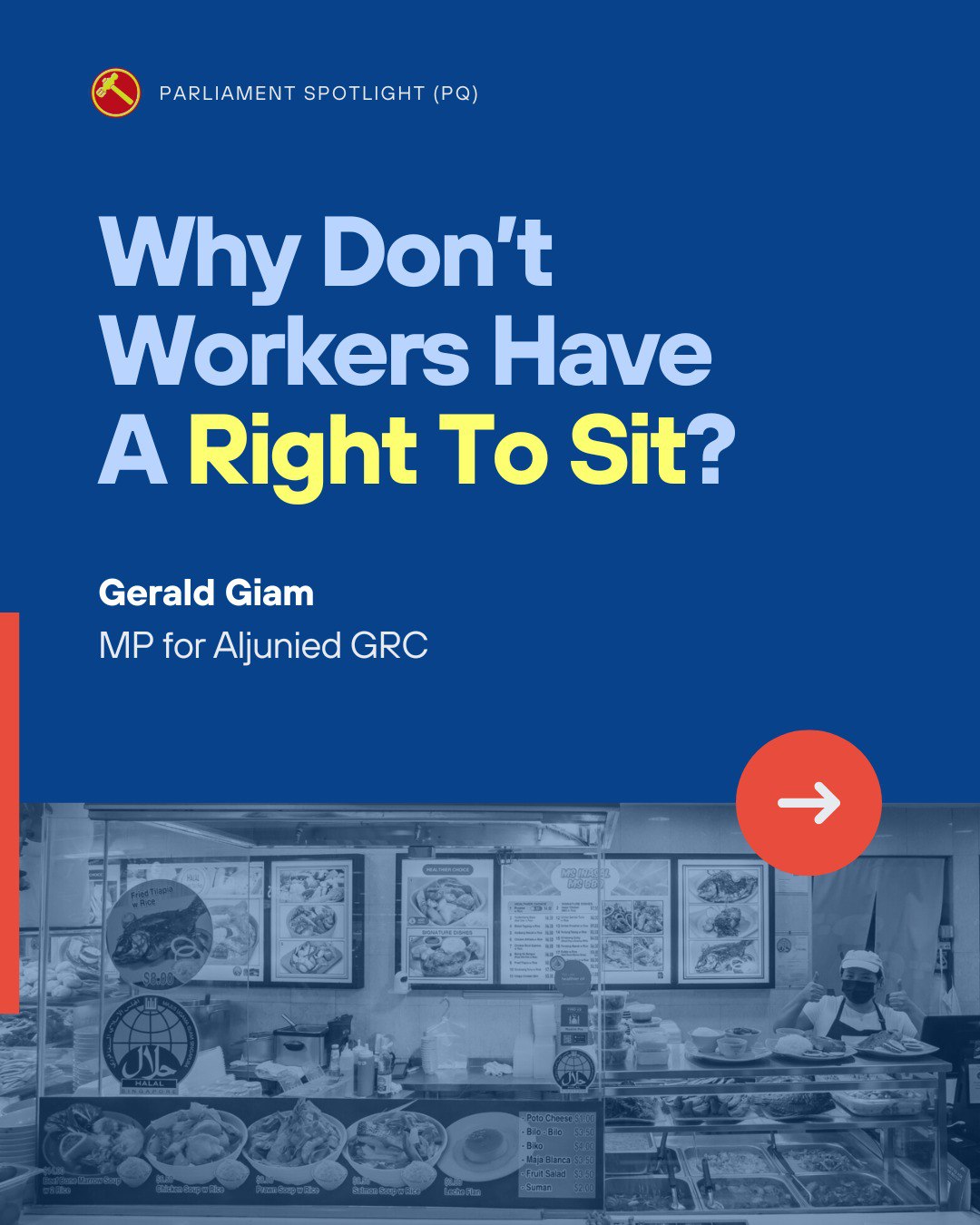
The Right to Sit

In Parliament on 24 Sep 2025, I asked the Minister for Manpower why there aren’t mandatory rest periods for service workers—so they can actually sit during off-peak hours. Prolonged standing isn’t just tiring—it can cause serious long-term health issues.

The Minister responded that mandatory rules might not fit every workplace. MOM’s current approach relies on voluntary guidelines, like providing anti-fatigue mats and sit-stand stools, so solutions can be tailored.

Can we do more to protect our workers’ health? Drop your thoughts in the comments! 

This is the full question and answer:

Reasons against Mandatory Rest Periods for Service Workers and Ensuring Compliance with Voluntary Guidelines

Mr Gerald Giam Yean Song asked the Minister for Manpower (a) what is the reason for not mandating that service workers be allowed to sit during off-peak periods given the health risks of prolonged standing; (b) how does the Ministry ensure adherence to voluntary guidelines in workplaces, such as food courts and retail stores; and (c) whether it will mandate employers to allow sitting to prevent long-term health problems.

Dr Tan See Leng: The Ministry of Manpower (MOM) encourages all employers to provide adequate rest and welfare for their employees. To help employers create a conducive and healthy work environment, MOM and the Workplace Safety and Health (WSH) Council have issued the WSH Guidelines on Improving Ergonomics in the Workplace, which provide recommendations on how employers can support employees who need to stand while at work. These include allowing employees to sit and rest at regular intervals and providing anti-fatigue mats or sit-stand stools.

Mandatory regulations on when service workers should be allowed to sit may not effectively address the diverse operational requirements of different workplaces. Our current approach allows employers to implement appropriate solutions tailored to their specific circumstances and their workers’ needs.

MOM and the WSH Council work with industry associations, unions and employers to promote awareness and adoption of the good practices in the Guidelines on Improving Ergonomics in the Workplace. We will continue to regularly review our occupational health policies, taking into account the latest scientific evidence and international best practices.

Source: Singapore Parliament Reports (Hansard)

Levelling Up Our Society

25 Sep 2025, Parliament

Mr Speaker,

I wish to thank voters of Aljunied GRC, including those in Bedok Reservoir-Punggol division, for giving my teammates and I in the Workers’ Party an opportunity to serve them again. We know that each vote was a carefully considered decision and we do not hold that lightly. We are committed to honouring your trust by working tirelessly to earn your votes again in the coming years.

In his speech at the opening of Parliament, the President spoke of the need to resist self-perpetuating inequality. This message was echoed by the Prime Minister yesterday, who pointed out how other societies have become increasingly stratified, with privilege becoming more entrenched. I share this deep concern.

While it’s reassuring that income inequality, as measured by the Gini coefficient, is declining, the Gini coefficient does not measure wealth inequality. This refers to the unequal distribution of assets like property, stocks, bonds and savings.

If left unchecked, widening inequality can fracture our social compact and undermine the meritocratic system that has been key to our nation’s prosperity.

Meritocracy, in turn, relies on the public’s confidence that it can deliver upward social mobility. A waning of that confidence could lead to distrust—both between different segments of society and with the government—making it harder to forge the consensus required to navigate systemic challenges.

Inequality is therefore a fundamental fault line in our society. Narrowing this divide demands the same level of attention, resources and effort that we have dedicated to maintaining racial and religious harmony.

Confronting inequality requires more than giving everyone the same opportunities in school, as even when public goods are equally available, private advantages remain unequally distributed.

Wealth is frequently passed down from parents to children, not only through inheritances, but a combination of social, informational and financial capital from the time they are born until deep into adulthood. This provides children of privilege the best opportunities to thrive at every stage of their lives, and a strong safety net to catch them if they fall.

These translate into a significant and enduring head start in life. They are subtle and unspoken, but they compound over time.

For a start, well-resourced parents cultivate cultural capital by providing a wide range of enriching experiences to their children. This includes frequent overseas travel and exposure to the arts, which builds an understanding of cultural norms in influential circles and provides a foundation for sophisticated conversations in social and professional settings. Etiquette lessons and public speaking from a young age equip their children with the confidence highly valued in the workplace and in leadership roles.

These parents have the resources to send their children for enrichment camps in areas like artificial intelligence, coding and robotics. They know that these courses build competence from a young age in STEM, a skillset that generally commands higher salaries in future careers. This hands-on experience, beyond what’s taught in textbooks, can spark interest and give an indirect boost to academic performance.

The Direct School Admission scheme offers an alternative route into top schools based on students’ non-academic talents. For parents with resources, hiring top coaches to provide individual training on technique and fitness gives their children a significant head start. This allows them to become high-performance athletes before their peers, giving them a distinct advantage during school trials.

Furthermore, if their child does not do well enough in local exams, their parents have the option of sending them to private schools locally or overseas. This additional safety net ensures that a pathway to higher education is always available, a luxury that less-affluent families cannot afford.

As these young adults enter the workforce, their accumulated social capital continues to open doors. Some might land prized internships at multinational corporations through their parents’ professional networks, bypassing traditional hiring procedures. Likewise, a parent might introduce their child to an influential business contact who can give them their first professional role or provide helpful career tips. These relationships create an often-hidden job market, leading to opportunities that are not publicly advertised.

This safety net extends to significant housing and financial advantages. For instance, some well-to-do parents buy property for their children when they are still young to hedge against rising prices, ensuring they won’t have to struggle to afford their first home when they get married. Others hand over their successful businesses to their children after they graduate, removing the need for them to compete with their peers in the job market.

The actions of these parents are perfectly legal—they are simply doing their best to help their children in a very competitive economy. But this creates a growing chasm between those with and without these advantages. This divide will only widen as economic competition intensifies and the nature of entry-level jobs shifts due to artificial intelligence, demanding new skills that are more accessible to the privileged.

Levelling Up

Our challenge is to bridge this gap—not by suppressing the privileged, but by levelling up everyone else. To do this, we must bolster our public institutions until they rival the private sphere, ensuring every citizen has the opportunity to achieve their maximum potential. I have a few suggestions in this respect.

Junior SkillsFuture Credit

The SkillsFuture Credit scheme has empowered adults to upskill, but the race for skills and opportunities begins much earlier in life. To truly level the playing field, I propose a Junior SkillsFuture Credit scheme. This new initiative would provide a dedicated skills development credit to all Singaporean children below 18 from households in the lower 40th percentile income bracket. This credit could be used for approved enrichment courses in areas like coding, public speaking, sports and the arts. By democratising access to the same hard and soft skills that are often the privilege of the affluent, we can ensure every child has a fair chance to build their confidence and competence from a young age.

I have noted Minister of State Jasmin Lau’s response earlier today to Mr David Hoe, who made a similar proposal in his parliamentary question—I’m glad we are on the same wavelength here. I acknowledge that schools have many in-school and out-of-school extracurricular  opportunities for students, including those from low income families. These should certainly continue. What I am asking for is a separate credit that gives parents and children the agency to choose enrichment programmes that are not available in their schools. In today’s economy, we cannot precisely predict the skills that will be in demand, or the specific passions and interests that will ignite in our young people. Therefore, by giving parents and children the autonomy and agency to choose enrichment courses, we are empowering them to explore a diverse range of opportunities and build skills in emerging areas, just as well-resourced families can.

Building Cultural and Social Capital

The SG Culture Pass, which provides credits for citizens to attend arts and heritage events, is a commendable initiative. However, I am concerned that its take-up rate may be low among households from the lower-income brackets. To ensure that all citizens can benefit, the National Arts Council would need to strengthen its outreach efforts to publicise the pass across all segments of society, and address the unique challenges faced by these lower-income families, such as competing financial priorities, time constraints and the hidden costs of attendance.

We should establish a Global Horizons Fund to provide financial support for international student exchanges, internships, and volunteer trips, democratising the global exposure that is a key component of cultural capital. The Singapore International Foundation (SIF) would be a natural partner to manage this fund, as its mission already aligns with connecting Singaporeans with global communities. Through SIF, donations for the fund could be sought from philanthropic foundations, corporate sponsors, and individuals who have benefited from such international exposure.

Levelling Up: Educational Pathways

To match the college preparation provided to higher-income students, education and career guidance services in schools could be enhanced and personalised. These services could offer comprehensive support to guide students from less-privileged backgrounds through the complex application process for local and foreign universities. Critically, this service would make them aware of the importance of building up a competitive portfolio early and would help them strategically utilise financial support programmes designed to help them do so.

At the same time, our local universities should continue to monitor their admissions processes to ensure that donations do not impact how students are admitted—a problem which has occurred in other countries.

Expanding Professional Networks and Career Mentorship

Existing professional mentorship schemes could be expanded into a National Career Mentorship Programme for all young Singaporean professionals, tradespersons and workers seeking career guidance and professional networks. Crucially, this programme must conduct proactive and targeted outreach to individuals from less-privileged backgrounds who may lack the social and informational capital to access these opportunities.

To attract and retain truly committed mentors, the programme could offer public recognition and award continuing professional development hours. These incentives would not only reward their time but also formalise their commitment to guiding young people from all backgrounds, thus helping to build a more equitable professional landscape.

Levelling Up: Business Ownership

To level up on the advantage of wealthy parents providing seed capital or passing on their businesses to their children, Enterprise Singapore should adjust the Startup SG Founder (SSGF) programme. The programme’s recent shift to a 1-to-1 co-matching ratio presents a financial barrier for first-time entrepreneurs who lack personal savings or family wealth. It makes funding less accessible and favours those who are already financially well-off. I urge ESG to revert to the previous 1-to-4 co-matching ratio. This would make crucial seed funding more accessible, ensuring that promising ideas are judged on their merit alone, without a founder’s financial means becoming an obstacle.

Levelling Up: Publicity

All these programmes can only make a national impact if they are able to reach and assist a wide section of society. The various agencies running these programmes should redouble efforts to publicise their programmes on social media and traditional advertising platforms, and partner with schools, interest groups, grassroots organisations—including those linked to opposition—to encourage participation from Singaporeans from less privileged backgrounds.

Summary

While our journey as a nation has been a remarkable one, the true measure of our success lies not in our peaks of wealth, but in the enduring opportunities we provide all our citizens.

The proposals I have outlined today are not designed to penalise success, but to strengthen our meritocratic system, ensuring that every citizen, regardless of their family’s background, has a fair shot at success.

By giving every Singaporean access to the exclusive advantages that provide a head start in life, we can create a powerful equalising force, offering a clear pathway to upward mobility and a robust safety net for all.

This is how we can build a society where a child’s destiny is not dictated by their birth, but by their grit and hard work.

This is how we assure those who are growing up in difficult circumstances that our society is empowering them every step of the way.

This is how we inspire the next generation to give their all for their families and the progress of our nation.

Mr Speaker, I support the Motion.