Bank accounts for ex-offenders

I have increasingly been approached for assistance by residents who face problems opening personal bank accounts. Their applications were rejected by banks either because of their past criminal records, past investigations for financial-related crimes or are currently under criminal investigation resulting in their bank accounts being frozen.

Members of this House will agree that access to basic banking facilities is essential in today’s digitalised society. These individuals are deprived of basic banking activities such as receiving their salaries. Employers do not usually agree to deposit into their family members’ bank accounts and are unwilling to pay them in cash. They also have difficulty receiving Government cash benefits like GST Vouchers – Cash.

Individuals with past criminal records have paid their dues to society and such a deprivation can be an impediment in their efforts to turn over a new leaf. Similarly, individuals under investigation are deprived despite the operation of the maxim “innocent until proven guilty”. These investigations can take any time between several months to years, which is a long time to function without access to basic banking facilities.

I understand MAS (Monetary Authority of Singapore) has been working with the larger retail banks to open limited-purpose bank accounts for individuals that banks assess to pose a higher risk of being implicated in financial crimes. 

Can I ask the Minister, what are the limitations on such accounts? Will the functions of such accounts vary on a case-by-case assessment by the banks? Additionally, will the pool of eligible individuals for these accounts include persons who are currently under investigation?

This may emerge as a growing problem owing to the increase in bank accounts being frozen during investigations into financial crimes. Owing to the time-sensitivity of this matter, can I ask the Minister what is the progress of the rollout of these limited-purpose bank accounts? Is it generally available to all affected applicants yet? If not, when will it be generally available?


This was a speech I made on 2 Mar 2022 during the Committee of Supply debate in Parliament on the Prime Minister’s Office.

Building a resilient Singapore

The Covid-19 pandemic serves as a reminder to all of us of the importance of national resilience. We are now moving towards life with Covid-19 as an endemic disease, a path which is bound to be fraught with unexpected challenges. The Russian invasion of Ukraine has been a stark demonstration of the fragility of territorial sovereignty in the face of aggression by a larger neighbour.

Building national resilience is a key effort we need to undertake to prepare for current and future challenges. It has to be a joint effort borne out of the partnership between the people, society, companies and the Government. It is vital that government policies must be supportive of the endeavour to build and strengthen resilience.

As I respond to the Finance Minister’s Budget Statement, I will talk about the Seven Pillars of Resilience I believe we need to continuously build up in our nation. These are resilient families, resilient environment, resilient infrastructure, resilient companies, resilient workforce, resilient society and resilient government.

Resilient families

Families are the building block of society. We must do all we can to increase the resilience of family units, whatever form they might come in. 

I am concerned about the plan to raise the Basic Retirement Sum (BRS) by 3.5% per year for the next five cohorts turning 55 from 2023 to 2027. MOF said that eight-in-10 active CPF members turning 55 in 2027 will be able to set aside the heightened BRS. This means that 20% of them will not be able to withdraw more than a token amount from their CPF. 

Currently some 435,000 Singaporeans aged between 55 and 70 are unable to meet the prevailing BRS. Many of them struggle with their living expenses and are not able to use their CPF for housing payments. I hope the MOF will give careful consideration to the needs of CPF members with lower balances before raising the BRS.

For our children, building resilience starts at home. All parents — myself included — view our kids as precious gems but we must be careful not to mollycoddle them. Let’s encourage our children to take part in competitions, whether in sports, games or the arts. Every competition will have only one winner and many losers. Let them learn to win with grace and remain resilient in defeat, by picking themselves up to fight another day. 

Let our children take public transport to school instead of ferrying them everywhere by car. This brings an additional benefit of reducing traffic jams near schools. I commend schools that disallow parents from turning up at school with water bottles or homework that their children left at home. Occasions like these are opportunities for our children to learn to take responsibility for their actions and their belongings.

Resilient environment

Next, on building a resilient environment. I am glad to hear the Finance Minister announce that Singapore aims to achieve net zero emissions by or around mid-century. In order to realise this goal, Singapore must be prepared to make big investments in emerging green technologies and take decisive steps towards wielding the mantle of climate leadership, regionally and globally.

I would like to renew my call made in January for Singapore to launch a national hydrogen strategy and roadmap to spur the creation of a hydrogen economy in Singapore. This will set Singapore on a path towards being a global player in the hydrogen industry and benefit Singaporean workers.

NEA is now mulling the introduction of a mandatory plastic bag charge at supermarkets. I support the reduction of one-time use plastics. However, policies designed to achieve this must take into account the local context. 

Most shoppers don’t throw away their plastic bags but use them to bag their trash before throwing it down their rubbish chute. If they don’t have enough plastic bags from supermarkets, they might end up buying plastic bags or, worse, throwing their rubbish directly down the chutes. Therefore any policy interventions should strive to encourage intrinsic attitudes towards conservation, not lead to people trying to work around punitive measures. 

Instead of a per bag charge, has NEA considered requiring large supermarkets to offer a discount as an incentive for not using plastic bags?

Resilient infrastructure

Singapore’s rapid urban development and ascent on the global economic stage was made possible in large part due to good infrastructure.

Our public transport network has seen improvements in recent years, although the convenience and frequency bus services in some areas like Bedok Reservoir has been a bugbear for many commuters. This has shown up in commuter surveys which rate bus services the lowest among transport modes. I will speak more about this during the MOT COS.

Moving on to digital infrastructure, the prevalence of online scams points to the need for more resilient cyber infrastructure, not only at the back end but also at the front end, with efforts to detect attempts at social engineering and prevent people from falling prey to scammers. While public education is important, the financial institutions must redouble their efforts to use technological solutions to detect suspicious patterns of use and stop using SMS as a channel for sending passwords.

The world has entered an age where cyber warfare is a real threat, as demonstrated by Russia’s alleged cyberattacks on Ukrainian infrastructure long before the air, land and sea invasion began. Adversaries can potentially maliciously shut down or control critical infrastructure with the click of a mouse. Are our government agencies putting enough resources into countering this threat, and are critical infrastructure providers like water treatment plants, power grid operators, telcos and public transport operators ready to counter these threats? 

Resilient companies

Our companies have seen challenging times in this pandemic. Many are still struggling to stay afloat. The pandemic has shown our over-reliance on our foreign workforce. We need to transform our economy to boost the attractiveness of local talent to companies. 

MOM should watch out for companies that circumvent market testing requirements, for example by doing a token posting on MyCareersFuture when they already have a foreigner in mind to hire. Where there are instances of companies claiming that they are unable to find Singaporeans to take up open positions, we need to make a deeper qualitative assessment on why this is so. For example, are there gaps in our education system that are preventing our schools from producing market-ready graduates?

On a separate note, I believe that one of the brightest sparks about the pandemic is the mainstreaming of work-from-home arrangements. A large proportion of both employees and employers want to continue remote work, at least part of the time, even after the pandemic ends. We should build on these gains, and encourage more companies, especially the more traditional SMEs, to provide work-from-home options for their employees.

Good economic prospects and technological advances disproportionately benefit the highly skilled. To make our growth more inclusive, we should engage more Singaporeans economically, including people with disabilities and the elderly. Companies should extend work-from-home opportunities to engage and empower Singaporeans with mobility issues. Not only do they form a large untapped labour market with valuable experience to contribute, enabling them to work from home would help them to connect better with the society, improve their overall well-being and to strengthen Singapore’s social security. I hope MOM can consider ways to incentivise companies to extend work-from-home opportunities to this group of Singaporeans.

Resilient workforce

In his Budget Statement, the Finance Minister introduced a $500 a month minimum income requirement to qualify for the Workfare Income Supplement (WIS) from 2023. This could potentially impact up to 46,600 employed residents, inclusive of part-timers, who earn less than $500 a month. It will disadvantage workers who have extremely low incomes, are forced to work reduced hours through no fault of their own or have unpaid caregiving responsibilities.

The Minister said that this is to encourage part-timers and casual workers to take up regular, full-time work. However, I fear it will result in the exact opposite. Workers may decide to drop out of the workforce because their income cannot even cover their travel expenses. I appeal to the Minister to rescind the minimum income requirement so that all low wage workers will benefit from Workfare. This was a call made by the Leader of the Opposition yesterday as well.

We must ensure that every working Singaporean receives a decent minimum wage. I welcome the requirements for all local workers to be paid at least $1,400 a month if their companies employ foreign workers, or the workers are in a Progressive Wage Model (PWM) sector or occupation. I am cheered that the Government is going to co-fund the pay increases for lower wage workers over the next five years. 

Building on this approach, would the Minister consider also co-funding for five years the pay increases of all Singaporean workers who are taking home less than $1,300 a month, including those who are not in sectors or occupations covered by the PWM. This will help companies adjust to paying their workers a minimum wage and bring Singapore closer towards implementing a national minimum wage, something that the Workers’ Party has been consistently advocating for.

In addition to strengthening our workers’ rights, we also need to build more resilience in our local workers. Some employers have lamented to me about local employees quitting when they are made to work long hours, in contrast with foreigners, whom they claim have no qualms about working overtime. We shouldn’t be dismissive of those who may have genuine domestic responsibilities like taking care of children or elderly parents. However, for those that don’t, including many younger local professionals, I feel it doesn’t hurt to “piah” a bit more during your first job, so you can establish your career and compete more effectively with the global workforce. Of course, do this without sacrificing your mental and physical health!

Resilient society

A vibrant local sports scene contributes towards building a resilient society. The Suzuki Cup football tournament was a great demonstration of how sport can promote national unity. I experienced it myself when I took my son to see one of the matches. However, cheering for the Lions once every two years is not enough. Our sporting talents are playing in international tournaments throughout the year. They should be better featured. 

For example, Loh Kean Yew’s historic victory at the 2021 Badminton World Championships could only be watched “live” on a cable channel. Non-subscribers had to wait almost a week to watch it on free-to-air TV. Featuring more of our local sporting talents on free-to-air TV or local online channels like meWatch will not only imbue a greater national spirit, but will also inspire a generation of young sports enthusiasts who may go on to become future champions.

Resilient government

Finally, I believe we need a resilient government. A sizable presence of Opposition MPs in Parliament will keep the Government on its toes and responsive to the needs of the people, and increase the resilience of our government.

The other side of the coin is an efficient and effective Civil Service. I commend our public servants for demonstrating great resilience in helping our nation through the pandemic. I was once a civil servant and, to this day, I hold close to my heart a piece of advice my permanent secretary gave to me when I first joined the Service. He told me he expected me to be the subject matter expert on issues covered by my desk. He said it was my responsibility to provide objective recommendations in the policy submissions I put up to senior management and Ministers. This was sound advice. 

Civil servants should not second guess what their political masters want or implement instructions blindly just because the Minister said so. They must also not be afraid to respectfully point out policy errors made by political office holders, as it is in Singapore’s interest that the best possible policies are advanced. The Civil Service must also remain politically neutral. 

GST hike

The final point that I wish to raise to register my concerns over the planned hike in GST rates in 2023 and 2024. I understand the budgetary pressures that come with an ageing society and I support moves to socialise more provision of more public welfare services, especially for the elderly. 

However it remains my belief that a consumption tax hike should be a last resort to increasing revenue. This is because the GST is an inherently regressive tax, to which the poor pay a higher percentage of their income compared to the rich. In Singapore, only a portion of GST paid is returned in the form of GST Vouchers. The GST Offset Package meant to help households adjust will only last for five to 10 years. However, the GST hike will be forever. 

The Ministry of Finance should consider other more progressive sources of revenue besides the GST hike. Yesterday, MP for Sengkang, Assoc Prof Jamus Lim, did a deep dive into the Workers’ Party’s alternative levers for raising revenue. These include higher taxes on carbon emissions, multinational corporations and wealth; using a portion of land sales; and increasing the investment returns contribution, which can more than make up for shortfalls in revenue brought about by higher social spending, without having to increase GST.

Conclusion

Mr Speaker, the pandemic has precipitated societal and political upheavals in many countries. Singapore has, thankfully, been largely spared the kind of widespread rifts in society caused by measures to deal with the pandemic. Nevertheless, we must anticipate that future challenges will only get harder. Let us take the necessary steps now to build a more resilient Singapore so that our next generation will be better prepared to weather any storm that comes.


This was my speech in Parliament on 1 Mar 2022 during the debate on the 2022 Budget Statement.

Electricity price hikes disproportionately affect SMEs

Several business owners in my constituency, including kopitiam operators, shared with me their shock at seeing their electricity bills jump more than threefold since October 2021. This was despite their efforts to reduce electricity usage. Many are facing difficulties managing the sky high electricity costs. 

SMEs are disproportionately affected by the exit of electricity retailers and the drastic increase in the wholesale electricity price. They are not offered fixed tariff price plans by SP Group, and most retailers are not offering such contracts at this time. 

On 14 February 2022, I asked the Minister for Trade and Industry for an update on EMA’s Temporary Electricity Support Scheme (TRECS). TRECS was oversubscribed when it was launched in January 2022.

I also asked whether EMA will consider working with electricity retailers to provide a 12-month fixed electricity plan for smaller business consumers, specifically SMEs with a monthly consumption between 4,000 and 20,000 kWh.

I further asked if EMA could extend TRECS for another six to 12 months beyond May 2022, in view of the current economic situation and energy supply situation. If this was not possible, I asked if EMA could allow these SMEs to buy electricity at the regulated tariff instead, so that their operational costs do not skyrocket.

This is the full text of my question and exchange in Parliament with the Minister:

UPDATE ON TEMPORARY ELECTRICITY CONTRACTING SUPPORT SCHEME AND IMPACT OF EXIT OF ELECTRICITY RETAILERS ON SMES AND SUPPORT AVAILABLE

The following question stood in the name of Mr Edward Chia Bing Hui –

41 To ask the Minister for Trade and Industry (a) to date, what is the take-up rate of the Temporary Electricity Contracting Support Scheme (TRECS); (b) what is the number of companies not supported by TRECS; (c) what is the cost delta impact on these companies and the reasons for not being supported; and (d) whether the Ministry intends for TRECS to continue for an extended period of time.

42 Ms Sylvia Lim asked the Minister for Trade and Industry (a) what is the Ministry’s assessment of the effect of the exit of various electricity retailers in 2021 on the electricity bills of small and medium enterprises (SMEs); and (b) how is the Government monitoring or managing the capacity of the remaining retailers so as to facilitate SMEs having options to manage their electricity costs.

43 Ms Jessica Tan Soon Neo asked the Minister for Trade and Industry in light of five electricity retailers ceasing operations last year and many small and medium businesses (SMEs) having to shift back to SP Services’ wholesale electricity plan, what support can be extended to these SMEs to provide more certainty to manage their business costs against very high increases in their monthly electricity charges, particularly those with average monthly electricity consumption of 4,000 kWh and above.

44 Mr Gerald Giam Yean Song asked the Minister for Trade and Industry (a) whether he can provide an update on the Temporary Electricity Support Scheme (TRECS) since it was introduced in December 2021; (b) whether the TRECS will be extended beyond February 2022; and (c) whether EMA will consider working with electricity retailers to provide a 12-month fixed electricity plan for smaller business consumers, specifically SMEs with a monthly consumption between 4,000 and 20,000 kWh. 

45 Ms He Ting Ru asked the Minister for Trade and Industry (a) what support is available to SMEs; and (b) what are the options available to affected businesses, when their utilities costs have increased by large factors due to the insolvency of their previous utilities retailers.

Ms Jessica Tan Soon Neo (East Coast): Question No 41, please.

The Second Minister for Trade and Industry (Dr Tan See Leng) (for the Minister for Trade and Industry): Mr Speaker, may I have your permission to answer Question Nos 41 to 45, as well as the Parliamentary Question filed by Mr Saktiandi Supaat1 that has been scheduled for a subsequent Sitting?

Mr Speaker: Yes, please.

Dr Tan See Leng: Mr Speaker, the world has been facing a global energy crunch since September last year. The price of LNG, or spot Liquefied Natural Gas, rose significantly and remains elevated at more than three times the levels as at the start of 2021.

While our piped natural gas (PNG) supply typically helps to moderate the impact from higher LNG prices, there was a series of disruptions and planned depletions to our PNG supply since the second half of 2021. This confluence of factors has resulted and caused increased volatility in wholesale electricity prices. Since October 2021, EMA, or the Energy Market Authority, has implemented a set of measures to enhance Singapore’s energy security and stabilise the SWEM, or Singapore Wholesale Electricity Market, prices.

Nevertheless, some market participants were adversely affected by the volatility. Between October and December 2021, six electricity retailers exited the market and another two retailers prematurely terminated some of their customers’ contracts. As a result, about 9% of all electricity consumer accounts were affected.

All affected households and businesses with an average monthly consumption of less than four megawatt hour (MWh) can switch to Singapore Power’s regulated tariff at any time. Some businesses consuming four MWh or more managed to secure plans with other retailers.

There remains about 11,000 business consumer accounts – accounting for about 1% of consumers – which have to buy electricity directly from the Singapore Wholesale Electricity Market, or SWEM, and are thus exposed to more volatile electricity prices.

To help these businesses, EMA worked with the generating companies or gencos to offer monthly fixed price plans under the Temporary Electricity Contracting Support Scheme, or TRECS for short, in January this year – that is last month. The TRECS plans were fully subscribed for January. For the month of February, the initial offering of TRECS was also fully subscribed. In response to requests for more such contracts, EMA worked with gencos and electricity retailers to offer about 645 megawatts of TRECS and other plans with significant fixed price components. At least 200 megawatts of the contracts are still available and we are extending TRECS for March, April and May.

We encourage all consumers without a retail plan to consider taking up these contracts for greater certainty.

Mr Speaker, let me now turn to the issue of electricity prices. Singapore imports all of our energy and cannot be fully insulated from developments in the global energy market. Well, let me make a correction – Singapore imports a vast majority of our energy, not all of our energy. We still have some from solar. The higher fuel prices feed into our electricity bills to reflect the higher costs of electricity production.

As I had mentioned during the Committee of Supply debates last year, we had been enjoying artificially low electricity prices for several years, because this is due to an over-investment in capacity and fuel by the generation companies. I have also alluded to the fact that that was also below the cost of generating electricity; and thus, it was not sustainable. In fact, if Members of the House remember, I also put up a chart that clearly demarcated and showed that the cost of generation was higher than the cost of the electricity tariffs at that time.

An electricity price correction was therefore unavoidable and the current global energy crunch has precipitated and exacerbated this correction.

Again, Members of this House would have asked what help is therefore available for the affected businesses. Household and small consumers which need help with their electricity bills can apply to SP Services for instalment payment plans. Businesses which need financing support can also make use of ESG’s programmes such as the Temporary Bridging Loan and Enterprise Financing Scheme SME Working Capital Loan.

The 11,000 or so business accounts without a long-term retail contract bear the brunt of the electricity crunch. To help them weather the storm, EMA has worked with gencos and electricity retailers to reduce the volatility and lower the cost of buying electricity through TRECS, additional monthly contracts offered by gencos, and on the wholesale market for businesses, as I had mentioned earlier. For example, Sembcorp Power Pte Ltd is offering one-month fixed price plans at preferred rates to consumers with average monthly consumption of between four and eight MWh.

EMA will also continue to monitor closely market developments, including heightened geopolitical tensions and their potential impact on global energy prices, and put in place the necessary measures to secure our energy supply, enhance stability and ensure the orderly functioning of the market.

Mr Speaker, Singapore has an open and competitive electricity market where prices will rise and fall depending on demand and supply conditions and developments in the global energy market. Over the last 20 years, our energy market has served us well. Our electricity supply is one of the most reliable and price competitive amongst major developed cities.

Our energy market is now being tested by unprecedented shocks and volatility in the global energy markets. Nevertheless, we are committed to ensuring that Singapore’s power supply remains secure and reliable, and to supporting our vulnerable customers during this period.

My only exhortation and urging is for all consumers to use energy prudently and to adopt energy conservation as a way of life. We will also learn from this episode to see how we can strengthen and fortify our energy reliance, resilience and our electricity market. And I am confident that together, we will emerge from this stronger. 

Mr Speaker: Mr Gerald Giam.

Mr Gerald Giam Yean Song (Aljunied): Thank you, Sir. Several businesses in my constituency have shared with me they are shocked at seeing their electricity bills jump threefold or more despite their efforts to reduce electricity usage. Businesses with the consumption of more than four MWh, but less than 20 MWh, which include many neighbourhood kopitiams, have to buy electricity from SP Group at the wholesale electricity price, which is very elevated and volatile now. They are also facing difficulty buying electricity from retailers because many retailers are not offering contracts until later in the year or even next year. 

Can EMA extend TRECS for another six to 12 months beyond May 2022, in view of the current economic situation and energy supply situation? If this is not possible, can EMA allow these SMEs to buy at the regulated tariff instead, so that their operational costs do not skyrocket? 

Secondly, Minister mentioned that TRECS was fully subscribed for the months of January and February. How many businesses applied for, during these two months under TRECS, but were not able to obtain contracts? Are there plans to expand the number of slots in TRECS available for those who need it?

Dr Tan See Leng: I thank Mr Gerald Giam for his questions. Can I answer the second question, and then I will go back to the first one? For TRECS, in January, it was oversubscribed. As I have shared, earlier on in my main PQ reply that for February, there still remains about 200 megawatts, and I was encouraging, many of these SMEs to consider going into this particular retail plan.

As far as the extension of TRECS for another six months is concerned, we have now extended for March, April and May. That is three months. Our estimates also tie in generally with the consultants, and these are global market consultants, who look at the trend of energy prices. Of course, we hope that the situation in the Eastern Europe, I think namely that between Russia and Ukraine, does not get worse. But once winter is over, we are cautiously optimistic that natural gas prices will ease somewhat. So, we may not need to extend TRECS beyond six months.

At this particular point in time, we are monitoring the situation very, very closely. In fact, we do not monitor on a month-to-month basis, but we monitor it on a weekly basis, and sometimes, even on a daily basis.

I hope that answers the Member’s question.

Today, TRECS will be extended for March, April and through to May. But other than TRECS as a scheme, we are also now working to see whether there are any other assistance measures that we can roll-out to help. So, I hope that answers the Member’s second point,

For his first question, in terms of the assistance, we have worked with electricity retailers and gencos to lower the cost of buying electricity through eligible contracts to support those businesses that have been affected. I do not have the data for how many businesses have not been able to subscribe to TRECS in January, but as a follow-up, what I can do is to try and get the statistics and then answer that either as another PQ that the Member can file later, or I will see how to get that answer across.

We are also contemporaneously working with gencos to see if they can offer additional temporary discounts at their end.

I just want to also manage expectations. These offsets will not be able to help account for the price increase completely. Because, as I have said before in the past, this has gone up by threefold since the start of 2021. But, I think certainly it will go some way to help companies to adapt to the sudden surge in prices. I hope that clarifies. 

Mr Speaker: Mr Gerald Giam. 

Mr Gerald Giam Yean Song: There is one question which I think was not answered, which is, is it possible for EMA to allow SMEs to buy – I am talking about SMEs who use between four MWh and 20 MWh of electricity of month – at the regulated tariff, instead of at the wholesale electricity price?

Dr Tan See Leng: I think the reason why we created TRECS was because we took into consideration the fact that, to expect SP to suddenly open it up to everyone for them to buy, I think SP may have difficulty in supplying all that incremental needs in a short run.

So, I think we need to also understand how the market works. Electricity which is offered through the regulated tariff is purchased by Singapore Power or SP through existing long-term vesting contracts with the gencos. SP has contracted a limited quantity of such long-term electricity contracts and we have to reserve them for households, for small business consumers, who traditionally do not have the bargaining power to negotiate for better retail prices.

If we allow for large consumers to switch to the regulated tariffs, then this means that the SP group will now have to contract for additional supply with gencos at higher prices and/or buy additional electricity supply from the SWEM at the prevailing Uniform Singapore Electric Price, or USEP. This will then cause the regulated tariffs to rise. So, all households and small consumers, who are, today, on the regulated tariff would then have to bear the costs of price stability for the large consumers. This may not necessarily be fair to the household consumers and the small business owners.

Hence, as a result of that we wanted to make sure that we can segregate it and protect the existing consumers, of which many of them are your residents as well, by making sure that we move and negotiate for a new scheme, TRECS, to help those that are in the four MWh to 20 MWh range. I hope this answers the Member’s question. 

Source: Singapore Parliament Reports, 14 Feb 2022
Who is responsible for preventing online scams?

I am very concerned about the increasing number and brazenness of online scams in recent years. This has been an ongoing issue since at least 2019. From 2019 to 2020, the total number of scam cases reported increased by 65.1% from 9,545 cases in 2019 to 15,756 cases in 2020, according to the Singapore Police Force (SPF). In the first half of 2021 alone, the total number of reported scam cases was 8,403 cases.

Fighting fraud is a collective effort, and the onus should not be placed so heavily on customers, who may not have all the wherewithal to detect and prevent it.

I have filed some questions in Parliament for the Prime Minister and the Minister for Home Affairs. I asked whether financial institutions can be legally required to compensate victims of online scams in order to place a greater onus on them to take measures to prevent customers from falling victim to scams.  

There should be a greater onus on financial institutions to prevent and detect fraudulent transactions. This is especially pertinent as criminals continue to engage new and more sophisticated methods to carry out scams. 

This is the full text of my Parliamentary questions:

Mr Gerald Giam Yean Song: To ask the Prime Minister whether financial institutions can be legally required to make at least a partial compensation to victims of online scams in order to place a greater onus on them to take all possible technical and customer education measures to prevent their customers from falling victim to scams. 

Mr Gerald Giam Yean Song: To ask the Minister for Home Affairs (a) what proportion of mobile phone users in Singapore are currently using the ScamShield app; (b) to date, what percentage of scam calls and SMSes have been successfully blocked by the app; (c) why is the app not available to Android users; (d) when will the app be available to Android users; and (e) what plans are there to step up public education to encourage residents to install the app.

Bus services along Bedok Reservoir Rd

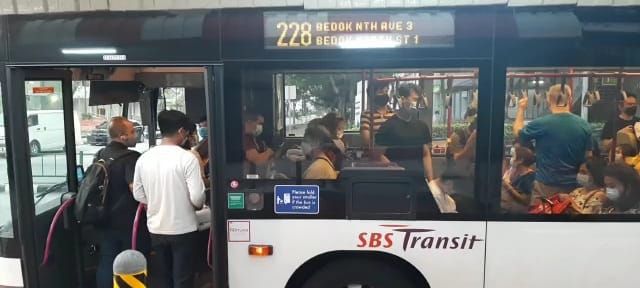
Residents living in my constituency along Bedok Reservoir Road, Kaki Bukit Road 4 and Bedok North Avenue 3 in Aljunied GRC were recently disappointed to learn that several bus services they had been used to taking, namely bus 22, 66 and 506, were rerouted and no longer ply the road near their homes. I received many emails and WhatsApp messages from frustrated residents who lamented that their journeys had become longer and more inconvenient.

Longer, because the wait time for buses to Bedok MRT has become significantly longer as now only a single service, bus 228, can take them there.

More inconvenient, because they no longer enjoy a direct bus service between their homes and destinations in Jurong East, Bukit Batok, Bukit Timah and Upper Paya Lebar Road. Instead, they now have to make transfers — taking two buses or a combination of bus and MRT. (Full disclosure: I am one of those affected commuters, as I sometimes used to take bus 66 all the way home after constituency visits.)

The Government’s rationale for truncating these bus services is that ridership has been lower than before, there is route duplication with the Downtown line and that there are alternative travel options. These reasons have not gone down well with many of my residents, especially the elderly and those with elderly parents.

I therefore asked the Minister for Transport on 10 Jan 2022 in Parliament whether the Land Transport Authority (LTA) has conducted any studies on the effects of additional bus transfers on the elderly or disabled commuters that are brought about by the rerouting and withdrawal of bus services. I further asked how LTA assists elderly or disabled commuters who are faced with additional transfers, following the changes to bus services, including those living along Bedok Reservoir Road.

The Minister responded that when amending bus routes, LTA does its best to enable commuters to complete their journeys with minimal inconvenience, while balancing operational and financial considerations. He said the frequency of bus 228 was increased during the morning peak period for commuters who travel between Bedok Reservoir Road and Bedok Interchange.

I separately wrote to LTA on behalf of several residents who pointed out that the frequency of bus 228 was still not high enough to overcome the removal of bus 66 to Bedok MRT.

LTA acknowledged that there were “isolated trips with prolonged wait times due to poor operations”, and some resulted in crowded buses because of an uneven utilisation of buses. The transport regulator has since instructed SBS Transit, which operates bus 228, to “tighten its operations” and ensure its bus captains adhere closely to their schedules.

Here is the full Q&A in Parliament on 10 Jan 2022:

HELP TO ALLEVIATE IMPACT ON ELDERLY AND DISABLED COMMUTERS WHEN PUBLIC BUS SERVICES ARE RE-ROUTED OR DISCONTINUED

Mr Gerald Giam Yean Song asked the Minister for Transport (a) whether LTA has conducted any studies on the effects of additional bus transfers on the elderly or disabled commuters that are brought about by the re-routing and withdrawal of bus services; and (b) how does LTA assist elderly or disabled commuters who are faced with additional transfers, following the changes to bus services, including those living along Bedok Reservoir Road.

Mr S Iswaran: When amending bus routes, LTA does its best to enable commuters to complete their journeys on public transport with minimal inconvenience, while balancing operational and financial considerations.

For example, with the shortening of Service 22 and Service 66 which used to ply Bedok Reservoir Road, Service 65 was retained and adjusted so that commuters would continue to have a bus connection between the central areas and Tampines. LTA also increased the frequency of Service 228 during the morning peak, for commuters who travel between Bedok Reservoir Road and Bedok Interchange.

Service ambassadors are also deployed at key bus stops along the amended routes on the first few days of implementation to guide commuters, including the elderly. They assist commuters and advise them on the most efficient travel route to reach their destinations.

LTA and the Public Transport Council have also worked with the operators to promote a more inclusive and caring commuter culture in our public transport system to complement the above measures. This includes growing the Caring Commuter Champion volunteer corps to educate members of public to assist vulnerable commuters, including the elderly and people with disabilities.


Are you affected by these bus service changes? Drop me an email at gerald.giam@wp.sg or WhatsApp at 89250747 to share your experience and thoughts with me. If necessary, I will raise this matter again in Parliament to speak up on behalf of my residents.

Banking scams

SMS is an inherently vulnerable platform to use for secure transactions. On 5 October 2021, I asked the Prime Minister how MAS, the banking regulator, is working with banks and telcos to prevent hijacking of one-time passwords (OTPs) sent by banks via SMS. I asked whether MAS will require banks to reimburse customers for any losses resulting from the hijacking of SMS OTPs. The Minister confirmed that customers will not have to bear any such unauthorised charges resulting from SMS OTP diversion so long as they had taken care to protect their card information and authentication credentials.

I further asked if MAS be directing banks to move their multi-factor authentication methods away from SMS to more secure app-based authentication methods. The Minister said that MAS does not prescribe.

Next, I asked if MAS will require banks to allow customers to disable SMS OTP authentication and only allow app-based authentication. The Minister said that it is something MAS can engage the banks on to see if banks will be prepared to give more options for customers who feel they would prefer something more secure.

In the wake of the massive scam of OCBC customers that took place recently, I think there is an added urgency to move banks away from using SMS for financial transactions.


The full Parliamentary Q&A is below:

REVIEW OF FRAUDULENT CREDIT CARD TRANSACTIONS INVOLVING DIVERSION OF ONE-TIME PASSWORDS PRIOR TO SEPTEMBER 2020

REVIEW OF FRAUDULENT CREDIT CARD TRANSACTIONS INVOLVING DIVERSION OF ONE-TIME PASSWORDS PRIOR TO SEPTEMBER 2020

The Minister for Finance (Mr Lawrence Wong) (for the Prime Minister): Mr Speaker, Sir, aside from Dr Tan’s Parliamentary Question (PQ), Member Ms Joan Pereira had filed similar PQ yesterday and Mr Gerald Giam1 had also filed a PQ on this matter.

So, with your permission, may I take all these PQs related to MAS’ recent announcement on the SMS OTPs fraud, at the same time.

Mr Speaker: Yes, please.

Mr Lawrence Wong: Sir, MAS, the Infocomm Media Development Authority (IMDA) and the Singapore Police Force (SPF) announced on 15 September that malicious actors overseas had diverted and used SMS OTPs to perform fraudulent credit card transactions between September 2020 and December 2020. Seventy-five bank customers in Singapore had been affected. Banks have reached out to all the affected customers to waive the unauthorised transactions, amounting to approximately S$500,000.

There have been no confirmed cases of SMS OTP diversion in Singapore prior to September 2020. Banks are reviewing all card dispute cases reported to them from September 2020, to identify if there may be other fraudulent transactions that were enabled by SMS OTP diversion. Banks will similarly investigate any new reports by customers, including any such transactions before September 2020. Bank customers will not have to bear any unauthorised charges in cases which are confirmed to have been enabled by SMS OTP diversion, as long as customers had taken care to protect their card information and authentication credentials. So, bank customers will not have to bear any such unauthorised charges so long as they had taken care to protect their card information and authentication credentials.

Sir, this attack has shown us that the fight against scams and fraud requires collective effort.

Banks have a responsibility to secure their IT systems, put in place robust measures to authenticate customer transactions and conduct active surveillance to detect unusual transactions patterns. They are required to institute robust security controls to safeguard customers’ account information and transaction data from unauthorised access and misuse.

Likewise, bank customers too have a responsibility – to protect their online banking and payment credentials for authentication such as passwords and OTPs, by inputting them only on official websites or mobile applications. These should never be disclosed over the phone, via text message or email.

Mr Giam had asked about the measures taken by banks and telecommunication companies to safeguard against the SMS OTP diversion attack. While banks’ systems were secure and not the cause of these incidents, banks have further enhanced their fraud surveillance measures. This includes rejecting card payments made to common merchants linked to the unauthorised transactions. Banks will continue to closely monitor the evolving cybersecurity landscape, and regularly review authentication mechanisms and other security measures put in place to address risks posed to customers using online financial services.

As for the local telecommunication networks, IMDA, in consultation with the Cyber Security Agency of Singapore (CSA), has required telco operators to put in place specialised firewalls and system safeguards to monitor and block suspicious diversions of SMS.

As Ms Pereira highlighted, consumers need to also take action to protect themselves. Allow me to share a few actions which consumers can focus on.

First, consumers must assume that criminals will try to obtain their online banking credentials. Criminals typically do this by tricking consumers into installing malware on their devices or disclosing their online banking username and passwords through phone calls or fake websites. When in doubt, consumers should call the banks’ official hotlines to verify the legitimacy of requests for online banking and card credentials.

Banks work with SPF, National Crime Prevention Council (NCPC) and MoneySense, our national financial education programme, to regularly alert consumers to new methods adopted by scammers and to educate consumers on how they can protect themselves.

Consumers must also develop a healthy scepticism about websites, unsolicited phone calls, messages and emails. When making online purchases, they only should use established and reputable online services. If there is any doubt about a merchant’s legitimacy, do not proceed with the transaction. And be wary of any deal or offer that sounds too good to be true.

Second, consumers should set transaction notification thresholds at low levels so that unauthorised transactions are detected early. Banks work closely with SPF and Anti-Scam Centre to exchange intelligence on emerging scam trends, so that they can take prompt action. The sooner a report is made, the higher the likelihood that the funds can be recovered.

Where bank customers suffer financial losses from fraudulent transactions, they are protected as long as they have acted responsibly. Banks are expected to consider whether the customers could have taken reasonable steps to prevent the occurrence of the fraudulent transactions. Bank customers will not have to incur any losses which arise from the banks’ non-compliance with MAS’ rules.

Let me reiterate: fighting fraud is a collective effort. As criminals will continue to perpetuate new and more sophisticated methods to defraud consumers, banks, consumers and the authorities need to remain vigilant in preventing as well as detecting fraudulent transactions. MAS will continue to work with all stakeholders to ensure that e-payments remain safe and secure.

Mr Speaker: Dr Tan Wu Meng.

Dr Tan Wu Meng (Jurong): I thank the Minister for his answer. Sir, these are serious revelations. A Clementi resident told me that when he disputed a credit card transaction with his bank, he was told because there was an OTP record in his phone number’s name, the transaction must be genuine and therefore, cannot be challenged. He appealed a number of times; the case was resolved. But how many more consumers would have given up before attaining a resolution?

Sir, I have got three supplementary questions for the Minister. First, prior to September 2020, how many reports were there of fraudulent card transactions in recent years where the victim said they did not perform the transaction nor receive the SMS OTP? Has the trend been going up, prior to the latest findings?

Second, will MAS consider looking into these earlier cases too? Cases, which based on earlier assumptions, might have been deemed clear-cut open and shut, but given the latest revelations, might warrant repeat scrutiny? 

And thirdly, can MAS reassure the public, including our Clementi residents, that agencies will continue keeping an open mind when a customer is concerned about cyber fraud affecting their credit card, involving the SMS OTP?

Mr Lawrence Wong: Mr Speaker, as I mentioned in my reply just now, we have not seen any confirmed cases of SMS OTP diversion. I emphasise, we are talking about SMS OTP diversion fraud cases. We have not seen any confirmed cases up to now, prior to September. But the banks, as I mentioned just now, are investigating any further reports by consumers and customers, and these will include transactions that occurred before September 2020, taking into consideration this new revelation or this new finding that some of these SMS OTPs could have been diverted and we would take that into consideration in resolving these cases.

Certainly, if any subsequent report were to be made and found to be linked to SMS OTP diversion, the cases would be resolved as with the 75 cases that I highlighted, which means that for affected customers, the banks will waive the unauthorised transactions, so long as the customers have taken the necessary care to protect their card information and authentication credentials.

Going forward, for future cases, whether it is due to SMS OTP diversion or other fraudulent methods, I have mentioned before in this House that we have a Payments Council. They are reviewing guidelines and responsibilities for customers as well as financial institutions to clarify responsibilities and liabilities.

Ultimately, everyone needs to play their part: financial institutions will have to do so, customers will have to do so. If we clarify what the responsibilities and guidelines are, then, hopefully, we can continue collectively to do more to guard against such fraudulent transactions.

Mr Speaker: Mr Gerald Giam.

Mr Gerald Giam Yean Song (Aljunied): I thank the Minister for answering my PQ. Given that SMS OTP diversion is something that takes place overseas where MAS has no jurisdiction, how are the banks going to prevent this from happening to their customers again? For example, are banks or IMDA going to work with these overseas telcos to close these loopholes? 

Secondly, will MAS be directing banks to move their multi-factor authentication methods away from SMS to, for example, more secure app-based authentication methods? If so, how will they ensure that the less tech-savvy customers will not be left out?

Lastly, can MAS also require banks to allow existing customers to disable SMS multi-factor authentication for their own accounts and then use app-based authentication instead, because they are more secured?

Mr Lawrence Wong: Sir, let me just take these three questions in turn. First, as I mentioned in my reply, IMDA is putting in place some safeguards with regard to how the telcos operate. In this instance where it comes to SMS OTP diversion, the perpetrators needed to do several things.

One, they would have obtained the victim’s personal and financial information and mobile phone number already. That would have been compromised already, through malware, through phishing, whatever methods they would have gotten that information.

Second, the perpetrators would have gained access to a few overseas telco networks to compromise their system. Then, they would fraudulently modify the location details of the targeted victims as though these victims were overseas. Then, you make a transaction and the bank sends an SMS OTP through this overseas network. And that is how, with the compromised credit card credentials, the fraudulent transaction is made.

And so, as I mentioned just now, telcos are already putting in place additional safeguards, for example, specialised firewalls and other system safeguards to monitor and block suspicious diversions of SMS. This would include, for example, knowing where an individual’s location is, and if you suddenly see the change in location, a red flag may be triggered, and then, the telco would then have safeguards in place to prevent the SMS from being diverted. These system safeguards are being worked on by telcos.

On the second question, can you please repeat the second question?

Mr Gerald Giam Yean Song: Asking the banks to use other forms of authentication besides SMS.

Mr Lawrence Wong: Thank you. Other forms of authentication and whether you can allow customers to opt out. MAS does not prescribe. The financial institutions are required to implement multi-factor authentication mechanisms. It can include SMS OTP but they can include other forms of multi-factor authentication. Each one will potentially be susceptible to perpetrators trying to take advantage of any possible weakness. It is a continuous process where the financial institutions have to review the type of authentication mechanisms which they would like to use, commensurate with the risk level of the financial transaction and the sensitivity of the data involved. 

As for allowing options for customers, it is something that MAS can engage the banks on, to see if the banks will be prepared to give more options for customers who feel they would prefer something more secure. 

But I must say whatever you put in place, the perpetrators will always be looking out for new ways to identify vulnerabilities and weaknesses. So, this has to be a continuous effort to make sure that our systems remain secure and it requires continued vigilance by regulator, financial institutions and customers, importantly.


Footnote:

1 To ask the Prime Minister (a) how is MAS working with banks and telecommunications companies to prevent hijacking of the One-time Passwords (OTPs) sent by banks via SMS; and (b) whether MAS will require banks to (i) proactively reach out to customers affected by such schemes given customers may be unaware of these transactions taking place and (ii) reimburse customers for any losses resulting from hijacking of SMS OTPs.  

Source: Singapore Parliament Reports

Towards a low-carbon society

Mr Speaker,

Combating climate change is the challenge of our generation and, quite possibly, the next two generations. If our generation does not set in motion sufficient changes to mitigate climate change, our grandchildren will pay a painful price for our lack of resolve and action. It will be infinitely harder for successive generations to reverse the impact of global warming, even if they try their best to. It is therefore incumbent upon our nation — and the world — to rise to meet this challenge.

Singapore has in the past approached climate action as a small nation which is unable to make much impact on the vast world. This approach has, thankfully, evolved in recent years. Nevertheless, a greater resolve in our outlook towards this challenge is needed. We are still constantly reminding ourselves that we are a small country with inherent limitations as to what we can do to reduce emissions. We waive the flag that our alternative-energy disadvantaged status is officially recognised by the United Nations Framework Convention on Climate Change.

Certainly, these are realities that we cannot run away from. However we must not, in our attempts to temper expectations, allow these mantras to limit our imagination and innovation. 

Decarbonisation within Singapore’s boundaries is important. However, carbon dioxide doesn’t respect national boundaries. Arguably the biggest impact that Singapore can have in averting climate change — and hence saving ourselves from the harm that global warming will do to us — will come from test-bedding and developing new green technologies, and sharing these discoveries with the rest of the world. 

Making low-carbon technology widely available and at a reasonable cost will be critical to spurring industry adoption and helping the world to achieve net-zero carbon emissions.

We may be small, but that does not prevent us from working around the constraints of a small land area, high urban density and hot tropical weather, to innovate solutions that could mitigate climate change in an increasingly urbanised world. Our constraints can actually be our comparative advantage over other larger nations. 

Our green inventions could spread far beyond our shores to benefit the rest of the world. Climate change is global. We should therefore aim to make a global impact in our climate change efforts.

We should be prepared to make big investments in emerging green technologies and, in doing so, take decisive steps towards wielding the mantle of climate leadership.

In my speech today, I wish to focus on a few of these green technologies and how the Government can play a bigger part to drive their adoption.

Green transport

First, the transport sector, which is one of the largest emitters of greenhouse gases in Singapore.

Singapore plans to phase out internal combustion engine (or ICE) vehicles by 2040 and replace them with electric vehicles (EVs). Almost all of the current plans for the roll-out of EVs focus on battery electric vehicles (or BEVs). However, it may be risky to place all our bets on BEVs.

For starters, it is still unclear whether we will have the infrastructure to handle an all-BEV fleet of vehicles once ICE vehicles are fully phased out. A study by KBR commissioned by the National Climate Change Secretariat (NCCS) estimated that approximately 164,000 publicly available BEV chargers will be required for a 100% BEV scenario. 

Singapore plans to roll out just 60,000 BEV charging points by 2030. This will equip only about 6% of public car park lots and 3% of private car park lots with charging stations. 

Given that it takes anywhere from 30 minutes to six hours to recharge a car, and assuming that people charge their cars only once every five days, my calculations indicate that the infrastructure will support only about 30% of cars in HDB estates and 15% of cars in private estates each night.

I am, in fact, making optimistic assumptions about driver behaviour. In reality, range anxiety will dictate that drivers will avoid waiting for their battery to run flat before recharging them, just like we don’t wait for our mobile phones to go flat before plugging them in.

To avoid hogging the charging stations, one driver will have to hurry down to the car park at 12 midnight to unplug her car and find another parking spot, while another will need to come down at the same time to plug his car into that same charging station. Imagine the disruption to everyone’s sleep-rest cycle and the number of neighbour disputes that would spark!

One possible solution to this problem would be for charging stations to serve multiple car lots at once, with an automated system that recharges the cars on a rotational basis. This will spare drivers the need to unplug and re-park at night. The technology for this already exists, but it is unclear if these types of chargers will be deployed in Singapore’s car parks.

The batteries in BEVs are heavily dependent on two metals, lithium and cobalt. According to a study by Deloitte, BEVs account for about 27% of global lithium demand, while lithium-ion batteries account for about 59% of cobalt demand. More than half of the world’s cobalt comes from mines in the Democratic Republic of the Congo, and there are ongoing concerns about the health, human rights and geopolitical risks of mining this mineral.

Any disruption in supply of materials for BEVs may affect their production and raise their prices in the future. The price of cobalt rose by over 90% between January and December 2021. Economists have warned against the possibility of “greenflation” caused by supply chain shortages leading to higher prices for metals and minerals that are essential to EVs and other renewable technologies.

We also have to keep in mind that the mining of lithium and cobalt, and the manufacture of lithium-ion batteries also produce large amounts of greenhouse gas emissions. This could negate some of the green benefits across the full lifecycle of BEVs.

A large number of BEVs will also place a heavy load on the electricity grid. Will the grid be strong enough to support so many vehicles being charged at the same time, including many using fast chargers, which will drastically increase peak power demand? The cost and carbon output of grid upgrades will need to be considered if we want to fully electrify our transport using BEVs.

Fuel cell electric vehicles

Fuel cell electric vehicles (FCEVs) are another major type of EVs which are much less discussed than BEVs. They run on hydrogen, the most abundant gas in the universe. They are more energy efficient than ICE vehicles and produce no harmful tailpipe emissions — only water vapour and warm air. They are powered by electricity generated by fuel cells, through an electrochemical reaction between the hydrogen fuel and oxygen in the air, facilitated by a fuel cell catalyst.

Some may have safety concerns about the FCEV vehicles becoming Hindenburgs on wheels. In terms of vehicle fires, leaks, and explosions, FCEVs are measurably safer than ICE vehicles. Hydrogen is much lighter than petrol vapours and dissipates much faster if there is a leak, reducing the potential for explosions. In any case, safety regulations will dictate that hydrogen fuel stations must store the gas above the ground in well-ventilated areas.

FCEVs bring with them some advantages over BEVs. First, they can be refilled much faster than BEVs are recharged. Each BEV bus will require at least 90 minutes to fully charge using a fast charger, and up to six hours using other types of chargers. In contrast, FCEV buses can refill their hydrogen tanks in as fast as 10 minutes. 

Second, with improvements in technology for the production and distribution of hydrogen, FCEVs could eventually have a lower carbon footprint than ICE vehicles and possibly even BEVs.

Third, a study by Deloitte forecasted that the total cost of ownership of FCEVs will be less than BEVs by 2026. Currently the cost of production and distribution of hydrogen is much higher than diesel or petrol. However, many countries are devoting significant efforts to developing sustainable hydrogen production technologies. With improvements in technology, hydrogen prices are expected to decline over 40% in the next 10 years.

With the benefits that FCEVs bring, and some of the risks and disadvantages of BEVs, it would be prudent for Singapore to include FCEVs in our local mix of EVs. The KBR hydrogen study commissioned by NCCS found that taxis, buses and heavy goods vehicles are well-suited for hydrogen fuel given the high daily distances they travel. What are the steps the Government is taking to transition our public transport and goods transport systems to use green hydrogen?

National renewable hydrogen strategy

Hydrogen is not just useful as a source of clean energy for vehicles. It also has multiple other industrial applications, including in clean power generation.   

About 30 other countries, including New Zealand, the Netherlands, Belgium and South Korea, have already rolled out hydrogen roadmaps. Singapore should do the same.

This national renewable hydrogen strategy will spur the creation of a hydrogen economy in Singapore. It should map out our plans to invest in the development of hydrogen technologies, propose new legislation, set national targets for low-carbon hydrogen, and develop a pipeline of local talent to take advantage of careers in this emerging sector.

This will set Singapore on a path towards being a global player in the hydrogen industry and benefit Singaporean workers.

Bigger push for solar energy

The Government is targeting a 2 gigawatt-peak of solar energy by 2030. Yet even if this target is met, solar energy will still supply only about 4% of our total electricity demand.

Given that solar energy is one of Singapore’s most promising renewable energy sources, we have to make a much bigger push to develop it, and set bolder targets for solar energy in our electricity mix.

Rooftops present one of the most promising platforms to deploy solar photovoltaic (PV) systems, given our highly urbanised landscape.

The Government’s SolarNova programme is looking to install solar PV systems on the rooftops of public sector buildings, including HDB flats. 

I asked the Minister for National Development on 10 January whether HDB intends to install solar PV panels on all HDB block rooftops, where feasible. I’m glad to note that the Minister has replied in the affirmative. We should make a stronger push to install solar panels on all rooftops — both public and private — that do not have physical incumberences. This is similar to a call made by my honourable friend, Mr Leon Perera, back in 2017. This will greatly increase our solar energy capture. 

Currently, EMA allows consumers to be paid for channelling their excess solar electricity back to the grid and BCA has a Green Mark scheme for solar panel adopters.

However, from a reply by the Minister for Trade and Industry to the Member for Sengkang, Assoc Prof Jamus Lim, I note that the Government does not provide grants or subsidies to further incentivise the adoption of solar energy. 

The Minister also stated in his reply to A/Prof Lim that “the cost of solar energy is now generally cheaper than the retail electricity price and regulated tariff”. It would therefore make economic sense to encourage widespread installation of solar PV panels among private property owners and to purchase electricity from them. This rings especially true in view of the current high electricity prices caused by supply shortages of natural gas, which we are currently over-dependent on for power generation. This is a subject which I elaborated on during the debate on the Energy (Resilience) Bill last November.

The Government should rethink its current approach and provide more incentives for solar adoption in the private sector. Landed properties, condominiums and commercial buildings provide a significant amount of rooftop space for solar panel deployment. Incentivising all of them to install solar panels could greatly improve our solar panel coverage.

It could help Singapore derive more than the projected 4% of our electricity from solar energy. To be clear, I am not suggesting that the Government should unconditionally subsidise landed property owners or companies to install solar panels, which they can later profit from by selling electricity back to the grid. They should be required to transfer excess electricity back to the grid without receiving any payment until their installation subsidy is fully covered. At the end of the day, this will still be a win-win for property owners and the nation.

Conclusion

In conclusion, Mr Speaker, Singapore needs to be bolder and braver in setting green goals to secure our future. Some of these may be stretch goals today, but we have to trust that future generations will discover breakthrough technologies to overcome our disadvantages.

Technology is improving all the time — and more so when the huge resources of governments are being poured into research and development into low carbon alternatives. We need to ride the technology wave, not fall behind it.

If we take a wait-and-see approach to hydrogen and other technologies, we might start seeing even our neighbours overtake us. Let’s push harder on the adoption of fuel cell electric vehicles, come up with a bold hydrogen roadmap and incentivise the installation of solar PV panels in Singapore. This will move the needle significantly to advance Singapore’s transition towards a low-carbon society. I support the motion.


This was a speech I delivered in Parliament on 12 Jan 2022 during the debate on the motion, Towards a low-carbon society.

Illustration by pikisuperstar (https://www.freepik.com/free-vector/) / CC BY-SA 3.0)

Protecting family members from scams

Mr Gerald Giam Yean Song asked the Prime Minister (a) whether there is currently a facility for an individual to prevent close family members whom they suspect are victims of scams from making outbound funds transfers from their bank accounts; and (b) what recourse do such families have to prevent unwitting loved ones from draining their savings due to such scams.

The number of scams in Singapore increased 165% in the first half of 2021 compared to 2020. The most common scams include internet love scams, loan scams, tech support scams and the impersonation of Chinese officials. I have met and assisted residents who have been victims of all of these scams. Listening to their stories is heart-rending. Some had lost their entire life savings after sharing a one-time password (OTP), while others watched helplessly as loved ones unwittingly continued to send money to scammers. 

I was particularly concerned about my residents in the latter group who approached me. After writing an appeal to the Monetary Authority of Singapore (MAS), the banking regulator, I realised that there is no facility to enable individuals to stop family members from making outbound fund transfers to suspected scammers. This was confirmed in a response to a Parliamentary question I asked on 2 Nov 2021. Senior Minister Tharman Shanmugaratnam said that banks generally act only upon the instructions of the account holder unless they had provided written consent and mandated another person to operate the account on their behalf.

While I understand the importance of not undermining the agency of bank account holders, I find the current policy position unsatisfactory. I was alarmed to learn that my resident’s mother may be preparing to sell the family home to cash out her money to give to a scammer. Surely there should be some recourse for families to prevent unwitting loved ones from losing their family savings to scammers. It was reported that some bank officers in OCBC have gone to great lengths to persuade their customers not to make transactions they suspected to be fraudulent. They deserve to be commended for their persistence. However, effective safeguards against scams cannot depend solely on the dedication of individual bank officers.

I hope the MAS will urgently look into putting in place more effective safeguards to protect Singaporeans and their loved ones from becoming victims of scams.

Here is the full answer to my question:

FACILITY FOR INDIVIDUAL TO PREVENT OUTBOUND FUNDS TRANSFER FROM BANK ACCOUNTS OF CLOSE FAMILY MEMBERS SUSPECTED TO BE VICTIMS OF SCAMS

Mr Gerald Giam Yean Song asked the Prime Minister (a) whether there is currently a facility for an individual to prevent close family members whom they suspect are victims of scams from making outbound funds transfers from their bank accounts; and (b) what recourse do such families have to prevent unwitting loved ones from draining their savings due to such scams.

Mr Tharman Shanmugaratnam (for the Prime Minister): There is no facility to enable an individual to stop outbound fund transfers from the bank accounts of family members whom they suspect may become victims of scams. Banks generally act only upon the instructions of the account holder unless he has provided written consent and mandated another person to operate the account on his behalf. This is to protect the rights of the account holder.

But Mr Giam also asks how family members can help one another avoid becoming victims of scams. Anyone who suspects that a family member has been a victim of a scam, or is being targeted by scammers, should advise the family member to contact his or her bank and make a police report.

In the event that the suspected victim does not agree to do so, the concerned family member can contact the Singapore Police Anti-Scam Hotline, where trained staff are available to provide independent advice to the suspected victim. 

We can help our family members to take pre-emptive measures to better protect themselves. We can share with them information and other resources on scam prevention. The National Crime Prevention Council (NCPC) has a dedicated website – scamsalert.sg – which provides useful tips on how to identify and avoid falling prey to scams, as well as a mobile application – ScamShield – which will block scam calls based on a list of numbers maintained by the Police. We can also discuss with family members the banking facilities they require for daily use, and advise them to protect their accounts by setting appropriate transaction limits and lowering transaction alert thresholds. These are basic measures that can help them stay alert to unauthorised transfers and limit their financial losses in the event of an unauthorised transaction. 

MAS, together with the Singapore Police Force and the financial industry, will continue to look into measures to help consumers defend themselves against scams.

Source: https://sprs.parl.gov.sg/search/sprs3topic?reportid=written-answer-9267 

Martial arts in Hougang

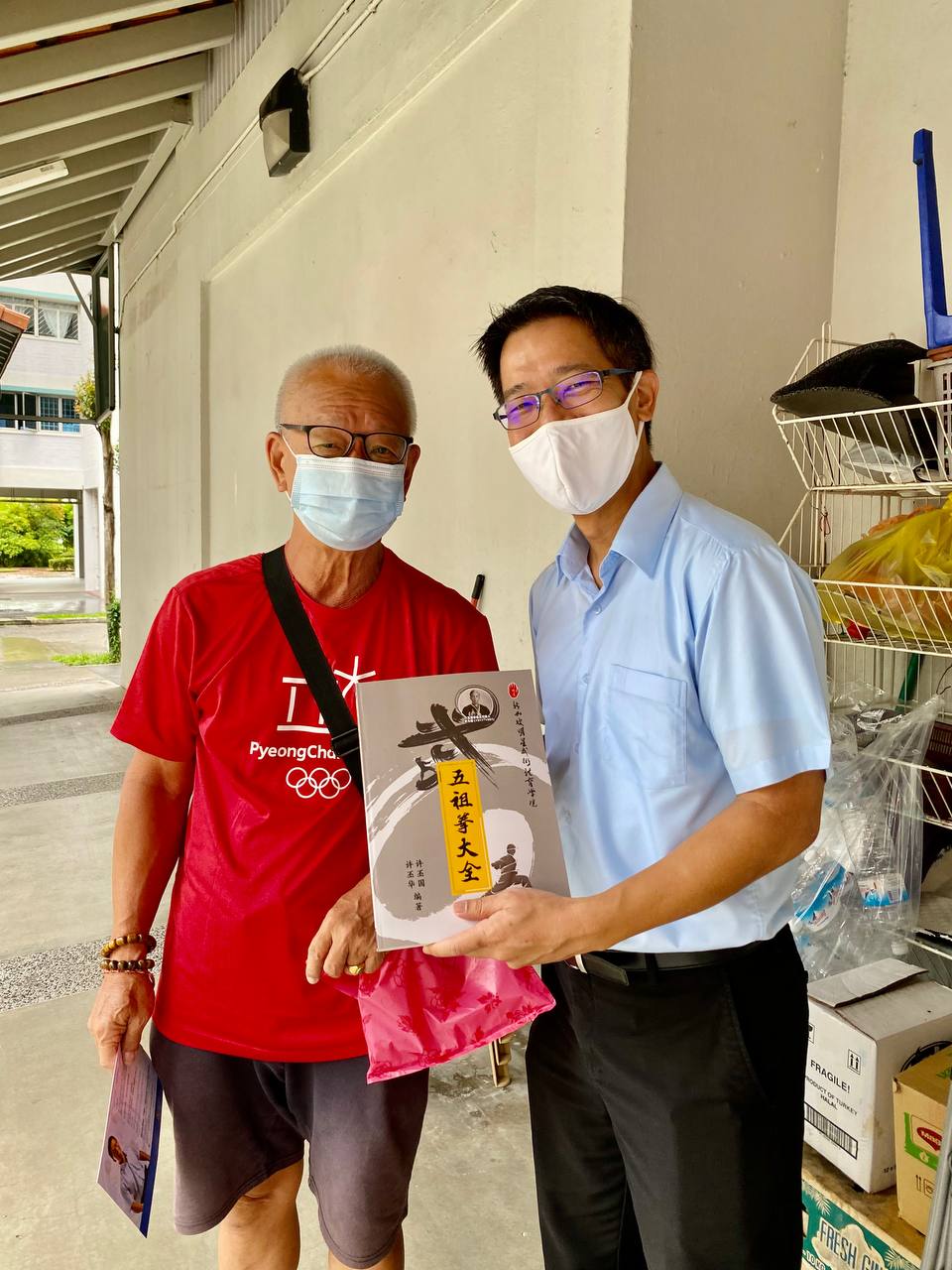
这个周末我在走访阿裕尼集选区的后港邻里时,碰到了许先生。他赠送了我一本他自己编著并亲笔签名的《五祖拳大全》。五祖拳是一门中华武术,许先生的父亲是第三代传人。我们很庆幸许先生能够延续传统,并编撰了这本记录这门拳法历史的书。

I had a delightful morning this weekend walking about Hougang estate in Aljunied GRC. I was pleasantly surprised and honoured to be presented with a personally autographed book, The Complete Guide to Five Ancestors Fist (五祖拳大全), written by my resident, Mr Koh. Five Ancestors Fist is a form of Chinese martial arts. Mr Koh’s father was among the third generation of practitioners. We are so fortunate that Mr Koh is carrying on the tradition and has written this book to record the history of this practice.

Use of Job Support Scheme payouts by companies

A building construction group in Singapore was recently asked by a shareholder why the remuneration for its key executives was higher than the previous year, even though net profit, excluding government grants, was lower. It responded that executive bonuses are calculated based on the group’s profitability. It said that additional operating costs due to the pandemic and government grants received to help defray such costs were included in the computation. It later issued a clarification that Covid-related expenses were “higher than the grant amount received”.

One of the key government grants that most companies and organisations received in the past year are the Jobs Support Scheme (JSS) payouts, which has cost the taxpayer (and the Reserves) more than $27.6 billion since Feb 2020.

This revelation raised questions about whether the JSS, which is supposed to support the wages of workers to reduce retrenchment during the economic downturn, has been used to benefit top executives instead.

I asked Minister Lawrence Wong how the Ministry of Finance (MOF) ascertains that JSS payouts are used for wage support and what are the MOF’s plans for claw backs if JSS payments are found to have been used for other purposes, including senior executive bonuses or stock buybacks.

There have been several companies and even non-profits who returned their JSS payouts because they felt they did not need it. This is commendable. I asked whether MOF will consider publishing the list of organisations which returned all or part of their JSS payouts so that they can be given due public recognition.

Here is the full Parliamentary question and answer on 2 Nov 2021:

ENSURING JOBS SUPPORT SCHEME PAYMENTS ARE USED DIRECTLY FOR WAGE SUPPORT AND NOT FOR EXECUTIVE DIRECTORS’ REMUNERATION OR BONUSES

26 Mr Zhulkarnain Abdul Rahim asked the Minister for Finance whether the Ministry tracks data on the number of companies which have obtained Government grants such as that under the Jobs Support Scheme but have paid their workers less based on the amount of CPF contributions disclosed while the executive directors received bigger bonuses or remuneration in the same year.

27 Mr Gerald Giam Yean Song asked the Minister for Finance (a) how does the Ministry ascertain that Jobs Support Scheme (JSS) payments are used for wage support; (b) what are the Ministry’s plans for clawback if JSS payments are found to have been used for other purposes, including senior executive bonuses or stock buybacks; and (c) whether the Ministry will consider publishing the list of organisations which returned all or part of their JSS payouts so that they can be given due public recognition.

Mr Lawrence Wong: The Government introduced the Jobs Support Scheme (JSS) in 2020 to provide rapid, broad-based wage support to help employers retain their local employees during the height of the COVID-19 crisis.

JSS payouts are computed based on actual mandatory employer CPF contributions made to bona fide employees. The CPF Act requires employers to make CPF contributions on wages payable to their employees, subject to the prevailing wage ceilings. Employers will not receive JSS payout if they fail to make CPF contributions for their employees for the respective reference month. Similarly, if employers cut wages for their employees during the respective reference month, their JSS payout will be correspondingly reduced. In other words, the JSS is designed as a reimbursement to help employers offset part of the wages already paid to their employees. Announcing the timing and schedule of JSS payouts allowed employers to take these payouts into account and retain local workers despite the challenging economic circumstances during the pandemic.

We also capped the Government’s co-funding under the JSS to first $4,600 of gross monthly wages paid to each local employee. This means that employees and senior executives whose gross monthly wages are higher than $4,600 will have a lower effective JSS support.

Given how JSS payouts are computed, the Ministry of Finance does not track the data that Mr Zhulkarnain asked about. To prevent abuse of JSS, IRAS, as the administrator of JSS, has instituted a robust anti-gaming framework since the first JSS payout in April 2020. For cases with high risk of fraud, such as irregular CPF contributions to get higher JSS payouts, IRAS requires the firms to authenticate their CPF contributions before the payouts are released. As of August 2021, 1,889 cases have been denied or had their JSS payout adjusted. Cases with strong corroborative evidence to support JSS abuse are reported to the Commercial Affairs Department (CAD) for further investigation and prosecution. As of August 2021, 10 cases are undergoing police investigations. 

Besides IRAS’ anti-gaming checks for JSS, the CPF Board also audits employers to check the accuracy of CPF contributions paid and wages declared. The CPF Board is also piloting the CPF Contribution Alert which allows employees to receive personalised notifications when their monthly CPF contributions are credited. Employees can conveniently verify the wages declared by their employers and CPF contributions paid by their employers against their payslip. Employees and whistleblowers can lodge reports to the CPF Board for any non-compliance of CPF contributions.

The JSS and other COVID-19 economic relief grants were meant to support businesses in this period of significant economic uncertainty. While the Government does not intervene in how business owners and board directors determine remuneration and bonuses for key executives, they are expected to practise good corporate governance and stewardship. In particular, a good practice is to exclude government grants in the computation of a company’s financial performance for the purposes of determining remuneration and bonuses for key executives. This is because government grants are not a result of the performance efforts of these key executives. We understand that the Singapore Institute of Directors will also be putting out some guidelines on best practices in remuneration governance soon.

For companies that are managing well, we encourage them to return the JSS to us, or donate the JSS received to a charity of their choice. It is commendable that companies which were able to cope well with the crisis, have declined to receive JSS or donated the JSS received. Some have asked to remain anonymous for internal organisational reasons. Meanwhile, there are also companies that have chosen to use the JSS in other responsible ways, such as providing additional training to upskill their employees or expanding their operations, hiring more Singaporeans as a result.

We will need to study carefully the implications of publishing the list of organisations that have returned part or all of their JSS, balancing public recognition, requests for anonymity, and the risks of placing undue pressure on other firms that have been using the JSS monies responsibly in other ways. 

Source: https://sprs.parl.gov.sg/search/sprs3topic?reportid=written-answer-na-9444