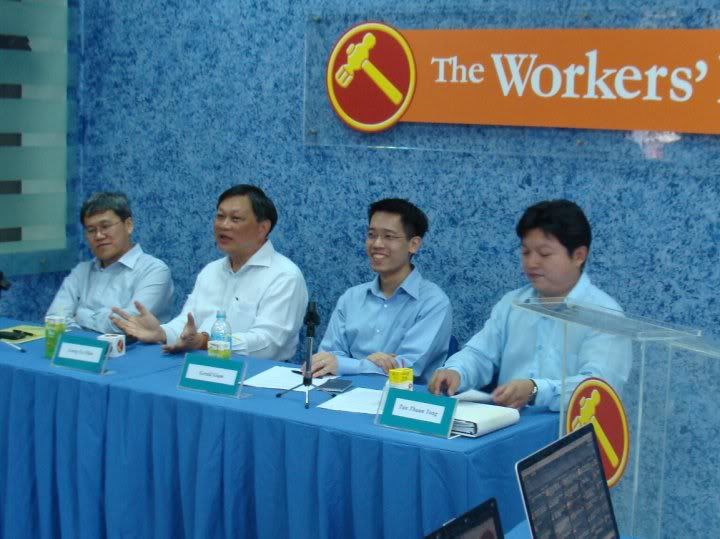
Low productivity not our workers’ fault: WP’s Low

Workers’ Party chief Low Thia Khiang has slammed the PAP government for seemingly suggesting that Singaporean workers have only themselves to blame for their low incomes, because of their low productivity and skills. He said it was easy to blame our local workforce for low productivity when it was the Government which opened the floodgates to foreign workers.

Workers’ Party chief Low Thia Khiang has slammed the PAP government for seemingly suggesting that Singaporean workers have only themselves to blame for their low incomes, because of their low productivity and skills. He said it was easy to blame our local workforce for low productivity when it was the Government which opened the floodgates to foreign workers.

Low was speaking Parliament on Tuesday in response to the Finance Minister’s Budget 2010 speech last week.

The Opposition leader pointed out that manual workers like cleaners and garbage collectors in developed economies are paid so much more than their counterparts in Singapore, attributing this to those countries’ more compassionate and effective policies to ensure that workers at the bottom of the economic ladder enjoy a decent and dignified life. Referring to the Government’s latest productivity drive, which is to grow productivity by 2 to 3 per cent each year over the next decade, Low wondered if low wage workers had to wait another 10 years for the wage increases which they had not seen in the last 10 years.

Continue reading “Low productivity not our workers’ fault: WP’s Low”

The Economist calls Singapore a ‘stingy nanny’

The respected British weekly, The Economist, has published a cutting criticism of Singapore’s social safety net in its latest edition dated 13 February 2010, titled “Welfare in Singapore: The stingy nanny”. Here are some excerpts.

The respected British weekly, The Economist, has published a cutting criticism of Singapore’s social safety net (or lack thereof) in its latest edition dated 13 February 2010, titled “Welfare in Singapore: The stingy nanny”. Here are some excerpts:

Citizens are obliged to save for the future, rely on their families and not expect any handouts from the government unless they hit rock bottom.
In government circles “welfare” remains a dirty word, cousin to sloth and waste.
The most destitute citizens’ families may apply for public assistance; only 3,000 currently qualify.
Applicants complain that the process of seeking help is made tiresome and humiliating. Indeed that could be the point, supposing it deters free-riders.
But the thinness of the safety net also reflects a widespread article of faith, recited and reinforced over the years. Even among the social workers who work in hard-hit communities there is surprisingly little frustration at the meagreness of the handouts on offer or at the lengthy application process.
In 2008 the World Bank rated it the third richest country in the world, in terms of GDP per head at purchasing-power parity. And the idea that its Big-Brotherly government might be outfoxed by conniving welfare queens seems odd.
Lee Kuan Yew, Singapore’s founding father and still its “minister mentor” has maintained that ambitious migrants help to keep citizens on their toes. In an interview given to National Geographic last July he said that if native Singaporeans lag behind “hungry” foreigners because “the spurs are not stuck on [their] hinds”, that is not the state’s problem to solve.
The Economic Society of Singapore (ESS)—not exactly a radical cell—recently proposed to a government committee that it should build a more robust safety net, starting with unemployment insurance. This would promote social stability and help muster public support for Singapore’s open-door migration policies, it argues. Properly designed, such measures would not create disincentives to work and thrift. “While self-reliance is a good principle in general, it may be neither efficient nor just if taken to extremes,” noted the ESS.

Citizens are obliged to save for the future, rely on their families and not expect any handouts from the government unless they hit rock bottom.

In government circles “welfare” remains a dirty word, cousin to sloth and waste.

The most destitute citizens’ families may apply for public assistance; only 3,000 currently qualify.

Applicants complain that the process of seeking help is made tiresome and humiliating. Indeed that could be the point, supposing it deters free-riders.

But the thinness of the safety net also reflects a widespread article of faith, recited and reinforced over the years. Even among the social workers who work in hard-hit communities there is surprisingly little frustration at the meagreness of the handouts on offer or at the lengthy application process.

In 2008 the World Bank rated it the third richest country in the world, in terms of GDP per head at purchasing-power parity. And the idea that its Big-Brotherly government might be outfoxed by conniving welfare queens seems odd.

Lee Kuan Yew, Singapore’s founding father and still its “minister mentor” has maintained that ambitious migrants help to keep citizens on their toes. In an interview given to National Geographic last July he said that if native Singaporeans lag behind “hungry” foreigners because “the spurs are not stuck on [their] hinds”, that is not the state’s problem to solve.

The Economic Society of Singapore (ESS)—not exactly a radical cell—recently proposed to a government committee that it should build a more robust safety net, starting with unemployment insurance. This would promote social stability and help muster public support for Singapore’s open-door migration policies, it argues. Properly designed, such measures would not create disincentives to work and thrift. “While self-reliance is a good principle in general, it may be neither efficient nor just if taken to extremes,” noted the ESS.

————

Continue reading “The Economist calls Singapore a ‘stingy nanny’”

Foreigners pay more, but what’s in it for Singaporeans?

In its latest political move in preparation for the election, the PAP government has decided to reduce health subsidies given to Singapore permanent residents (PRs) by 10% this year and another 10% in 2011.

This comes hot on the heels of the recent increase in fees for PRs and foreigners studying in local schools. Back in 2008, the Ministry of Health had already reduced the PR subsidy in hospitals by 10% and completely eliminated the subsidies for non-PR foreigners. The government claims that these moves are to “make a sharper distinction between the privileges a citizen is entitled to, as compared to a PR”.

I fail to see how all this benefits Singaporeans. Are Singapore citizens now going to pay less when they are admitted to hospital or attend local schools? No. Is the PAP expecting Singaporeans to rub their hands with sinister glee, as they rejoice that their PR counterparts are paying more? I don’t think Singaporeans are that vindictive.

Therefore my conclusion is that this is simply a pathetic attempt to lull Singaporeans into thinking there is actually a significant distinction between the position of foreigners and Singaporeans in this country. Secondly, it seems this is another revenue-raising exercise for the government, since there has been no mention that the money saved in subsidies is going to feed into any programme that benefits Singaporeans.

If the government was really sincere about treating Singaporeans better, they would reduce the fees that Singaporeans are paying for government services, instead of punishing foreigners for political gain.

YouthQuake 6 – The Influence of Online Media on Singaporean Youths

The Workers’ Party Youth Wing will be holding its sixth session of its YouthQuake series this Saturday at the Workers’ Party HQ.

The Workers’ Party Youth Wing will be holding its sixth session of its YouthQuake series this Saturday.

Speakers:

Making Sense of Virtual Reality – Agenda, Audience, Action
By Elvin Ong, 24, SMU Business Undergraduate
Elvin will explore the question to what extent can online media in the virtual world motivate people to take action, in particular, political action, in the physical world?

Fighting in the Trenches: The New Media Jungle
By Terence Lee, 23, NTU Communications Undergraduate & News Editor of The Online Citizen
Having served as a writer, reporter, and editor of The Online Citizen, Terence will share unique and penetrating insights of his dip into the public sphere, some which he picked up the hard way.

Implications of Singapore Law on Online Media
By Sangeetha Yogendran, 23, NUS Law Undergraduate
Sangeetha will be examining the rights one has regarding online media, focusing on censorship and defamation laws. She will also examine the potential implications of the cooling-off day and talk about whether the current laws should be changed in this new online era.

Too Much of Anything is Poison
By Ruth Komathi, 19, TP Psychology Student
Ruth will be exploring the increasing usage of online media and its detrimental effects when used in excess.

Event details:

Date: Saturday, 16 January 2010

Time: 14:30 – 17:00

Venue: Workers’ Party Headquarters, 216-G Syed Alwi Road #02-03 Singapore 207799

To register, please contact Bernard Chen at bernardchen@wp.sg.

Military is no place for foreigners

I am of the view that non-Singaporeans should be prohibited from being members of our security services, especially the military.

Today’s newspapers were flush with stories of foreigners who are serving in the Singapore Armed Forces (SAF). The Straits Times highlighted some Russians, Chinese and Indian nationals, as well as Malaysians, who are serving in various leadership capacities in the SAF.

This uniquely Singaporean quirk has come about because our law requires children of first generation permanent residents (i.e., second generation PRs) to serve their National Service (NS) or forfeit their PR status. With the influx of foreigners into Singapore over the past 10 years and the liberal way in which PR status is dispensed to so many foreigners, it is inevitable that we are seeing many more foreigners donning camouflage green uniforms these days.

I feel that non-Singaporeans should be prohibited from being members of our security services, especially the Singapore Armed Forces (SAF). I know I am treading on sensitive ground by saying this, especially in the context of the debate between the privileges and obligations of citizens and foreigners in Singapore.

Continue reading “Military is no place for foreigners”

PUB knew canal was not big enough but didn’t act?

I don’t expect to have no floods in Singapore, and I think Singaporeans are willing to forgive the occasional lapse in planning that leads to floods of this nature. But I would have expected at least an ounce of contrition on the part of the Minister for his ministry’s failure to act on a known problem in time. Instead, Singaporeans just got excuses and extreme examples. “Sorry” seems to be the hardest word for our leaders to say.

Environment Minister Yaacob Ibrahim attributed last Thursday’s floods in Bukit Timah to a “freak” event that occurs “once in 50 years”.

He said: “What happened was very unusual. The intensity was tremendous.”

Flood waters partially submerged ground-floor buildings and cars. The Straits Times carried a picture of a car in car park with the water mark reaching almost the side view mirrors. The flooding occurred along two stretches of Bukit Timah Road — from Coronation Road to Third Avenue and from Wilby Road to Blackmore Road. The damage from all this has yet to be tallied.

A businessman TODAY interviewed remarked: “This is like those news footage you see of floods in Manila or Jakarta. This is a prime housing area. I don’t understand how the flooding could have happened.”

According to a PUB spokesman, the heavy rainfall caused the 1st Diversion Canal from the main Bukit Timah canal to burst its banks. The canal was built 37 years ago, in 1972.

I was therefore surprised was to hear the Minister say: “We knew the diversion canal was not big enough to take this.”

Continue reading “PUB knew canal was not big enough but didn’t act?”

Chinese leaders afraid of losing control: LKY

I would encourage my fellow citizens who have a heart for people and a passion to bring change for the better to Singapore, to count the costs, and then step out and be counted. If more of us step out and live out our passions in life, it is really the ruling party which has to fear losing the control they have over Singaporeans.

Minister Mentor Lee Kuan Yew gave an interview with Charlie Rose, which was broadcast on Bloomberg Television on October 22nd. The interview covered mainly the rise of China and India, and their relationship with the US.

While the discussion hardly touched on domestic Singapore politics, Mr Lee did reveal some of his thinking which has undoubtedly shaped the actions of the Singapore government.

Charlie Rose had asked how communications, technology and the flow of information will impact China. Mr Lee said that the Chinese leaders were “watching the Internet very carefully” and paying attention to what people think.

Continue reading “Chinese leaders afraid of losing control: LKY”

WP rebuts Minister on lift upgrading

This shows the respect the government has for the people’s choice of Member of Parliament, who is vested with the Constitutional mandate to represent the constituency.

The Workers’ Party’s rebuttal published in the Straits Times today.

————–

I refer to the reply from the Minister for National Development’s Press Secretary on Tuesday entitled: “Ministry: MP Low wrong on lift upgrading”. I am responding to it as Mr Low Thia Khiang is currently out of town.

MND states that HDB’s letter published last Friday “should be read in conjunction with” the Minister’s earlier explanations to the media. This impliedly acknowledges that the reason given by HDB to Mr Muhd Yusuf Osman, who had pointedly asked why protocol seemed to be ignored when HDB worked with the unelected candidates in opposition wards to announce LUP plans rather than with the elected MPs, does not stand up to scrutiny.
It is not disputed that the LUP is a government programme. After all, it is to rectify a design flaw in public housing which does not cater for an ageing society. Given this imperative, the public interest should trump politics.

Mr Low’s letter was not about wanting credit for the programme. He has stated that he is prepared to work with the government’s appointees for the benefit of his constituents, and indeed has met the grassroots advisor several times over many months to give input on the LUP plans for Hougang.

It was HDB’s unjustifiable answer to Mr Yusuf – that the grassroots advisor was more appropriate than the MP to announce the LUP plans because he was able to gather residents’ input and marshal support for the plans – which compelled Mr Low’s response. HDB should have just given the real reason in its letter and not beat around the bush.

MND’s letter goes further to state that the LUP is funded from budget surpluses which Opposition MPs are not responsible for generating. However, the budget surpluses are hardly the effort of the government alone, as they include significant contributions from the public through taxes, levies and stamp fees, which the government simply reaps.

Finally, MND also appears to interpret the General Elections as an event where the only outcome which matters is who forms the government. This shows the respect the government has for the people’s choice of Member of Parliament, who is vested with the Constitutional mandate to represent the constituency.

SYLVIA LIM (Ms)
CHAIRMAN,
WORKERS’ PARTY

Mah to Low: Stay within your sandbox

The Minister for National Development has basically told Low Thia Khiang to stay within the confines of his town council and stop trying to manage the Lift Upgrading Programme.

In what is probably one of his most insulting and condescending statements to date, the Minister for National Development, though his taxpayer-funded press secretary, has basically told Opposition leader and Hougang MP Low Thia Khiang to stay within the confines of his town council and stop trying to manage the Lift Upgrading Programme (LUP), period.

Here are excerpts of what the press secretary to the Minister wrote in his Straits Times Forum letter today:

Continue reading “Mah to Low: Stay within your sandbox”

How PAP uses taxpayer-funded grassroots for political gain

Not many Singaporeans are aware of how much the taxpayer-funded grassroots have been used by the PAP for political gain.

Last week, Mr Eric Low and Mr Sitoh Yih Pin, the PAP MP-aspirants who lost to Workers’ Party’s Low Thia Khiang and SDA’s Chiam See Tong respectively in the last election, grabbed the limelight for themselves by announcing HDB’s decision to upgrade lifts in Potong Pasir and Hougang.

I had written an article questioning why HDB had informed the losing candidates in opposition wards of the upgrading plans.

A Straits Times forum letter writer, Mr Muhammad Yusuf Osman, said it best when he called for the mandate that the residents gave to the elected MPs to be respected. He asked: “Under what authority did both Mr (Eric) Low and Mr Sitoh (Yih Pin) act as advisers to the grassroots organisations, given that the People’s Association is a government statutory board and should work with the elected MPs of the constituencies?”

In response, HDB and People’s Association replied that “it is the Government’s practice to implement its national programmes for residents through advisers to grassroots organisations who are appointed by the Government to gather feedback from residents.”

They forgot to mention that these “advisers” are always PAP men, whether or not they won the election.

Not many Singaporeans are aware of how much the taxpayer-funded grassroots have been used by the PAP for political gain.

Here’s a quick run down:

Continue reading “How PAP uses taxpayer-funded grassroots for political gain”