My speech in Parliament during the debate on the 2021 Budget Statement on 25 Feb 2021.
In line with the theme of the Budget Statement, I would like to examine four areas in which we can work together towards emerging in a stronger condition than we were in before the start of the Covid-19 pandemic.
Redirecting our competitive spirits
First, I wish to address how we view and approach competition. Competition is a ubiquitous aspect of life in Singapore. In school, our children compete for grades, awards and places in top schools. Even in co-curricular activities, they compete for a spot in the school team to improve their chances of entering secondary school via the Direct School Admission scheme. We even grew a billion-dollar industry in the form of tuition centres, which have fuelled the competitive dynamic that is part of our education system.
Keen competition continues after finishing school. Employees compete with each other for raises and promotions, while enterprises engage in the survival of the fittest.
Competition in itself is not bad. It can draw out the best in each person and each firm. However, when competition starts taking on a negative edge, we need to re-examine our priorities. As we are told time and again, Singapore is a small and vulnerable country which needs to stay relevant and competitive. Therefore, we must ensure that our competitive spirits are directed towards the right targets, and adopt a more cooperative mindset with our fellow Singaporeans.
For example, Singaporeans at the workplace could orient themselves more towards looking out for each other and helping each other succeed. This is how professionals and workers from other countries instinctively operate, even when they are working here. We should not see our fellow workers as competition for promotions, but as partners we can cooperate with to improve the products and services of our companies, thereby improving the company’s earnings and contributing to our bonuses.
Government-linked companies (GLCs) could look at more ways to collaborate with SMEs in ventures overseas and form local consortiums with them, thus increasing Singapore’s competitive edge.
Middle income squeeze
Mr Speaker, the pandemic support measures have helped many low income families. However, we must not forget the plight of the middle income, who make up a growing proportion of our population. Middle income families often find themselves squeezed from both ends—their incomes render them ineligible for many government benefits, yet they still have to cope with high costs like their home mortgage, children’s education and aged parents’ medical fees. The increase in petrol duties adds to this squeeze, and so will the future hike in GST. All this leaves them with little buffer against the vicissitudes of life. An unexpected shock like a family medical emergency can throw them into financial distress.
We need to provide more help to this group. To be clear, I am not calling for universal handouts. Assistance should still be targeted, but I hope to see more flexibility when it comes to assessing the eligibility of applicants for schemes like the Covid-19 Recovery Grant. Individuals who narrowly miss the eligibility requirements or have circumstances that deserve special consideration should not be denied assistance. Such flexibility should be exercised at the first instance based on their merits. Government agencies should not wait for these individuals to pluck up the courage to send in appeals before they can get the help they need.
Essential jobs
The Covid-19 pandemic has forced us all to re-examine what constitutes an essential job. Some supposedly higher skilled jobs have turned out to be less critical than their lower skilled counterparts. This was amply demonstrated during the just-concluded Australian Open tennis tournament, which was held in Melbourne under the shadow of the pandemic. To minimise the spread of the virus, all human line judges were replaced with Hawk-Eye, an electronic line judging system. Umpires are still featured, but their role seems to be relegated to calling the score, not adjudicating line disputes. It remains to be seen when they too will be made redundant.
On the bright side, ball kids face far better prospects, since it is harder to build a robot which can run, retrieve and throw balls on cue. Naturally, to gear up my kids to be future-ready, I signed them up to be ball kids at the ATP 250 Singapore Tennis Open, which is taking place this week at the Sports Hub. This tournament also uses electronic line judges.
Automation is by no means limited to the tennis court. Many other highly skilled jobs are either being taken over by machines or offshored to lower cost locations. According to the OECD, 14% of jobs in rich countries are highly automatable, while a further 32% are likely to change because many of their routine tasks can be automated. Robo-advisors are giving active fund managers a run for their money; X-rays can be read by radiologists in India; and mobile app development can be outsourced to developers in Vietnam or Romania.
The pandemic has also shown us that many so-called “3D jobs”—dirty, dangerous or difficult—have turned out to be more essential than some white collar jobs. We need to accord sufficient recognition to workers manning these positions. I am glad that nurses and healthcare workers are getting a much-deserved raise. But let us not forget our repairman, refuse collectors and delivery drivers. These everyday heroes kept our country running when we were all locked down at home.
With the restrictions in supply of foreign workers and the reluctance of many locals to take up 3D jobs, the demand for workers in these occupations often exceeds their supply. Based on the law of supply and demand, these workers’ wages should naturally rise to reach a higher equilibrium price. In practice, however, many of their wages still remain painfully low. This is in part because of the structure of our industries and in part because our society does not esteem them highly enough. This is a market failure. The State needs to intervene to ensure that these workers’ earnings increase to match the value they bring to society.
A living wage for all workers
In 2012, the Government introduced the Progressive Wage Model (PWM) to raise the pay of low-wage workers. Today, almost a decade later, the PWM still covers only 15% of workers in the lowest quintile of income earners, and only from three industry sectors—security, cleaning and landscaping. According to MOM, there are a residual 100,000 workers in other sectors who still earn less than $1,300 a month. The NTUC has announced plans to roll out the PWM to six more sectors. It is yet unclear when all three 100,000 workers will be covered.
The Deputy Prime Minister said in his budget statement that the Government’s aspiration is for every sector of the economy to have some form of progressive wages, echoing the NTUC’s call for a universal PWM. Senior Minister Tharman Shanmugaratnam has termed the PWM a “minimum wage plus”.
It is not my objective today to debate the merits or demerits of the PWM vis-à-vis the national minimum wage. I think the parties have stated their position on this issue. The WP has called for a national minimum wage, first set at $1,300 in take-home pay per month, and the Government and NTUC have explained why they have chosen the path of the PWM, while pointing out that they are not ideologically opposed to a minimum wage.
I accept that the Government is heavily invested in the PWM, and so my goal today is to discuss how the PWM framework can be improved so that we achieve our common goal.
Whether Singapore adopts the PWM, a universal PWM, a national minimum wage or minimum wage plus, I believe the common goal of everyone in this House is the same: To raise the wages of all our low wage workers and ensure they earn a living wage that can support their families, in what is one of the most expensive cities in the world.
A household budgets study by researchers from NTU and NUS in 2019 found that to meet basic standards of living in Singapore, a single elderly household needs $1,379 per month while an elderly couple needs $2,351 per month. According to MTI, the average household expenditure for basic needs (or AHEBN) for a four-person household was estimated to be about $1,300 a month in 2017. AHEBN is an estimate of the average that households spend on essential needs such as food, clothing and shelter every month. This is how the WP derived our figure for a national minimum wage, which will rise with the AHEBN.
However, the PWM’s goals are not limited to setting a basic minimum wage—something which the Government has emphasised is the very reason why it favours the PWM over a national minimum wage. The PWM also seeks to chart out skills ladders and career progression for workers.
NTUC deputy secretary-general Koh Poh Koon shared plans to roll out PWM to six more sectors in the next two to three years. These sectors include strata management and solar technology, both of which do not typically employ low-wage workers. I find this rather puzzling. Why are we venturing into PWM for these industries when there are still so many more low wage workers who lack a basic wage floor to protect them?
The basic principle of the PWM is that higher wages must be the result of improvements in productivity, not government fiat. Higher productivity can be achieved by upgrading workers’ skills through training. With a better-skilled and more productive workforce, firms will be able to pay their workers better, while still remaining profitable. This sounds great in theory, but is less straightforward in practice.
First, the training element of the PWM may be well-intentioned, but training can improve productivity only to a limit. In many low wage occupations, there is a skills ceiling due to the manual nature of the work. How many more HDB blocks can a conservancy worker sweep if we send him for more training? After completing basic training, further training will reap diminishing returns. Worse, it could cost the firms money and lost work hours, with marginal or no improvements to productivity. Even if the Government subsidises much of the training and absentee payroll, it does not mean training is free, because it is still borne by taxpayers.
Second, providing pathways for career progression for our low wage workers is also a worthy goal to strive for. However, it has limited utility for many low wage workers. How many elderly cleaners are striving to be promoted to be supervisors, where they will have to manage a team and churn out monthly reports for management? For most of them, their priority is first and foremost to earn enough to provide for their families.
And third, the PWM is designed to be rolled out to specific industries through licensing conditions set by the respective lead sector agencies—NEA for the cleaning sector, PLRD for security agencies and NParks for the landscaping industry. These lead sector agencies require that firms implement the PWM before they are issued an operating license. If an industry does not currently have any licensing conditions, the relevant lead sector agency will need to introduce a licensing requirement before implementing the PWM. This will be the case for the proposed rollout of PWM to the retail sector, which currently has no licensing requirements. This two-step process will be cumbersome for both the government agencies and the firms involved. It would surely introduce more red tape and dent productivity, leading to more overheads to firms, which may cost them far more than just a wage hike to meet a basic minimum wage. I’m glad that the NTUC is looking at a vocational PWM, and I look forward to more details of how this will be implemented.
Someone on Reddit once remarked that the PWM is like a Rube Goldberg machine which tries to solve too many things at once, without solving anything well. This may be a rather harsh critique of the PWM and I know there are many officials who are working very hard to make the PWM work. However, I believe there needs to be a fundamental re-ordering of the PWM framework so that it can be rolled out faster, for the benefit of more of our low wage workers.
The current pace of rollout of the PWM is much too slow. At this rate, it will be another decade or more before all low wage workers are on the PWM. What’s more, we have to-date only picked the low-hanging fruit. It will be far harder to roll out the PWM, particularly in its current form, to the remaining industries and occupations.
I believe it will be less bureaucratically complex and more efficient to first set a basic wage floor for specific industry sectors, and expand the list of sectors quickly so that we can eventually cover all local workers. The other aspects of PWM like training requirements and career progression ladders can still be brought in, but later.
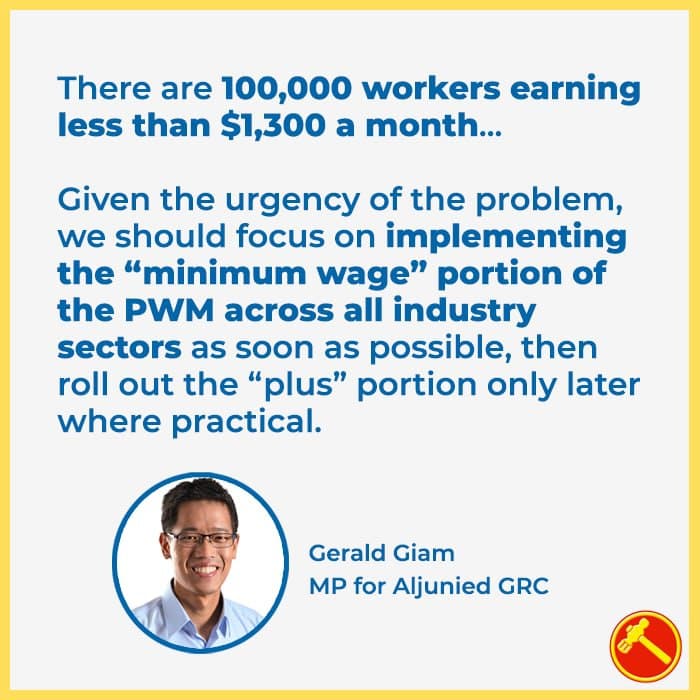
Given the urgency of the problem that remains to be addressed—100,000 employed and self-employed workers earning less than $1,300 a month—we need to pick our battles more carefully and focus on what will move the needle the most and the quickest for our low wage workers. Since the PWM is a “minimum wage plus”, we should focus on implementing the “minimum wage” portion of the PWM across all industry sectors as soon as possible, then roll out the “plus” portion only later where practical.
I acknowledge that the pandemic period is not a good time to impose wage increases across a large swath of industries. To ease the transition for all employers, the Workfare Income Supplement can be used to temporarily top up wages to the minimum wage, and this can be eased off as the economy recovers, with employers taking over. Dr Koh Poh Koon said yesterday that the Wage Credit Scheme (WCS) could be used for this same purpose.
Mr Speaker, rolling out a basic wage floor more widely and quickly will not only improve the welfare of thousands of our lowest paid compatriots and their families, it can also have positive effects on our economic recovery. The lower income have a higher marginal propensity to spend because they need to meet their basic needs, so putting more cash in their hands will have a multiplier effect on our GDP growth. Higher wages for these occupations will encourage more people to enter the workforce and ease the labour crunch in many essential industries. Those already in the workforce will be more motivated at work, resulting in improved personal productivity, and lower turnover and retraining costs for companies. It will be a win-win-win for workers, employers and our economy.
Changing paradigms
Mr Speaker, our people have demonstrated great resilience during this pandemic. However, in order to emerge stronger together from this economic downturn, we need to jettison some legacies that have lost their relevance in today’s world, and be willing to adopt new paradigms to bring our country forward.
Sir, I support the Motion.